No Help In Worrying

shadowhands_1 copy

I know that worrying is a waste of time.Regardless I find myself doing too much of it. I am grateful for a reminder to loosen my grip on worry. It is nothing more than a bad habit.

If a problem is fixable,
if a situation is such that
you can do something about it,
then there is no need to worry.
If it’s not fixable, then there is
no help in worrying.
There is no benefit
in worrying whatsoever.
Dalai Lama XIV

13 Things Mentally Strong People Don’t Do

mountain roadMentally strong people have healthy habits. They manage their emotions, thoughts, and behaviors in ways that set them up for success in life. Check out these things that mentally strong people don’t do so that you too can become more mentally strong.

Text of article removed by request by original author. Go to link below to view.

Taken from an article by Amy Morin http://www.lifehack.org/articles/communication/13-things-mentally-strong-people-dont.html

I am grateful for the reminder to practice what I already know. It is not the knowing that matters. It’s the doing!

I have a simple philosophy:
Fill what’s empty.
Empty what’s full.
Scratch where it itches.
Alice Roosevelt Longworth

Dandelion Growing Out of a Crack

emmanuel3210

Suddenly I realized that I wanted everything to be as it was when I was younger. When you’re young enough, you don’t know that you live in a cheap lousy apartment. A cracked chair is nothing other than a chair. A dandelion growing out of a crack in the sidewalk outside your front door is a garden. You could believe that a song your parent was singing in the evening was the most tragic opera in the world. It never occurs to you when you are very young to need something other than what your parents have to offer you. Lullabies for Little Criminals Heather O’Neill

When I tell people I was ten years-old before I lived in a house with an indoor toilet most don’t believe me, at least not at first. I cared little about that fact before adolescence when I began not sharing it. That was a long time ago and I have come to know that experience was one of many which taught me great gratitude for things as simple as a bathroom. Doing without makes one appreciate what they have a lot more.

Happiness cannot be traveled to,
owned, earned, worn or consumed.
Happiness is the spiritual experience
of living every minute with
love, grace, and gratitude.
Denis Waitley

We All Have Twenty-Four Hour Days

habit0001

You can do anything,
but you can’t do everything.
David Allen

What has my attention at this moment? My thoughts are directed at words surfacing in my mind and typing them with a considerably lesser amount of awareness of music playing on Pandora. I’m vaguely aware of the surroundings of my home office, the art and posters on the wall and the noise of an occasional neighborhood car that drives by. That’s all my mind can take on at the moment.

People have a fixed amount that must be allocated according to need. To use a popular analogy, attention is like a bucket of water. People draw upon it as needed, but every dipper full and every teaspoon full leaves less for other purposes. Marc Green

Two interesting components have arisen with the increase of discretionary time I now have: 1) my perception of the world outside me has increased. I notice more, see things more deeply and generally feel good because of it. 2) With a richness of time, it is easy to let hours and days slip by with little to show for them. Some of that is good. Some of it is not so positive.

Zig Ziglar said, “Lack of direction, not lack of time, is the problem. We all have twenty-four hour days.” My conclusion is that expecting myself to settle into new routines within my first 60 days of semi-retirement was too much to ask. Already I feel better letting myself off the hook of that unrealistic expectation.

…the allocation of attention is largely automatic and occurs without awareness. As a result, it is not easily brought under conscious control. You may direct someone’s attention by saying “watch the step,” and temporarily cause a conscious allocation of attention to the step. However, there is a good chance that within a few minutes or even seconds, the memory trace will disappear and the next time the person will fail to notice the step. The same automatic factors that directed attention away from the step in the first instance have not changed. Marc Green

The paragraph from Marc Green helps me a good deal because it tells me that keeping a keen awareness of my desire to form new routines is a great start to having them. All I have to do is follow through on what I have concluded and stay aware with a sense of priority. Then new routines will simply fall into place. Whew. I am grateful to “get off my own case”.

I didn’t pay attention to time or distance,
instead focusing on how it felt just to be in motion,
knowing it wasn’t about the finish line
but how I got there that mattered.
Sarah Dessen

 Originally Posted on September 17, 2013

To Laugh Often and Much


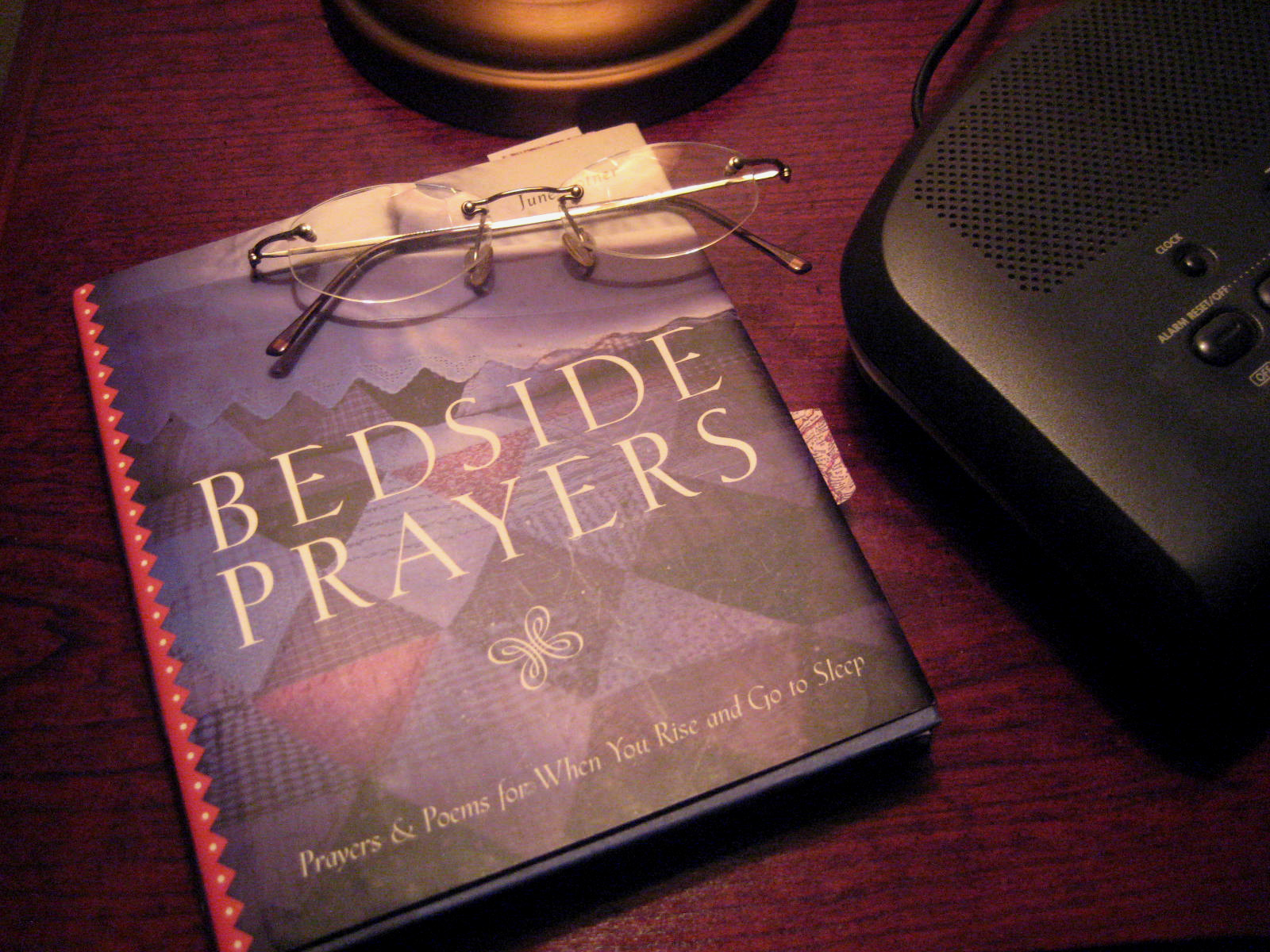
I found a used copy of the book pictured above a few weeks ago:  “Bedside Prayers, Prayers and Poems for When You Rise and Go to Sleep” collected by June Cotner.  It has found a convenient home on my night stand.  With decent regularity it finds its way into my hands just before lights out at night to put some meaningful thoughts to put into my head before sleep.

“Bedside Prayers” has these words of description on its dust cover:  a marvelous collection of prayers, meditations, sentiments, and quiet celebrations.  Drawing from a rich spectrum of traditions and writers – from Rainer Maria Rilke to Robert Louis Stevenson, and from Buddha to contemporary writers with fresh insights… for spiritual seekers of any tradition… a charming companion that encourages us to recognize the divine gifts all around us each day.  I find something meaningful every time I pick the book up and read a random page.

Among my favorites found in “Bedside Prayers” is thirteen lines by George Eliot that encourage me to be grateful for each day and to live with courage and intent to leave the world a little better than I find it.

May every soul that touches mine—
Be it the slightest contact—
Get from there some good;
Some little grace; one kindly thought;
One aspiration yet unfelt;
One bit of courage
For the darkening sky;
One gleam of faith
To brave the thickening ills of life;
One glimpse of brighter skies
Beyond the gathering mists—
To make this life worthwhile,
And heaven a surer heritage.

In a poem written almost a hundred years ago Ranier Maria Rilke described the power of being in the moment long before it was a popular notion.  Being aware of one’s “aliveness” is the message he left to be printed in “Bedside Prayers”.

You see, I want a lot.
Maybe I want it all:
The darkness of each endless fall,
The shimmering light of each ascent.
So many are alive who don’t seem to care.
Casual, easy, they move in the world
As though untouched.
But you take pleasure in the faces
Of those who know they thirst.
You cherish those
Who grip you for survival.
You are not dead yet, it’s not too late
To open your depths by plunging into them
And drink in the life
That reveals itself quietly there.

First time through the following eight lines by Joseph Byron seemed to be only be a play on words.  Then as I read them a second and third time it became apparent that simply changing the order of words added great meaning. I get the most from Byron when I read his forty-five word poem slowly and savor each line before moving to the next.

Feeling strong and strongly feeling.
Being glad and glad of being.
Care for need and needing caring.
Sharing self and selfless sharing.
Full of spirit, spirit filling.
Will is warm and warmly willing.
Give joy, enjoy the giving
Life is love and love is living.

Those eight lines really touch me!

There is nothing new or original in what I offer gratitude for today.  What is stated, I have written about before.  Here again is my thankfulness expressed for the work of others that touch my heart and spirit and make me think.  The canvas of an artist can have that effect on me and so can the notes of a musician.  A script well acted can move me deeply as can the words of a writer, but few things touch me as quickly or as profoundly as a well written poem.

Maybe I am old-fashioned. Maybe my soul has remnants within of the Victorian Era.  Or maybe I feel deeply which allows my sensitive self to receive in great dimension the feelings, thoughts and sentiments in poetry.  Whatever the reason may be, my gratitude is deep for the writers who put pieces of themself into measured word for me to discover, for my ability to feel what the poets left behind and for books like June Cotner’s “Bedside Prayers” that bring poetry into my life.

To laugh often and much;
To win the respect of intelligent people
And the affection of children;
Earn the appreciation of honest critics
And endure the betrayal of false friends;
To appreciate beauty,
To find the best in others;
To leave the world a bit better,
Whether by a healthy child,
A garden patch,
Or a redeemed social condition;
To know even one life has breathed easier
Because you have lived.
This is to have succeeded.
This old favorite by Ralph Waldo Emerson is included in “Bedside Prayers”

Originally Posted on November 30, 2011

Riddle: “Who Am I?”

Chain%20of%20supply

The following ‘riddle’ was written by an anonymous writer. The answer did not automatically come for me when I read it, but the solution made perfect sense once I got to the bottom. I encourage you to give it a try (the answer is at the very bottom of this blog entry).

I am your constant companion.

I am your greatest helper or heaviest burden.

I will push you onward or drag you down to failure.

I am completely at your command.

Half of the things you do you might as well turn over
to me and I will do them – quickly and correctly.

I am easily managed – you must be firm with me.

Show me exactly how you want something done
and after a few lessons, I will do it automatically.

I am the servant of great people, and alas,
of all failures as well.

Those who are great, I have made great.

Those who are failures, I have made failures.

I am not a machine though I work with the precision
of a machine plus the intelligence of a person.

You may run me for profit or run me for ruin,
it makes no difference to me.

Take me, train me, be firm with me,
and I will place the world at your feet.

Be easy with me and I will destroy you.

Who am I?

The best of these I have kept. A good bit of the worst I have shed or else diminished their impact. I am grateful to be the person I have deliberately grown into and the one I was led to be. (riddle answer below the Gandhi quote below)

Your beliefs become your thoughts,
Your thoughts become your words,
Your words become your actions,
Your actions become your habits,
Your habits become your values,
Your values become your destiny.
Mahatma Gandhi

I am Habit.

Seeing Beyond Just Looking

old couple in woods

I have no certainty where exactly I got the idea.  It may have been from something I read or several things I came across blended together.  It may have even been a spontaneous realization.  But in the last 10 years I have learned to “see beyond just looking”.  I can’t do it all the time.  Actually that is probably impossible for a human being.  If I could I suspect I’d end up over dosed in goodness like Woody Allen was with the “orb” in the movie Sleeper.  Seeing beyond looking does happen for me frequently and the more I intentionally try the more frequent the activity comes without thought or effort.

My discovery was I mostly only acknowledged what came into view.  I walked without really noting  what was right before me.  Mine was a bad habit of hardly never really “truly seeing” much of anything.  My mind seemed to always be racing forward thinking about where I was going, what I had to do and what issues I needed to deal with.  Or else, I was looking backwards trying to solve some past emotional riddle or find some meaning in an episode of life I wanted an explanation for.

What I began to do, inconsistently at first, was to just stop and really take in visually what I was looking at.  There was amazement the first intentional time I took 30 seconds to study a beautiful tulip, to see its unique form and texture and to take in its vibrant red color.  I was stunned to look and see so much always detail missed before.  It was during the early times of having these experiences with intention when I noticed how beautifully blue the sky really is (which is still one of my favorites to marvel at).

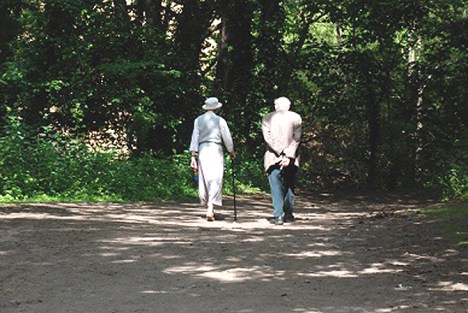
How touched I became when I locked my vision on an elderly couple watching the man help the fragile woman out of the car and attending to her to get into a restaurant.  Eating at the same place as they were I watched the smiles they exchanged while eating and from a distance the conversation they were having.  I saw a couple deeply in love just moving in slow motion;  true romance at half speed.  Without looking closely I would have dismissed them mentally as “old people” and hardly noticed them at all.

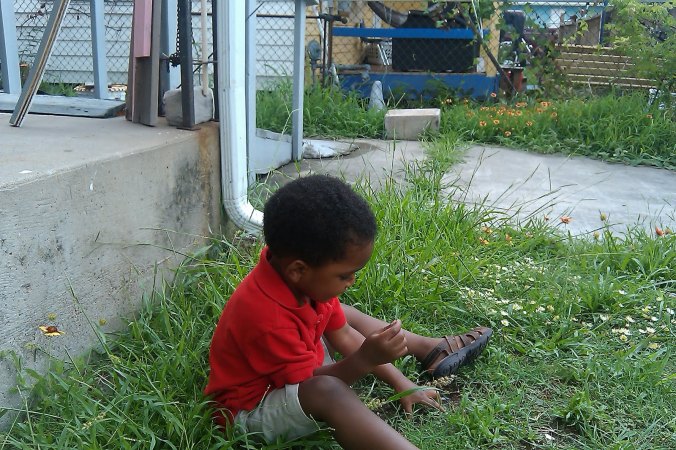
I found delight in watching a toddler in a park giggling wildly while chasing a grasshopper like it was the greatest find of the year.  Truly sitting and watching birds through a window enjoy a feast of crumbled bread I put out for them on top of a big snow allowed me to notice the quirky uniqueness of each breed and what appeared to be joy in the abundance they had found.  And then there is nature!  A walk in the woods or a park became a sensory banquet.

When was the last time you sat and watched a sunset or sunrise?  When was the last time you actually “saw” a person instead of just looking at them.  How long since you gazed in a mirror and actually saw yourself instead of just acknowledging your reflection?  How long has it been since you focused on something to the point to where you found sheer delight in what you were looking at?  For me I am glad to say “no long ago”.   I am grateful to have stumbled across this activity and to have cultivated the habit.  As time passes with consistent effort I find I am able to more truly see with greater depth and frequency.  If life is a feast, then this is the seasoning for the meal.

Taken from “Seeing Past Myself” – Don Iannone

Sometimes I have trouble
Seeing past myself
Blindsided by who I think I am
…oblivious
To the vast world of possibilities…
I clean my glasses twice a day
Unfortunately it’s to see what I want to see
And not beyond that
I guess I’m no different –
Than you, or anyone else.
My self-image directs my eyes.
There’s a solution you know
It’s not as hard as we think
Open our hearts to unknown possibilities
Accept that our version of reality
Is but one of many out there.

The real voyage of discovery consists of not in
seeking new landscapes but in having new eyes.
Marcel Proust

First Posted on May 25, 2011

A State of Being

miracle of gratitude

Today I chose just “to be”… and took a day off. Hope your Monday went well, and if it didn’t I hope you found ample strength to cope with what came your way.

We think we have to do something to be grateful
or something has to be done in order for us to be grateful,
when gratitude is a state of being.
Iyanla Vanzant

“Three Good Things”

Once upon a time I believed achieving happiness was the purpose of my life.  Experience has since taught the pursuit of happiness actually leads to a good deal of unhappiness.  My vantage point of today tells me happiness is actually a consequence of a very different pursuit in life – the pursuit of the evolution of my ability to love myself and others.

In days past my pursuit of happiness has included many different, but unsuccessful approaches including:

1. The pursuit of momentary pleasure drove me for a long while during the time when I believed happiness was the same as pleasure.  It took empty experience over decades to teach me that sex is not happiness nor is sex love.

2. The pursuit of money, the control it gives and the things money can buy was a catalyst for achievement for much of my adult life.  I thought having then what I did not have as a child would fill in some missing parts within.  Once I had an over abundance I found I felt more hallow than even before.

3.  I realize now my pursuit of happiness included a burning need to be valued as a human being by others.  My childhood environment provided almost none of that reinforcement and instead I felt a need to impress others, to be admired and thought well of.  In that thinking my happiness was attached to what others thought as I attempted to get love, attention and admiration in an impossible way.

Today the fact rings true within that true happiness is not the result of DOING, but of a way of BEING. Rather than being a result of the momentary pleasures or money or even other people, it is the result of my intention to evolve daily as a loving human being.

As a further aid in my positive evolution I am cultivating a new habit.  Each morning I focus on what I am grateful for and ask myself “what three good things happened yesterday”.  This practice comes directly from the book “Flourish” by Martin Seligman whose work I admire and has found a great help to me personally.

Anytime I focus on what I am thankful for and get away from what I wish were different, my life experience improves.  And the more I do that, the greater and more lasting the improvement is. “What three good things” is a simple method of redirecting attention towards positive thoughts and away from negative thinking. It works wonders for me.

We human beings evolved spending much more time thinking about negative experiences and possibilities than positive ones. That’s what kept us safe in the wild and from becoming some animal’s lunch.  Starting when we lived in caves the instinct was strong to spend a lot of time thinking about what could go wrong and how to avoid it.  Once upon a time there was an evolutionary advantage to this dominant way of thinking, but for modern humans this negative bias is a source of a lot of anxiety, depression, and general lack of wellbeing.  Luckily, by re-directing my thoughts intentionally towards positive events, I have found I can do a lot to correct this negative bias.

Dr. Deborah Barnett, Ph.D. writes the “3 Good Things” exercise, also known as the “3 Blessings” exercise, is a great Positive Psychology technique that has been well-tested. It has been shown to increase well-being and decrease depression and anxiety. Martin Seligman, Ph.D., conducted a study using this exercise. The results were that 94% of very depressed people became less depressed and 92% became happier in 15 days. Furthermore, the results lasted for at least 6 months.

“The good things” is simple to do.  Each morning soon after I first get up I pick out 3 things that went well the previous day (many prefer to do this in the evening at the end of the day).  In just a few words I write down three events or experiences that went well and why they went well or what felt good about the experiences. I’ve learned what I choose does not have to be spectacular or dramatic.  Something as simple as being grateful for the sweet strawberries at dinner, appreciating a cool, misty morning or a call from a good friend the night before are good examples of simple, but meaningful reasons for me to be grateful.

Growing my awareness of gratitude has been a profound life-changer.  Always I felt I was thankful, but looking back now I realize before I spent 90% or more of my time focused on what needed to be improved, what needed to change, what I needed to be wary of, what had gone wrong or what might go wrong.  While I can’t say the percentage has reversed to be vastly all gratitude, there is balance now.  My life today contains at least as much thankfulness and well-being as it does worry and anxiety.   I am grateful for my gratitude!

If you don’t get everything you want,
think of the things you don’t get that you don’t want
Oscar Wilde

Free download of “3 good things” log page show in image at top.  No strings attached.
http://papernstitchblog.com/wp-content/uploads/2011/06/3goodthingslist1.pdf

Originally Posted here on October 27, 2011


The Occupation of Childhood

Happy child with painted hands

Play is the most important activity in the lives of children.
Sometimes it seems more important than eating and sleeping.
Sometimes play is easy and fun.
Sometimes play is trying hard to do something right.
Play is the work, the occupation of childhood.
L.S. Lagoni

The ‘occupation of childhood’ is just as important to adults, but most of us have lost that knowledge in responsibility, ‘real work’, worry and generally being grownups. It’s been more than a decade since I had playtime regularly with my son as he grew up. I had nearly forgotten the joy of playing and how healthy it is.

Scoff at the thought of playing with finger paint, coloring in a coloring book or making a collage from magazine cut-outs for no particular purpose if you want. You don’t know what you’re missing. A unique and artistic friend and I got together for ‘playtime’ yesterday. We had planned to make collages for a couple of months, but our adult lives gave us excuses to kept it from happening.

We warmed up with finger paints and then moved on to the serious business of cutting pieces that moved us from magazines for our collages. It was interesting that the longer we did that, the quieter we became; each intently focused on finding just the right things to cut out. As we were scissoring stuff from the pages, each was understood completely in the moment by the other. Without speaking hardly a word it was clear between she and I that what we were doing was not just for children. This was serious and meaningful business for grownups: PLAY! We were doing the simple, enjoying the uncomplicated while being completely at home with each other and enjoying the ‘Now’. How very cool!

Play is simultaneously a source of relaxation and stimulation for the brain and body. A sure (and fun) way to develop your imagination, creativity, problem-solving abilities, and mental health is to play with your romantic partner, office-mates, children, grandchildren, and friends.

Play is often described as a time when we feel most alive, yet we often take it for granted and may completely forget about it. But play isn’t a luxury—it’s a necessity. Play is as important to our physical and mental health as getting enough sleep, eating well, and exercising. Play teaches us how to manage and transform our “negative” emotions and experiences. It supercharges learning, helps us relieve stress, and connects us to others and the world around us. Play can also make work more productive and pleasurable.

Despite the power of play, somewhere between childhood and adulthood, many of us stop playing. We exchange play for work and responsibilities. When we do have some leisure time, we’re more likely to zone out in front of the TV or computer than to engage in creative, brain-stimulating play. By giving ourselves permission to play with the joyful abandon of childhood, we can continue to reap its benefits throughout life. http://www.helpguide.org/life/creative_play_fun_games.htm

Thanks for the play-day K.! It was big fun and the positive effects are still bouncing within now a day later. My collage (below) is still hanging up in the kitchen. I still don’t have a clue what it means, but know what I randomly chose and glued down speaks from my heart and soul. Maybe it all has no meaning except I was able to feel contented like a child. And that’s a huge gift. How wonderful to feel seven years-old again!

What do most Nobel Laureates, innovative entrepreneurs, artists
and performers, well-adjusted children, happy couples and families,
and the most successfully adapted mammals have in common?
They play enthusiastically throughout their lives.
Stuart Brown

IMG_1874CLOSE