Window With A Different View

6312097041_b093d9c916_bI would be grateful if you’d forward to a few friends
an installment of G.M.G. you found meaningful and help set a record
for readership for GoodMorningGratitude.com’s second birthday on April 25, 2013.
Thank you.

Life without thankfulness is devoid of love and passion. Hope without thankfulness is lacking in fine perception. Faith without thankfulness lacks strength and fortitude. Every virtue divorced from thankfulness is maimed and limps along the spiritual road. John Henry Jovett

What a fast two years it has been. The benefits of sharing a little of myself with the world each day yields multiplied blessings the longer I do it. My view of the world is through a window with a different view from any I have known before. From where ever and what ever the inspiration came, I am humbly and deeply grateful.

The value we place
on what we’ve been given
correlates to our depth
of gratitude for it.
Todd Stocker

What I Think, I Become

Sun_after_rain_by_Ritsuka_kawaiMy life is living proof that changing the focus of thoughts can change a life. Worry and compulsion used to be stirred into my thinking most of the time which kept me constantly dealing with a brooding outlook on life. While not immune to feeling such things today, my ‘habit’, even addiction if you will, to negative thinking is no longer.

Buddha said it succinctly, “The mind is everything. What you think you become”.

For me it is all about what I pay attention to. If I keep “pulling the scabs” off the past, wounds never heal. If I spend too much time lamenting about how the future will turn out, what I hope for never arrives because my thinking crowds out its possibility.

Controlling my thoughts fully is impossible. Certainly I slip into old ways of thinking regularly, but usually catch myself before being there for long. At first, breaking my habit/addiction to negative thinking was damned hard; I was hooked on feeling bad. Success at reflecting away some of my thoughts would come for only a short while before slipping back into thoughts of fear, doom and gloom. I kept trying and slowly my success grew at not getting stuck.

If we tune-in on thoughts of failure, illness, discouragement, despair and hate, the charts of our lives will take a sharp downward course.

If we tune-in on thoughts of victory, love, hope and faith, our lives will become larger, finer, more worth while.

If we tune-in on the surface things that break like bubbles and leave us nothing, our lives will be shallow and empty.

If we tune-in on the deeper things, eternal principles of plain living and high thinking, the riches which men have put into immortal literature, art and music, then entire personalities will grow and expand.

If we permit ourselves to become selfish and cold toward others, the springs of love and sentiment will dry up leaving us but the husks of life.

If, on the other hand, we are kind and thoughtful and considerate of others; if we strive always to pluck a thorn and plant a flower wherever we think a flower will grow, riches more valuable than much fine gold will enter our lives.

Saint and sinner, prince and pauper, the things men tune-in on become a part of them and make them what they are. By Lilly Ames-Light

Ups and downs are just as much a part of my life as for anyone else, but my mood swings don’t tear me down anymore. Just like rain only lasts for a time, dark days and dark thoughts pass away as well. When comparing life to 15 years ago, I have friends who refer to me as the “old one” and the “new one”. My evolution has been that pronounced. I am grateful!

Rules for Self Discovery:
1. What we want most;
2. What we think about most;
3. How we use our money;
4. What we do with our leisure time;
5. The company we enjoy;
6. Who and what we admire;
7. What we laugh at.
A.W. Tozer

Why the Sadness Passes

the_stillness_of_march_by_nelleke-d5h14q9It seems to me that almost all our sadnesses are moments of tension, which we feel as paralysis because we no longer hear our astonished emotions living.

Because we are alone with the unfamiliar presence that has entered us;
because everything we trust and are used to is for a moment taken away from us;
because we stand in the midst of a transition where we cannot remain standing.

That is why the sadness passes:
the new presence inside us,
the presence that has been added,
has entered our heart,
has gone into its innermost chamber
and is no longer even there;
is already in our bloodstream.
And we don’t know what it was.

We could easily be made to believe that nothing happened,
yet we have changed, as a house that a guest has entered changes.

We can’t say who has come, perhaps we will never know, but many signs indicate that the future enters us in this way in order to be transformed in us, long before it happens.

And that is why it is so important to be solitary and attentive when one is sad:
because the seemingly uneventful and motionless moment when our future steps into us is so much closer to life than that other loud and accidental point of time when it happens to us as if from outside.

The quieter we are, the more patient and open we are in our sadnesses, the more deeply and serenely the new presence can enter us, and the more we can make it our own, the more it becomes our fate. Rainer Maria Rilke

Rising whole and feeling well after a few days of moderate depression, I can find gratitude for those few days of monochrome life. Learning to use such times as a way of contrast to better days has greatly enhanced the good. And so today with much gratefulness I go into my day feeling contented, happy and a little stronger from enduring another little storm.

If you do not believe that hearts can bloom suddenly bigger,
and that love can open like a flower out of even the hardest places,
then I am afraid that for you the road will be long and brown and barren,
and you will have trouble finding the light.
But if you DO believe, then you already know all about magic.
From “Liesl & Po” by Lauren Oliver

Greet Yourself Arriving

see myself arrivingLived in thirteen states and a foreign country.
Two marriages and numerous failed relationships.
Lots of jobs. Work, work, work.
Learned to fly. Bought an airplane.
Became a professional photographer.
Success and money.
Accomplishment created more emptiness
Often learned little from failure.
Going and going not getting anywhere.
Never satisfied. Always wanting more.
… et cetera, et cetera, et cetera…

When first looking at that list of ten things it does not seem like such a short inventory should take up as much space as they have during the last thirty years. Of course there was more, but in majority those ten things are where I spent most of my time. Searching and searching but not knowing exactly what I was searching for.. Then a few years ago my focus began to be clearer. Slowly, so painfully slow, a form took shape. I was surprised  when I finally saw what I had been searching for. It was me…. I had been looking outside myself for what was inside all along

“Love After Love”

The time will come
when, with elation
you will greet yourself arriving
at your own door, in your own mirror
and each will smile at the other’s welcome,
and say, sit here. Eat.
You will love again the stranger who was your self.
Give wine. Give bread. Give back your heart
to itself, to the stranger who has loved you
all your life, whom you ignored
for another, who knows you by heart.
Take down the love letters from the bookshelf,
the photographs, the desperate notes,
peel your own image from the mirror.
Sit. Feast on your life.
Derek Walcott

Uncomplicated and plainly said; today I am grateful for “me”.

Whether I fail or succeed
shall be no man’s doing but my own.
I am the force.
Elaine Maxwell

Be Led By Your Dreams

400_1209788157_wsredsunset1024x768 In my Internet Exploder bookmarks I found a post saved about a year ago titled “12 Things You Should Be Able to Say About Yourself” from a blog called “Mark and Angel Hack Life” ago http://www.marcandangel.com/2012/04/26/you-should-be-able-to-say-about-yourself/ (Thanks M&A for the inspiration. I will be a regular visitor to your blog from now on!)

Before I filed the blog away the material got only a tertiary scan, but today’s look included a good read of the twelve things to aspire to. Some I am doing good at; others need work. However, I am especially proud of my current state with number 1 and number 5.

1. I am following my heart and intuition.

Don’t be pushed by your problems. Be led by your dreams. Live the life you want to live. Be the person you want to remember years from now. Make decisions and act on them. Make mistakes, fall and try again. Even if you fall a thousand times, at least you won’t have to wonder what could have been. At least you will know in your heart that you gave your dreams your best shot.

Each of us has a fire in our hearts burning for something. It’s our responsibility in life to find it and keep it lit. This is your life, and it’s a short one. Don’t let others extinguish your flame. Try what you want to try. Go where you want to go. Follow your own intuition. Dream with your eyes open until you know exactly what it looks like. Then do at least one thing every day to make it a reality.

And as you strive to achieve your goals, you can count on there being some fairly substantial disappointments along the way. Don’t get discouraged, the road to your dreams may not be an easy one. Think of these disappointments as challenges – tests of persistence and courage. At the end of the road, more often than not, we regret what we didn’t do far more than what we did.

5. I am growing in to the best version of me.

Judy Garland once said, “Always be a first-rate version of yourself instead of a second-rate version of somebody else.” Live by this statement. There is no such thing as living in someone else’s shoes. The only shoes you can occupy are your own. If you aren’t being yourself, you aren’t truly living – you’re merely existing.

Remember, trying to be anyone else is a waste of the person you are. Embrace that individual inside you that has ideas, strengths and beauty like no one else. Be the person you know yourself to be – the best version of you – on your terms. Improve continuously, take care of your body and health, and surround yourself with positivity. Become the best version of you.

In #1 “Be led by your dreams” is especially meaningful to me now. Before my 50’s I mostly put others before me, rightly so in some cases, but misguided in others. Now at times I feel like I just woke up and started living my own life after sleepwalking in a dream (not necessarily always the good kind) for most of my adult life.  I am leaving my profession this year to follow my dream of travel and writing. There will need to be income of some sort down the road, but I am convinced it is waiting for me. I only need to put my feet on the path forward and believe. The rest will come.

“..trying to be anyone else is a waste of the person you are.” After a myriad of failed attempts to be like others, eventually I became too tired to try. Through that exhaustion, as much as anything else, I began to make peace with who I actually am. Frankly, today I just don’t care a whole lot about what others think of me. Of course, I’d prefer it be good, but at a deep level it just does not matter much. Reaching that point is some of the best “growing up” I have done. Yea for me (as I pat myself on the back unabashedly). I am grateful to who I am… no more; no less.

Your perceptions are derived from your feelings
and your ability to be yourself, to own
and trust yourself, and to say what you feel,
even when it may be diametrically opposed
to everyone else’s opinion.
You may be called the Devil Incarnate.
You may feel like cow pies are being thrown at you.
Sometimes that is part of being true to yourself.
Barbara Marciniak

One I Will Not Forget

Native_American Indian_Color_apache-chiefAs I sit and stare into his eyes, and him into mine, it is as if I am looking across time. There is a momentary, but very real connection with this proud Apache Chief. Without knowing how, I am certain he appreciates me “seeing” him and acknowledging he one lived. I am honored to bear just a tiny amount of him within me now. His face will not be forgetten.

Native American Ten Commandments
1. Treat the Earth and all that dwell therein with respect
2. Remain close to the Great Spirit
3. Show great respect for your fellow beings
4. Work together for the benefit of all Mankind
5. Give assistance and kindness wherever needed
6. Do what you know to be right
7. Look after the well-being of Mind and Body
8. Dedicate a share of your efforts to the greater Good
9. Be truthful and honest at all times
10. Take full responsibility for your actions

There is no memory of the last time I slept twelve hours as I did last night, but am grateful for the rest. I need it to fight off yet another cold, my third in as many months. My leave-behind here today is short and humbly offered.

Even in illness, my gratitude is strong. It is not of the fair-weather sort. I will not grumble or grouse because I have another cold, or maybe even the flu. Rather, I will be thankful my sickness will pass and in a few days be a reminder to appreciate all the more being healthy.

This place,
This place with all creatures and their pain,
This place is beautiful all the same.
This place, with it’s ice and heat and rain,
Darkest depths, roughest terrain,
With its disasters, sorrows, shame…
This place is beautiful…
And is yours to better
And not to blame.
Evette Carter

Just Do It!

elephantThere are nineteen weeks remaining until I retire from a profession I have been engaged in for forty years. There is certainty I will be busier then than now, but with what I specifically want to do. For example, there’s extended travel, a book to finish and publish, far away friends to visit, work to do on my home, several hundred books to read and so much more. It has been my tendency to be busier in my personal life than while working and expect that to accelerate. The excitement that soon my time will be all mine makes me smile every time I think of it.

If you can do it, should do it, and want to do it, what are you waiting for? Many things in life that we excuse or misplace blame for are not created by what we do but by what we fail to do. Maybe we just procrastinate and just don’t get around to action. Or maybe it’s just a thought, something that we think would be nice to do, but we just aren’t serious about it.

Some possible answers come from my own experience. One excuse is that we just can’t seem to find the time. That won’t wash. Whatever we do in life, we have found or made time for. Final choices are matters of priority, and sometimes we don’t prioritize well.

Fear is an obvious cause of inaction.
Fear of failure.
Fear of being different or out-of-step.
Fear of rejection.
Even fear of success.
Fear of failure arises from self-doubt. We may think we don’t know enough, don’t have enough time or energy, or lack ability, resources, and help. The cure for such fear is to learn what is needed, make the time, pump ourselves up emotionally so we will have the energy, hone our relevant skill set, and hustle for resources and help. These things can be demanding. It is no wonder there are so many things we can, should, and want to do but don’t do.

All our life, beginning with school, we are conditioned to consider failure as a bad thing. But failure is often a good, even necessary, thing. The ratio between failures and successes for any given person is rather stable. Thus, if you want more successes, you need to make more failures. Even the corporate world recognizes this principle, and the most innovative companies practice it. Jeff Dyer, in his book The Innovator’s DNA, says the key to business success is to “fail often, fail fast, fail cheap.” It’s O.K.. to fail, as long as you learn from it. Our mantra should be: “Keep tweaking until it works.” This is exactly how Edison invented the light bulb. Most other inventors and creative people in general have operated with the same mantra. Taken from the article “Just Do It” by Professor of Neuroscience at Texas A&M University, William Klemm, D.V.M., Ph.D.  http://www.psychologytoday.com/blog/memory-medic/201303/just-do-it-0

“Just do it” is the course I have set for myself knowing regrets for most people are not what they did with their life, but what they did not do. It’s time to reach high. My most exciting, enriching and creative period has already begun. I am grateful for my life!

Far better it is to dare mighty things,
to win glorious triumphs,
even though checkered by failure,
than to take rank with those poor spirits
who neither enjoy much nor suffer much,
because they live in the gray twilight
that knows neither victory nor defeat.”
Theodore Roosevelt

Food for Thought

antidepressant-facts-400x400It has been no secret on this blog that I deal with cycling depression that comes around for two or three days about every six weeks. Though counseling I have learned to mostly just let it pass through me like “wind through the trees”. The depression comes, shakes me a bit and passes. For years now I have taken the prescription antidepressant Wellbutrin/Bupropion. While I don’t necessarily agree with the material I have placed here today, I don’t disagree with it either. Simply it makes me want to know more.
Depression is not caused by a chemical imbalance in the brain, and it is not cured by medication. Depression may not even be an illness at all. Often, it can be a normal reaction to abnormal situations. Poverty, unemployment, and the loss of loved ones can make people depressed, and these social and situational causes of depression cannot be changed by drugs.

Our analyses of the FDA data showed relatively little difference between the effects of antidepressants and the effects of placebos. Indeed, the effects were so small that they did not qualify as clinically significant. The drug companies knew how small the effect of their medications were compared to placebos, and so did the FDA and other regulatory agencies. The companies found various ways to make the data seem more favorable to their products, and the FDA helped them keep their negative data secret. In fact, in some instances, the FDA urged the companies to keep negative data hidden, even when the companies wanted to reveal them. My colleagues and I hadn’t really discovered anything new. We had merely revealed their ‘dirty little secret’.”

In 2004, the FDA urged drug companies to adopt a ‘Don’t ask, don’t tell’ policy with respect to their clinical-trial data showing that antidepressants are not better than placebos for depressed children. If the data were made public, they cautioned, it might lead doctors to not prescribe antidepressants.

Psychotherapy works for the treatment of depression, and the benefits are substantial. In head-to-head comparisons, in which the short-term effects of psychotherapy and antidepressants are pitted against each other, psychotherapy works as well as medication. This is true regardless of how depressed the person is to begin with.

Psychotherapy looks even better when its long-term effectiveness is assessed. Formerly depressed patients are far more likely to relapse and become depressed again after treatment with antidepressants than they are after psychotherapy. As a result, psychotherapy is significantly more effective than medication when measured some time after treatment has ended, and the more time that has passed since the end of treatment, the larger the difference between drugs and psychotherapy.

When people recover from depression via psychotherapy, their attributions about recovery are likely to be different than those of people who have been treated with medication. Psychotherapy is a learning experience. Improvement is not produced by an external substance, but by changes within the person. It is like learning to read, write or ride a bicycle. Once you have learned, the skills stays with you. Furthermore, part of what a person might learn in therapy is to expect downturns in mood and to interpret them as a normal part of their life, rather than as an indication of an underlying disorder. This understanding, along with the skills that the person has learned for coping with negative moods and situations, can help to prevent a depressive relapse.

Depression is a serious problem, but drugs are not the answer. In the long run, psychotherapy is both cheaper and more effective, even for very serious levels of depression. Physical exercise and self-help books based on CBT can also be useful, either alone or in combination with therapy. Reducing social and economic inequality would also reduce the incidence of depression. From “The Emperor’s New Drugs: Exploding the Antidepressant Myth” by Irving Kirsch

I am grateful for this food for thought came into my path. It deserves a good bit of further exploration. Maybe it is time I stood on my “own two legs” without being propped up by a pill. Then again, maybe without it I’d end up back in the ‘darkness’. From people I known there is a personal conviction that antidepressants really do help some, but don’t help others at all (sometimes doing some harm). For now, lots more research to do before I reach any conclusions for myself.

The truth will set you free,
but first it will piss you off.
Gloria Steinem

Who I Am

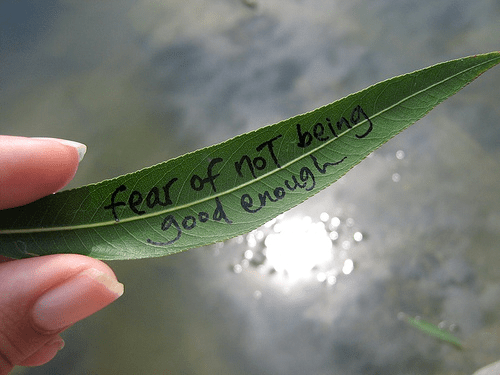
fear of not being good enoughI swear…

That my problems and failures will not stop me, nor will they dictate who I am.

That I will continue to be my own person.

That life is too short, and I will live every day as the best person I can be.

That I will grow and that I will change.

That I will smile and hold my head high.

That this is a new start and a new day.

That I will allow myself to cry or sit by myself when I need to.

That I will find things to really smile about.

From “Happyface” by Stephen Emond

If I’m among men who don’t agree at all with my nature, I will hardly be able to accommodate myself to them without greatly changing myself. A free man who lives among the ignorant strives as far as he can to avoid their favors. A free man acts honestly, not deceptively. Only free man are genuinely useful to one another and can form true friendships. And it’s absolutely permissible, by the highest right of Nature, for everyone to employ clear reason to determine how to live in a way that will allow him to flourish. Irvin D. Yalom

Three (2 above, 1 below) reminders to be authentically myself begin my day with heightened awareness that much of what I perceive about myself is either not true or relatively worthless to begin with. So many little stories I have spun about me, both from what others have said and from the mental ramblings of a man with more than his share of insecurities. The person I am is not that difficult to see. All I have to is slow down my thinking and just let myself be. Who I am has been there all along. I only need to step out of the fog to see it. I am grateful for a little self-told guidance this morning. It will serve me well today.

You must be true to yourself.
Strong enough to be true to yourself.
Brave enough to be strong enough
to be true to yourself.
Wise enough to be brave enough,
to be strong enough
to shape yourself
from what you actually are.
Sylvia Ashton-Warner

Keep Practicing the Art of Living

viktor-franklIn a little more than two weeks we arrive upon the 108th anniversary of birth for Austrian neurologist and psychiatrist, Dr. Viktor Emil Frankl, MD, PhD (March 26, 1905 – September 2, 1997). I did not read his renowned work “Man’s Search for Meaning” until about ten years and remember vividly how that little book stunned me with its simplicity and wisdom. In honor of the man and the teachings he left behind, what is just below is taken from an article published in the New York Times on the day Dr. Frankl died sixteen years ago.

Viktor Frankl’s mother, father, brother and pregnant wife were all killed in the camps. He lost everything, he said, that could be taken from a prisoner, except one thing: ”the last of the human freedoms, to choose one’s attitude in any given set of circumstances, to choose one’s own way.”

Every day in the camps, he said, prisoners had moral choices to make about whether to submit internally to those in power who threatened to rob them of their inner self and their freedom. It was the way a prisoner resolved those choices, he said, that made the difference.

In ”Man’s Search for Meaning,” Dr. Frankl related that even at Auschwitz some prisoners were able to discover meaning in their lives — if only in helping one another through the day — and that those discoveries were what gave them the will and strength to endure.

After their arrival at Auschwitz, they and 1,500 others were put into a shed built for 200 and made to squat on bare ground, each given one four-ounce piece of bread to last them four days. On his first day, Dr. Frankl was separated from his family; later he and a friend marched in line, and he was directed to the right and his friend was directed to he left — to a crematory.

As their illusions dropped away and their hopes were crushed, they would watch others die without experiencing any emotion. At first the lack of feeling served as a protective shield. But then, he said, many prisoners plunged with surprising suddenness into depressions so deep that the sufferers could not move, or wash, or leave the barracks to join a forced march; no entreaties, no blows, no threats would have any effect. There was a link, he found, between their loss of faith in the future and this dangerous giving up.

”We had to learn ourselves, and furthermore we had to teach the despairing men, that it did not matter what we expected from life, but rather what life expected from us,” he wrote. ”We needed to stop asking about the meaning of life but instead to think of ourselves as those who were being questioned by life, daily and hourly.

”Our answer must consist not in talk and medication, but in right action and in right conduct. Life ultimately means taking the responsibility to find the right answer to its problems and to fulfill the tasks which it constantly sets for each individual.”

Prisoners taught one another not to talk about food where starvation was a daily threat, to hide a crust of bread in a pocket to stretch out the nourishment. They were urged to joke, sing, take mental photographs of sunsets and, most important, to replay valued thoughts and memories. Dr. Frankl said it was ”essential to keep practicing the art of living, even in a concentration camp.” By Holcomb B. Noble http://www.nytimes.com/1997/09/04/world/dr-viktor-e-frankl-of-vienna-psychiatrist-of-the-search-for-meaning-dies-at-92.html?pagewanted=all&src=pm

When difficulty comes, I try to remember the insights Dr. Frankl left for us distilled in his quote, “Those who have a ‘why’ to live, can bear with almost any ‘how’. Dr. Frankl’s book, has been deeply meaningful to me and millions of others. I am grateful he left the world a better place than he found it.

Being tolerant does not mean
that I share another ones belief.
But it does mean I acknowledge
another ones right to believe,
and obey, his own conscience.
Victor E. Frankl