Master Gardener of His Soul

He made me angry with what he said.

She made me feel sad because she did that.

They made me feel hurt by not including me.

My employer made me feel bad when I did not get the promotion.

Most everyone, at least occasionally, expresses them self in the context of being “made” to feel one thing or another.  The reality however is no one makes us feel anything without our consent.  Through my growth of recent years I’ve learned to do my best to catch the words “he/she/they/you/it made me feel …” before they flow out of my mouth.  When expressing myself that way I am essentially trying to blame others for what is taking place inside me.  Fault is being reassigned for my thoughts, words, actions and feelings.  My “self” is being given up to an outside force. 

My knowledge today includes that I alone own my feelings and emotions and am responsible for what I do with them.  People can do or say things I can choose to make myself feel bad about, but I have to make the choice to allow it.

Giving my self away over and over used to be a frequent habit.  When thinking someone “made” me feel this or that I felt like one of those Superballs I had as a kid that when thrown bounced recklessly off any surface it hit.  With practice that kind of bouncing behavior became ingrained and made it easier to not take responsibility for my behavior.  Truth is I needed to look inward to find why I felt and reacted the way I did. 

Down deep now I know no one can make me ‘feel less’ than unless I already feel less than.  No one can make me feel crazy; no one can make me feel inadequate; no one can make me feel sad; no one can make me feel anything at all.  The most anyone else can do is to remind me of what I already feel inside.  If I have anger buried, someone can do or say something I might use to wake that feeling up, but only if I already have anger hidden inside me in the first place. 

My discovery has been that what worked the quickest to cause me to say others “made” me think or feel was most often what I needed to work on most.  By digging through a bunch of long-buried feelings I have slowly become more confident in my own skin.  As that confidence has grown I have become more adept at taking responsibility for my choices, feelings and thoughts.  I find myself saying things like “you made me feel …” less and less.  The frame of reference I now cultivate is simply “I feel …” That statement more accurately puts me in touch with what is going on inside me.

According to science, my thoughts about anything said or done by another can trigger a neurological response that sends chemicals into my brain trying get a reaction. The choice however is mine how I react.  The challenge I have had to work on (and still do) is my emotional responses have been repeated so much they are ‘habits’.  Having habitual reactions means when a trigger occurs – someone raises their voice, uses a certain tone, or behaves in a particular way – my neurological reaction occurs automatically.  Without my conscious awareness I then automatically act on the emotion as though I can’t control it.  My thinking was “this is just who I am” when in fact that is/was how I behave.  When I can accept this truth I am accept responsibility for myself, for my emotional state and my behavior.

When something happens that raises emotions within that make me feel out of control I have learned to try immediately to identify the emotion by asking “what am I feeling?”  Then I usually can find what my need behind the emotion is.  I ask myself “what do I need at this moment?” When that question can be answered I can move to meet my need.  Sometimes it is to set a boundary with someone.  At others my need is to ask for help or simply take a time out and walk away for a while.  With repeated and consistent practice I create new habits and ways of being.

Today I know what I feel is about me. To say someone else “makes” me feel is shirking responsibility.  The reality is that no one can make me feel anything. “I” alone am responsible for my emotions.  What I DO with those emotions is all about me and no one else.  I am deeply grateful to have that wisdom, even if my practice of it is far from perfect.

A man sooner or later discovers that he is the master-gardener of his soul, the director of his life.  James Allen

Like Wet Cement

Years ago scientists conducted experiments proving wind is essential for a tree’s healthiest development. When grown in an overly protective environment without experiencing the wind and the elements, a tree’s roots grow shallow and weak.  Conversely, trees that grow in an environment with natural forces create a strong and flexible root system.
 
Vegetation that grows in rain forests frequently has less dense and shallower roots as compared to those growing in areas that receive more moderate amounts of rainfall.  When rain is too plentiful at the surface a plant does not have to grow deep and durable roots to be quenched. 
 
Plant life that is able to eek out stunted life in arid and near desert areas usually has deep and often immense roots.  With so little water, the plant has to look everywhere it can to find enough water to stay alive.  These plants often have evolved to go dormant and be near lifeless between rain falls in order to survive.  Not infrequently they die.
 
Human life has some parallels. 
 
Learning from a normal and moderate of “turbulence” encountered in life, a person can grow up experienced, knowledgeable and able to cope.  This wisdom is not automatic, but can be gained fairly easily while growing up in a supportive environment if one is paying attention and learning the lessons presented.  Like wind through a tree strengthens a tree as it grows, challenge and difficulty of life can help a person build strong roots where they cannot be easily toppled. 
 
A person overly protected growing up will often not have a firm foundation of life experience to keep them well rooted.  Love and caring in good amounts makes a life “well watered” with love and esteem.  Excessive amounts figuratively drown a person emotionally.  Like a tree with shallow roots, someone who grew up too sheltered will frequently find their ability to cope with life’s challenges falling short.  Getting knocked down easily is often their lot in life. 
 
Too little “watering” with care and love, a child’s emotional development is stunted and does not develop normally.  Such a person will often seem to be emotionally unavailable and appear to have dormant feelings.  When the need has primarily been to survive psychologically, one mostly develops those coping skills and little else.  It can be very challenging to interface with others for these people as they simply do not know how to.

The result of “too little watering, care and feeding” emotionally during formative years can be the root of all sorts of issues from anxiety and addiction to codependence and depression. While controversial in some medical circles, a lack of unconditional love early in a person’s life can result in what is called “Emotional Deprivation Disorder”. 

E.D.D was first noted by Dutch Dr. Anna A Terruwe in the 1950’s and is a disorder characterized by difficulty in forming relationships with others, a general feeling of inadequacy, and oversensitivity to criticism.  Emotional Deprivation Disorder results from a lack of authentic affirmation and emotional strengthening in one’s life. A person may have been criticized, ignored, neglected, abused, or emotionally rejected by primary caregivers early in life, resulting in that individual’s stunted emotional growth.

Some who have been adopted and grew up in loving and supportive homes may still have issues along the lines of E.D.D.  It is not uncommon for an adoptee to struggle with feelings of abandonment and rejection they feel about their biological parents. 

Unaffirmed people suffering most from E.D.D. are often incapable of developing into emotionally mature adults until they receive authentic affirmation from another person(s). Maturity is reached when there is a harmonious relationship between a person’s body, mind, emotions and spiritual soul under the guidance of their reason and will.
 
Does Emotional Deprivation Disorder actually exist?  I can’t speak from a medical or clinical point of view.  My thoughts originate solely from my personal experience.  Without a doubt I suffered for many years from the symptoms of E.D.D. without knowing exactly what the cause was.  Getting involved in therapy, exploring and making peace with my childhood and becoming an active member of Codependents Anonymous has made a huge difference in my life. 

The majority of the time now I enjoy a “harmonious relationship between body, mind, emotions and spiritual soul”. The lack of “care, watering and feeding” of my youth has been largely overcome.  I am deeply grateful for my recovery and thankful to be able to pass on to others a little of what I have learned.

Children are like wet cement.
Whatever falls on them makes an impression.
Dr. Haim Ginott

Between Now and the Next Midnight

How will today be different from the one before and the one before that?  Will it be unique because of what I experience outside of me?  Or will this new day be made distinctive due to what is felt inside?  Somewhere between work, sleep, responsibility and interaction with others will there be inspiration to make this day highly memorable? Will today bring something I will always remember, or will it fade unremarkably into another page in the over 20,000 pages of my life so far?

As those questions ping-pong around mentally as I write them, a silent voice says to me “that’s up to you”.  Whether what I hear noiselessly is simply me speaking my own thought or is that four word answer from somewhere beyond my knowing is of no consequence.  All I need do is openly accept what happens today is more up to me than any other force on this Earth.

In the last nine months I have discovered taking the time to mentally and emotionally mark the start of a new day makes every one better.  Instead of free-falling into another date on the calendar without intention or direction of my own choosing as was long my habit, now I come here to kick-start another morning.  Sitting here writing, watching out my office window as the night turns into day and really noticing what I see is a slow miracle I used to miss completely.

From sitting in one spot for an hour or so while looking up now and then the seasons come noticed by a greater awareness.  The subtlety of changes in the cypress tree in the yard are obvious now.  Today that tree is gray and seems to be hanging its limbs down as it rests and builds energy to burst forward with green as I know it will begin to do in six weeks.

From my vantage point I can see daffodil shoots that have popped through the ground early this year. It is only early February!  The winter has been warm and those flowering harbingers of spring seem to think the days of April are already upon us.  Will they make it until Spring undamaged?  Will I be outside covering them with mulch to protect them from real winter that finally arrives?  With my heightened awareness I know those questions will be answered all in good time.  For now I am content to enjoy what is, just as it is.

Each morning comes bearing a new gift of renewal, redemption and another chance to start all over again.  Life does not go on and on and on forever for anyone.  It begins and ends.  Of that reality I become more aware of as I move closer toward my days of old age.  I do not fear them really, although I do have apprehension about death.  It is not trepidation about what happens after I expire or worries of a spiritual nature.  Rather, it is anxiousness toward the process of moving away from breathing and physical awareness that is worrisome to me in varying increments and at varied times.  That’s OK life should have its mystery and intrigue.  Again, I accept what is, just as it is.

Today I write my thoughts not to push some personal dread upon the world, but rather to wave the flag of life.  It is a reminder that I am here for only a time and like all other days my chance at life in this one will pass.  More than ever I want to make my days count for something.  Small or large, my hope is to leave the world better for having been here.  The thought of a life filled only with consuming, taking up space and contributing waste is not something I allow myself any longer.  Once upon a time, certainly that was true of me.  I was a “taker” of all I could get, thinking grabbing then would offset the long before shortages of youth.  Now it is clear to me, life is far from best when lived in that manner.

No doubt I will be imperfect today.  I will make mistakes.  Scoring the quantity of my missteps is of little use.  Instead keeping a tally or at least noticing what good has been done is what matters.  What will I do today that improves life even if for just one person?

Will it be the smile and “good morning” I speak to some overly solemn person on an elevator?  Will it be the person I let cut in front of me in the backed up traffic?  Will it be the email sent to a friend that arrives with a caring word just when they need it?  Will it be the “good job” or word of support I might give a coworker?  Will someone reading what I have cast into the world here via the Internet get a positive thought which changes the mood of their day for the better?  Or will I be called on to do something rare and miraculous that saves a life or inspires another to?

Only living out my day will answer those questions.  My awareness and desire to make today count will power me through the hours between now and the next midnight.  I am deeply grateful for lungs that breathe, a heart that pumps and a mind that thinks that allows me to be awake and aware on another morning.  It is my intention to practice something I speak often:  “Have a great day and make it count”! 

“The Guest House” by Rumi
This being human is a guest house.
Every morning a new arrival.
A joy, a depression, a meanness,
some momentary awareness comes
As an unexpected visitor.
Welcome and entertain them all!
Even if they’re a crowd of sorrows,
who violently sweep your house
empty of its furniture,
still treat each guest honorably.
He may be clearing you out
for some new delight.
The dark thought, the shame, the malice,
meet them at the door laughing,
and invite them in.
Be grateful for whoever comes,
because each has been sent
as a guide from beyond.

A Beautiful Struggle

For close to 20 years, when asked what I hoped for most my answer was the same:  I want peace.  My desire was for tranquility within; for the storm of emotions to die down to a distant soft rumble; for feeling so constantly troubled to change.  What I wanted so badly is found in a basic definition of peace:  freedom from disturbance; quietness; tranquility; calmness; stillness.

The reasons peace stayed beyond my reach were within since I was little, but I did not consciously know that for a long, long time.  My first hand awareness did not begin to come until my late 30’s.  That wish alone for peace was the actual beginning of moving toward it.  However I was 50-something before I had enough focus to make changes for the better and begin to find “freedom from disturbance”.   That came not in doing away mentally with what happened to me when younger, but instead learning to coexist with those things.  I had to learn to see clearly through and beyond my “junk from childhood”.

Here’s a teaching tale told about Buddha that helps to explain, at least in part, how to find peace.   Once Buddha was walking from one town to another town with a few of his followers. While they were traveling, they happened to pass a lake. They stopped there and Buddha told one of his disciples, “I am thirsty. Please get me some water from that lake.”

The disciple walked to the lake. When he reached it, he noticed some people were washing clothes in the water and others were bathing in the lake.  As a result, the water was stirred up and murky.  The disciple thought, “I can’t give this muddy water to Buddha to drink!” So he came back and told Buddha, “The water in there is very muddy and not fit to drink.”

After about an hour, again Buddha asked the same disciple to go to the lake and get him some water to drink. The disciple obediently went back and found all the bathers and washers were no longer in sight.  Now the lake was clear. The mud had settled down and the water above it looked clear and clean.  He collected water and brought it to Buddha.

Buddha looked at the water, and then he looked up at the disciple and said, “See what you did to make the water clean. You let it be … and the mud settled down on its own – and you got clear water.  Your mind is also like that. When it is disturbed, just let it be. Give it a little time. Let thoughts pass and your mind will settle down on its own. You don’t have to put in great effort to calm it down. It will happen. Let go your grip on your thoughts and it becomes effortless to gain peace.”

That’s a great story, but does not address how one lets go of habitual ways of thinking and stops threshing in the mental water making it muddy.  My efforts for peace within could not take root until there was awareness for what caused my mind to be muddy.  I had to bring to the surface my childhood traumas and abuse, make them commonly known and accepted.  Then through hard work, healing and understanding the majority of their energy over me was taken away.   I had to cultivate a new way of being to let the “water of my mind” clear.

Breaking habits and ways of being so deeply ingrained was literally “facing my own dragon”, learning I could not slay it and befriending him instead.  And in doing so I took away the negative fire of my dragon and learned to coexist with him.  I learned “peace does not mean to be in a place where there is no noise, trouble or hard work.  It means to be in the midst of those things and still be calm in your heart”.

Some things I learned are good weapons to use when my “dragon” wants to breathe fire:
Read, study and learn
Spread good feelings and kindness
Be as present as possible in the “now”
Love without boundaries as much as I can
Forgive and remember forgiveness is an act of peace
Cultivate and tend empathy and understanding of myself
Meditation and reflection are acts of encouraging internal peace
Stay involved with others who bravely battle what I do (self-help meetings)
Be kind to others and myself keeping mentally fresh that kindness is an act of peace

Happiness and suffering are states of mind, and so their main causes cannot be found outside the mind.  The knowing intellectually of that truth combined with actions to practice it has been life changing.  I am incredibly grateful!

Life is a beautiful struggle.
Martin Luther King

Can I Trust You?

Definition of trust:
A firm belief in the reliability, truth, ability, or strength of someone or something;
being able to predict what other people will do and what situations will occur.

“Can I trust you?”  Numerous times greater than needles on a pine tree I have faced that question.  Sometimes my response is “yes, I can” and gratefully I am correct more often than not.  But with higher frequency than I wish were true it is my discovery my trust was ill placed.

Wisdom gleaned from living has made me more discerning about who deserves my trust but still at times I will rely on those I should not.  Problem is I really want to trust everyone, but reality keeps showing me I can’t.  Instead I have to be reminded that trust has to be earned even knowing then no certainty is created.

Sometimes my disappointment is small.  I have faith in someone to return a book I loaned them and am let down when they don’t remember borrowing it.  Or, I trust a person to keep a confidence and they tell someone.  Or another will say they will do something and forget their words were ever spoken.  Such is the realm of everyday life.

If honestly is to prevail, I must admit the person who frustrates me most by violating my trust is me!  Let me explain.  I promise to faithfully begin working out once the weather turns cooler and the heat is gone, but the cold comes with me still parked on the couch.  I make the commitment to stop interrupting others while in conversation but find myself still doing it far too often to be considered an occasional mistake.

From John Mayer’s song “I Don’t Trust Myself…”
No I’m not the man I used to be lately
See you met me at an interesting time
If my past is any sign of your future
You should be warned before I let you inside.

Those words describe a warning that once could have been said truthfully about me.  With my best effort I attempt to not go tripping in my past, but being human invariably I do here and there.  Forgiveness is within for the vows of faithfulness broken in two marriages, but just because I forgive myself does not mean I have forgotten those ultimate violations of trust.   I have paid my penance, done my time in therapy and have grown beyond breaching such trust.  I learned from the mistakes made and am a better man now.

There is plenty in my past to regret, but tears and painful, sleepless nights of self-punishment have been paid.  Today I am a faithful man beyond doubt, but I do it for myself.  Being loyal to another is good for me, even more so than for the object of my fidelity.  Being proud of one’s self is a good addiction to cultivate.

One of the most painful aspects of trust is when one is being honest, but viewed as being deceitful.  It took a long time for the realization to come that telling the truth is all that is required.  Whether another believes me or not is their business, not mine.  If I have been honorable and am viewed otherwise the dishonestly is solely in the other person and his or her inability to see the truth when is presented.

Ultimately I have arrived in the here and now to be one of the most trustworthy people I have ever known. I know this to be true for it is with myself I live every moment of every day.  None of my actions or thoughts are a secret from me.  No longer do I need to try the impossible task of outrunning or fooling myself.  The transformation inside has been remarkable as I have learned to live up to my own standards.  Simple?  YES!  Hard to do?  YES, but worth every ounce of effort, sweat and tears!   Living parallel to my beliefs brings a sweet taste to living I have never known before.  I am grateful for the satisfying taste of my life today.

As soon as you trust yourself, you will know how to live.
Johann Wolfgang von Goeth

Unruly Children and Childish Adults

Some people spend leisure time keeping up with their favorite TV programs or sports teams.  Others enjoying going out frequently and being on the go.  Some give their available time to volunteering or supporting causes dear to them.  Many have lives so filled with responsibility there is little time except for trying to do what has to be done.  I don’t fit into any of those exactly, but have symptoms of all of them from time to time.

Generally I spent a good bit of time with friends, my son or the love in my life.  Otherwise on any given day I am most apt to spend spare time at home with my nose in a book or reading on-line.  The older I get the more insatiable my desire to learn has become and the greater my yearn to grow as a person has increased.  Those are mostly good things, except when I allow my self-absorption to take over a little too much.

In my daily grazing on the ‘Net’ and looking for inspiration for the writer in me, I came across a blog entry titled “40 Things To Teach My Kids Before They Leave Home” link by a woman only identified as Sherri.  In her article is a good list of admirable behaviors almost all parents hope to teach their children.  Here are four of the lessons Sherri says “I will teach my kids”:

– that they can be happy if they choose to be happy.

– to focus on enjoying what they already have instead of wasting time focusing on what they don’t have.

– that it’s okay to be wrong as that’s how we learn.

– that life is short and that they should make the most of each and everyday. They should do things that make them smile, that make them feel alive and energized. Live.

There are some of us who accept our parents did the best they knew how but also know their parental performance left a great deal to be desired.  There are those who were hard-headed, stubborn, even high rebellious as children who never “got” what parents were trying to teach.  Then there are those who moved through childhood being taught and guided well overall who grew up to be relatively well-balanced and happy adults.  I am one of the first group and was left as an adult to teach the child within some of the behaviors that are most healthy for me.

The four items above from “Sherri” are all ways of behaving I accepted long ago as being wise.  Knowing is a far cry from doing.  Having not been well taught such things nor having any discernible examples to follow, such habits never became instinctive. Consequently, here in the late middle of my life I am growing by being a parent to myself the adults of my youth never were.  John Lee wrote a book titled “Growing Yourself Back Up” whose title accurately describes the process and its content has helped me achieve the title’s premise.

One of the issues of a lack of upbringing in some areas is that childish behavior gets brought into adult life.  To me such things seemed natural as that is the way I had always been.  To other adults some behaviors looked like how a kid might conduct them self.  The scenario is one where the child within me always thought some problems were because of the ‘others’ way of reacting and being, when in fact the problem was me all the while.  I am certain there are two wives in my past and a number of others who would agree completely there where frequent times in my past when I behaved like a child!

There has been no miraculous cure.  No grand epiphanies have arrived.  No self-help book fixed me.  Rather by slowly acquired simple awareness, understanding and forgiveness I have become a kinder and gentler man who treats everyone, including myself, much more appropriately.  A slow and difficult process for certain, but one of the most rewarding of my life.

In the end I don’t believe any of us are ever completely grown up and thinking to the contrary only makes that point more readily true.  For everyone there are places in childhood where we got stuck on something and never completely moved past it.  That’s OK.  It is healthy to admit it.   Acceptance of my shortcomings, flaws, mistakes, failings and imperfections is at least half of the remedy for them.  To know this wisdom and to practice it as best I can each day is a way of living that fills me with gratitude and thankfulness.

In the United States today, there is a pervasive tendency to treat children as adults, and adults as children. The options of children are thus steadily expanded, while those of adults are progressively constricted. The result is unruly children and childish adults.
Thomas Szasz

Without You I Wouldn’t Have Tried

Thank You” Attributed to Jesse Owens

To those of you who laughed at me, thank you.
Without you I wouldn’t have cried.

To those of you who just couldn’t love me, thank you.
Without you I wouldn’t have known real love.

To those of you who hurt my feelings, thank you.
Without you I wouldn’t have felt them.

To those of you who left me lonely, thank you.
Without you I wouldn’t have discovered myself.

But it is to those of you who thought I couldn’t do it;
It is you I thank the most,
Because without you I wouldn’t have tried.

Paul Harvey wrote…

I hope you learn humility by being humiliated, and that you learn honesty by being cheated. I hope you learn to make your own bed and mow the lawn and wash the car.

And I really hope nobody gives you a brand new car when you are sixteen.

It will be good if at least one time you can see puppies born and your dog put to sleep. I hope you get a black eye fighting for something you believe in.

I hope you have to share a bedroom with your younger brother. And it’s all right if you have to draw a line down the middle of the room, but when he wants to crawl under the covers with you because he’s scared, I hope you let him.

When you want to see a movie and your little brother wants to tag along, I hope you’ll let him. I hope you have to walk uphill to school with your friends and that you live in a town where you can do it safely.

On rainy days when you have to catch a ride, I hope you don’t ask your driver to drop you two blocks away so you won’t be seen riding with someone as un-cool as your Mom.

If you want a slingshot, I hope your Dad teaches you how to make one instead of buying one. I hope you learn to dig in the dirt and read books. When you learn to use computers, I hope you also learn to add and subtract in your head.

I hope you get teased by your friends when you have your first crush on a girl, and when you talk back to your mother that you learn what ivory soap tastes like.

May you skin your knee climbing a mountain, burn your hand on a stove and stick your tongue on a frozen flagpole. I don’t care if you try a beer once, but I hope you don’t like it. And if a friend offers you dope, I hope you realize he is not your friend.

I sure hope you make time to sit on a porch with your Grandpa and go fishing with your Uncle. May you feel sorrow at a funeral and joy during the holidays.  I hope your mother punishes you when you throw a baseball through your neighbor’s window and that she hugs you and kisses you at Christmas time when you give her a plaster mold of your hand.

These things I wish for you – tough times and hard work, disappointment and happiness. To me, it’s the only way to appreciate life. 

All these lessons have not been mine to claim, but the majority has been contained in my life experience.  Only from the vantage point of over five decades can I realize how important and meaningful difficult lessons these lessons are.  My resilience, determination and ability to recover from anguish, heartache and grief are based largely in the simple life teachings above.  By knowing the darkest of dark days my soul was softened, my heart made gentle and my spirit made tender.  My gratitude overflows

 I am learning all the time. 
The tombstone will be my diploma. 
Eartha Kitt

Are You Limiting Yourself?

I don’t speak well enough.
I’m not attractive enough.
I don’t dress well enough.
I’m not confident enough.
I’m not educated enough.
I’m not talented enough.
I’m not creative enough.
I’m not smart enough.
I’m not good enough.
Sound familiar? 

All those pieces of crazy thinking have afflicted me at one time or another.  Some of them still dance in my head from time to time.  Experience has taught me I do not have to join in that dance.  Ignoring the tango of my limiting beliefs does not make them go away but the more I fight them the shorter duration the dance is and the slower the beat they thump my psyche with. 

From “Notes from the Universe” by Mike Dooley: 

Your invisible limiting beliefs are only invisible when you live within their limits – or when you keep on doing what you’ve always been doing.

Push yourself.  Dare yourself to think bigger, to reach, and to behave as if a dream or two of yours has already manifested. Then you’ll see ‘dem little buggers pop out of the woodwork, painted fluorescent orange, loaded to the teeth with logic, imploring you to turn around and go back to safety!

Do something, do it today, something you wouldn’t normally do. Like maybe… take off early from work and go to a matinée movie.

Aha!  Did you just see a couple of ‘em?

Be warned:  Sometimes, once exposed, they’ll try to snuggle up to you, looking sooo innocent and adorable.  And as if that wasn’t bad enough, they’ll start with their “baby talk”.  Sickening. 

The key to not giving in to limiting beliefs is learning to argue with myself over my inaccurate impressions. One battle is never enough and in some cases the fight may be something fought over a life time, although with practice the skirmishes become less and less severe.  All I had to do as try… then try again… then again.  With consistent practice and attention my beliefs that have limited my life have been greatly lessened.  

https://goodmorninggratitude.com/2011/08/23/being-a-superb-disputer/ On this previous blog entry a few months ago I wrote about learning to dispute my own BS.  Then I said “I learned a while ago that my world without is but a reflection of my world within.    My thoughts create the conditions my mind imagines.   “Superb Disputing “is an effective tool for inwardly sorting out my own thinking.  All I need to do is remind myself that I have a lot of control over what I think. From experience I know I can sort my thoughts into ones worthy of further attention and the ones that are garbage and proceed accordingly. I just have to not forget I know how to do this.” 

I am grateful to know four weapons effective in fighting my self-limiting thoughts:
FIND THEM
FACE THEM
ERASE THEM
REPLACE THEM

I just have to keep telling myself:
You are not as you think you are.
You are not as others think you are. 
You are so much more than either fully realize.
Your potential greatly exceeds what your mind can grasp.
You can do anything. 
No one can stop you but you! 

      Somebody should tell us, right at the start of our lives, that we are dying. Then we might live life to the limit, every minute of every day. Do it! I say. Whatever you want to do, do it now!
There are only so many tomorrows. 
Pope Paul VI

Wishing for What Might Have Been

There is no possibility of accurately counting the hours of life I squandered mourning ‘what might have been’.  If I had only done that or if she had only done this… if he had made a different decision or if the one I made had been different… or if I knew today what I knew then I would have… The sea of possibility used to nearly drown me at times.

What a barrier to living well collecting what might have been’s is.  Very little life in the present happens while wandering about in one’s history.  The future was obscured on the horizon when clouds of what went before filled my thinking. 

Looking for solutions to problems that have no answers is a waste of time. Making sense of what never made sense is as futile as flapping ones arms attempting to get airborne.  Lots of energy expended with absolutely nothing achieved except a loss of time and energy and frequently utter exhaustion.  (Oh, my surfing the past looked pretty ridiculous to everyone around me!)

The contrast is striking to now when I know to live as much of my life as possible in the present.  Certainly I am not free of the ghosts of the past, but their haunting is briefer, comes less often and rarely for more than a brief time do they emote me from living in the present.  

How did I learn do become more present?  By teaching and helping the child in me grow up with self-guidance like a good parent consistently gives directions.  When I drifted into playing in the past, with love I repeatedly told myself: “stop doing that”, “you’re doing to hurt yourself with that” or something stronger like “stop it”. The process is little different from how as a child I was taught to say “please and thank you”:  repetition and consistency of the message.

“What Might Have Been” by Judith Anness
Looking back, now looking again,
Wishing for what might have been.
I guess that could be my worst sin,
Wishing for what might have been.
When you’re least satisfied
Then it creeps in,
Wishing for what might have been.
When things seem bad,
There it is again,
Wishing for what might have been.
Now age as a way of letting it in,
Wishing for what might have been.
It never helps,
Only hurts in the end
Wishing for what might have been.

Nuggets of wisdom living has taught me about the past are:
– What I remember is not what happened, it only my version of what happened.
– Memory gets twisted over time to an almost delusional view of the past.  
– Past hurt gets amplified beyond the actual pain by the amount of thought I give it.
– In the past there is no living to be done, only unnecessary self-torture.    

Repeated in other words:  Often what I remember is not the way something actually happened.  What I recall is mostly what I have made up instead of what went on.  Recollections don’t contain the actual intensity of what occurred and has been replaced by a self-manufactured level of pain and discomfort.  Life happens “now” and at no other time. 

The first and most important step I made toward the happiness in my life today was to fight the past.  Until that was accomplished it was like I was caught inside a clear bottle looking out at life, but not engaged in it. The lesson was a painful one to learn and live through, but another example of what does not kill you can make you stronger.  I am grateful to be at this point in my life knowing the best is still ahead.   

There is no relationship between what is real
and what you think is real.  
From “A Course in Miracles”

The Art of Imperfection

In art and architecture, what looks like a mistake is often a deliberate signal meant to attract the attention of insiders to a particular aspect of the work.

  • In the Zen tradition, “wabi-sabi” objects, carefully crafted to be intentionally imperfect, impermanent, or incomplete, are considered most beautiful – their humble elegance transcending fads and fashion.
  • In music, notes that deviate from an established pattern are often used to create emotional tension.  Beethoven was fond of this technique.  In the Third Symphony’s “Funeral March”, for example, he replaced sounds with silences to express the mounting sense of sorrow in the piece.

I imagine a different world, one in which people do not spend an inordinate amount of energy fuming against their fate each time they made a mistake.  A world in which one takes for granted that if things go wrong, they probably will.

It would be so civilized.  Folks would bump into furniture, miss deadlines, get lost on the way to the airport, forget to return phone calls, and show up at parties a day early, without getting unduly annoyed with themselves.

You and I would not be personally insulted when we dropped the sugar bowl on the floor, back the car into the mailbox, burned the dinner while on the phone or failed to meet our quarterly projections. 

We are convinced that getting it right is a matter of survival. Surrounded as we are by machines, we feel that we must perform flawlessly to stay ahead of the game.  An industrial-age mentality keeps us all on the steep and narrow path of productivity. 

Unfortunately, thinking that being right will save us from being wrong is a misapprehension.  While, in the last decade, we have labored to be as accurate as our machines, these same machines have been redesigned to be as impulsive as we are.  Today, some of the most advanced electronic devices, from satellites to pacemakers, are engineered to be partly inconsistent, in accordance with the dramatic finds of “chaos scientists.”

Today, in various fiends, from space exploration to stock market predictions, computers are programmed to be quirky on purpose… A case in point is an energy-efficient Japanese dishwasher, designed to be “chaotic.” That gets china, glass, and silverware cleaner by using two rotating arms that spin erratically.

In our day and age, the irrational is on the cutting edge. More and more, you are likely to run into people who will explain to you that… progress is knowing less and less about more and more. 

What a bummer?  Not at all.  Letting of basic assumptions is as exciting as looking at earth from space.  You feel something like a delicious vertigo, a sense of weightlessness.

Next time you break a plate or lose your keys, or jump to false conclusions, why not take it in stride?  Consider the possibility that there is a hidden pattern behind your random acts of blunderism.

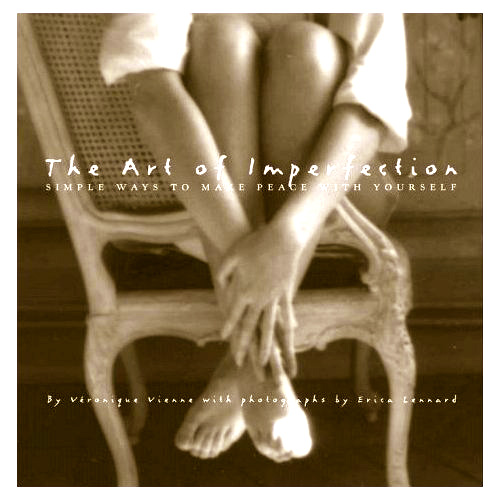
Until this paragraph, words here today are those of another sharedbecause the thoughts are better than any original ones I have this morning.  It is rare to open up a book that grabs my attention so quickly and completely as “The Art of Imperfection” did.  It is even rarer for me to include so much of another writer’s material as I have today.  The borrowed words that fill this blog come directly from the first chapter of the book because I was moved to share what touched me so deeply.   With these thoughts once again I am reminded imperfections are perfect as they are.  They make me who I am; no less; no more.  I am grateful for my “perfectly imperfect” self.  

Kudos go to Veronique Vienne for her meaningful words
and Erica Lennard for her remarkable photography that fill their little,
but very meaningful book titled “The Art of Imperfection”.  

It is as hard to see one’s self
as to look backward without turning around. 
Henry David Thoreau