All Of You Are Right

SAMSUNG DIGITAL CAMERA“Every man takes the limits of his own field of vision for the limits of the world” wrote German philosopher Arthur Schopenhauer. It’s so easy to think my take on things is the clearest view of reality when everyone has their own perspective that is just as valid for them. I learn nothing by regurgitating what I believe to be true, but can have my perception widened by listening to others with an open mind.

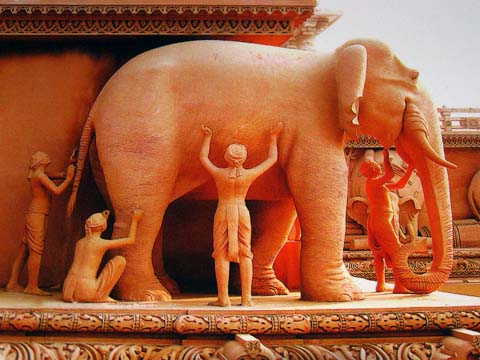
Once upon a time, there lived six blind men in a village. One day the villagers told them, “Hey, there is an elephant in the village today.”

They had no idea what an elephant is. They decided, “Even though we would not be able to see it, let us go and feel it anyway.” All of them went where the elephant was. Everyone of them touched the elephant.

“Hey, the elephant is a pillar,” said the first man who touched his leg.

“Oh, no! it is like a rope,” said the second man who touched the tail.

“Oh, no! it is like a thick branch of a tree,” said the third man who touched the trunk of the elephant.

“It is like a big hand fan” said the fourth man who touched the ear of the elephant.

“It is like a huge wall,” said the fifth man who touched the belly of the elephant.

“It is like a solid pipe,” Said the sixth man who touched the tusk of the elephant.

They began to argue about the elephant and every one of them insisted that he was right. It looked like they were getting agitated. A wise man was passing by and he saw this. He stopped and asked them, “What is the matter?” They said, “We cannot agree to what the elephant is like.” Each one of them told what he thought the elephant was like. The wise man calmly explained to them, “All of you are right. The reason every one of you is telling it differently because each one of you touched a different part of the elephant. So, actually the elephant has all those features that you all said.”

“Oh!” everyone said. There was no more fight. They felt happy that they were all right.

There is much wisdom to gained in allowing room for other viewpoints. Frequently accepting a different point of view does not invalidate mine. It adds to and expands it instead. When I am able to replace my opinion with someone else’s notion of things I mature in knowledge, open-mindedness and my ability for further growth is broadened. I am grateful my beliefs are often shown to me to be true, but just as thankful to find and accept frequently they are not!

Always keep in mind that no single person, place,
or thing can force you to believe or disbelieve anything.
Perhaps this was true when you were a child, but not now.
Now you have the independence to choose what you believe.
Your knowing is yours.
Dr. Wayne W. Dyer

We’re All Just Wandering Souls

1096582075_a6747a9a9fSomething happened yesterday where my feelings became hurt more so than in a long while. I presented myself to another person in a way I thought was honest and caring. My comrade found great offense in what I said. This was unexpected. I thought I had acted in an authentic and thoughtful way. Profusely I apologized for offending him, but my apology was not accepted. Over time I hope it is, but whether acceptance happens or not is out of my hands.

The gist of my thoughts this morning are not about specifically what happened. Rather, I am thinking of the realization once again how pain teaches. A moment’s painfulness can be a positive teaching that lasts for a lifetime. Pain not embraced will carry forward negatively and the clinging will bring only more pain. Learning to feel my pain then giving it the attention it demands has become a rich source of wisdom.

Pain is a great teacher, it constantly reminds us to work on our ego and get back to our presence. Pain is the attention seeking activity of our body, signaling to our mind that we need to pay attention… When we give attention to a particular area, that attention becomes energy for that area which aids in healing it.

The moment we lack attention, then pain invariably happens. Therefore, pain is actually the absence of attention, so the solution to get out of pain is by giving your presence. …if we look deeply within, every pain is because of our internal investment of our ego. Wherever we have invested our ego, we will suffer. Teo Siew Yong http://yourpresenceheals.com/pain-is-a-great-teacher/

Today I feel no animosity toward my friend who reacted with anger toward me. We’re all just wandering souls trying to find our way. The words spoken I found hurtful have been felt and I have moved past them. Mixed in was a piece of truth I needed to hear, no matter how it was presented. And it is that gift of insight I am grateful for.

“Turn towards me”, my pain whispers. “Just for a moment. Do not be afraid. I am made of you.”

“But I don’t know how to turn”, I reply.

Pain responds, “Feel me upon you, relax and fall into me; then my power to hurt you will be made small”.

After being given example after example over time, you’d think I would no longer be impressed at the amount of wisdom to be found in pain. I am grateful to have grown and matured enough to usually be able to embrace pain’s teaching and move on. The still fascinating part is how my accepting pain causes it to depart so quickly.

World’s use is cold,
World’s love is vain,
World’s cruelty is bitter bane;
But pain is not the fruit of pain.
Elizabeth Barrett Browning

Life: One, Two, Three, Four

puzzled dollarOne for the money:

Making money isn’t hard in itself… What’s hard is to earn it doing something worth devoting one’s life to. Carlos Ruiz Zafon

 ~2 Sad-MasksTwo for the show:

Please do not break your heart over the withering of a dream you once held, that never became yours! After all, the shattered dream could have very well been a nightmare and not a dream at all, you wouldn’t really know because you didn’t have it yet! Let the sparks fade, let the flame dim and die, you’ll never know it wasn’t poison. C. Joybell C.

~3 artworks-000010979347-wx4usy-originalThree to make ready:

I eventually came to understand that in harboring the anger, the bitterness and resentment towards those that had hurt me, I was giving the reins of control over to them. Forgiving was not about accepting their words and deeds. Forgiving was about letting go and moving on with my life. In doing so, I had finally set myself free. Isabel Lopez

~4 Join+Lets+go EDITAnd four to go:

Life will break you. Nobody can protect you from that, and living alone won’t either, for solitude will also break you with its yearning. You have to love. You have to feel. It is the reason you are here on earth. You are here to risk your heart. You are here to be swallowed up. And when it happens that you are broken, or betrayed, or left, or hurt, or death brushes near, let yourself sit by an apple tree and listen to the apples falling all around you in heaps, wasting their sweetness. Tell yourself you tasted as many as you could. Louise Erdrich

Accumulated wisdom is plentiful and easy to find. I am grateful for the reminder to not assume I know how to use it from simply reading the words. Only when I take the time to soak up what is said can wisdom offered by others become a help to me. Thank you to all who are and have come before who share their thoughts which help me live better each day. I am grateful for your gifts.

This Is All There Is

P1090385 copyEach person is unique; a completely original work crafted by intention, deeds, heredity, family, choices, fate and forces beyond understanding. And the path we each choose is one of a kind. There are commonalities, but no exact matches. That is as life as always been.

Another’s way of being is perceived through the unique filters my emotional, physical and spiritual experience has given me. While I may assume my perception of someone else is correct, in actuality my views are simply “my vantage point”. No one else seeing another will assess them exactly as I will.

The issue is compounded with the realization no one will ever accurately see me as I inwardly believe myself to be. Without meaning to my actions are seen as a combination of reality and fabrication; truth and untruth; as I am and as I am not.

I may forget an important date, but not its importance.
I may be with one person, wishing I was with another.
I may be one place, wishing I was somewhere else.
I may tell the truth when another is not ready for it.
I may say I don’t care about what matters greatly.
I may let go when all I want to do is hold on tight.
I may tell you one thing while meaning otherwise.
I may do wrong things with the best of intentions.
I may do something when I did not want to do it.
I may go one way yet wish I was going another.
I may see things incorrectly but still see them.
I may be proud of another but unable to say it.
I may say I don’t care, when it matters to me.
I may hurt another although it hurts me more.
I may speak angrily and not be angry at you.
I may not tell you I love you, yet always will.
I may tell a lie to keep from hurting another.
I may hear incorrectly without being wrong.
I may be afraid and not admit it to anyone.
I may do stupid things and not be stupid.
I may wonder and yet have little doubt.
I may act happy when I am really sad.
I may lose my way and not be lost…
Day appearing like night;
Black looking white,
Up appearing down,
“Yes” appearing “No”…
Such are the conflicting opposites of the human experience.
James Browning

I will not meddle when I ask a person “how are you” and they respond “fine” even though I know they are far from being okay. Instead I will cast a one or two sentence silent prayer of hope that spiritual and emotion symmetry comes to that person. No matter how rude, unkind, angry, annoyed, bad-mannered, mad, irate, offensive or vulgar I will do my best to send sincere wishes the offender finds peace and understanding.

I am far from virtuous enough to always send good wishes to a person provoking me based purely on the benefit to another. When I can see no other way I cast my positive thoughts for someone for selfish reasons knowing that whatever I put into the world comes back to me multiplied. If I am understanding, I will be understood. If I am compassionate, others will be for me and so on. I am grateful for my thoughts this morning that will, at least for a time, make my deeds a little closer match for my intentions.

Live with intention. Walk to the edge.
Listen Hard. Practice wellness.
Play with abandon. Laugh.
Choose with no regret.
Appreciate your friends.
Continue to learn.
Do what you love.
Live as if this is all there is.
Mary Anne Radmacher

Snips and Snails and Puppy-Dog Tails

77f3My boyhood memories that are predominately good are those from before the age of seven. Then life was filled with awe, joy and wonder. The painful realities from the adult world had not touched my little brother and me yet.

Clearly I recall a yellowed newspaper clipping my Mother kept with other keepsakes in a little cedar box up high on her chest-of-drawers. Enough times to imprint it on my brain she got it out and read it when I was little (more than once due to my insistence). I mentally filed the memory away titled “What are little boys made of…” although poem talked about girls and others.

In years since, frequently I am come across bits and pieces of the poem and searched without luck for a full version. Purely by chance this morning I stumbled across what appears to be the poem in complete form. I became so happy and excited, I just had to share it here.

What are little babies made of, made of?
What are little babies made of?
Diapers and crumbs and sucking their thumbs;
That’s what little babies are made of?

What are little boys made of, made of?
What are little boys made of?
Snips and snails and puppy-dog tails;
That’s what little boys are made of.

What are little girls made of, made of?
What are little girls made of?
Sugar and spice and everything nice;
That’s what little girls are made of.

What are young men made of, made of?
What are young men made of?
Sighs and leers and crocodile tears;
That’s what young men are made of.

What are young women made of, made of?
What are young women made of?
Rings and jings and other fine things;
That’s what young women are made of.

What are our sailors made of, made of?
What are our sailors made of?
Pitch and tar, pig-tail and scar;
That’s what our sailors are made of.

What are our soldiers made of, made of?
What are our soldiers made of?
Pipe clay and drill, the foeman to kill;
That’s what our soldiers are made of.

What are our nurses made of, made of?
What are our nurses made of?
Bushes and thorns and old cow’s horns;
That’s what our nurses are made of.

What are our fathers made of, made of?
What are our fathers made of?
Pipes and smoke and collars choke;
That’s what our fathers are made of.

What are our mothers made of, made of?
What are our mothers made of?
Ribbons and laces and sweet pretty faces;
That’s what our mothers are made of.

What are old men made of, made of?
What are old men made of?
Slippers that flop and a bald-headed top;
That’s what old men are made of.

What are old women made of, made of?
What are old women made of?
Reels, and jeels, and old spinning wheels;
That’s what old women are made of.

What are all folks made of, made of?
What are all folks made of?
Fighting a spot and loving a lot,
That’s what all folks are made of.

Attributed to Robert Southey (1774-1843): Southey, English poet and historian.
In familiar folk tradition, the popular ditty inevitably acquired additional verses,
written by authors unknown, until it became a ballad of some length.
Composited by Gloria T. Delamar in “Mother Goose: From Nursery to Literature”

I am beaming with gratitude this morning for a “golden oldie” memory from my childhood freshly awakened.

Memories of childhood
were the dreams that stayed
with you after you woke.
Julian Barnes

All These Things and More

6009209406_97be00d284_zIf my heart could be seen as living space it would be similar to the room above;

well used, a bit worn and even abused, but more than serviceable.

My heart…

…has become dusty from years of use

but is a safe place to be.

…has seen the ravages of time and grief

but loves better than it was ever able to before.

…has pieces of the past strewn all around

but plenty of safe space for feelings remain.

…has the grime and dirt of time all over it

but a joy for living lies brightly inside still.

…has a foundation of the spirit and soul that is strong

but with humility that has made room for more.

…has a window glazed with time from the inside

but light passes through softer because of it.

…has dark corners that linger and always will hang there

as scars covering pain; the teacher, that taught me well.

…has broken things within that will always remain

but they are no hindrance for love to have residence there.

Beat-up, tired,
broken, weary,
cluttered, soiled,
jaded, dark…
Alive, durable,
wise, strong,
healthy,
resilient,
passionate…

All these things and more describe the condition of my heart. It is capable of deep and more sustainable love of all kinds than ever before. To be grateful for the good that has been and yet will come, I also must have gratitude for the difficult and trying times that also helped grow my heart into the healthy state it is today.

Suffering has been stronger
than all other teaching,
and has taught me to understand
what your heart used to be. I
have been bent and broken,
but – I hope – into a better shape.
From “Great Expectations”
by Charles Dickens

Keep Practicing the Art of Living

viktor-franklIn a little more than two weeks we arrive upon the 108th anniversary of birth for Austrian neurologist and psychiatrist, Dr. Viktor Emil Frankl, MD, PhD (March 26, 1905 – September 2, 1997). I did not read his renowned work “Man’s Search for Meaning” until about ten years and remember vividly how that little book stunned me with its simplicity and wisdom. In honor of the man and the teachings he left behind, what is just below is taken from an article published in the New York Times on the day Dr. Frankl died sixteen years ago.

Viktor Frankl’s mother, father, brother and pregnant wife were all killed in the camps. He lost everything, he said, that could be taken from a prisoner, except one thing: ”the last of the human freedoms, to choose one’s attitude in any given set of circumstances, to choose one’s own way.”

Every day in the camps, he said, prisoners had moral choices to make about whether to submit internally to those in power who threatened to rob them of their inner self and their freedom. It was the way a prisoner resolved those choices, he said, that made the difference.

In ”Man’s Search for Meaning,” Dr. Frankl related that even at Auschwitz some prisoners were able to discover meaning in their lives — if only in helping one another through the day — and that those discoveries were what gave them the will and strength to endure.

After their arrival at Auschwitz, they and 1,500 others were put into a shed built for 200 and made to squat on bare ground, each given one four-ounce piece of bread to last them four days. On his first day, Dr. Frankl was separated from his family; later he and a friend marched in line, and he was directed to the right and his friend was directed to he left — to a crematory.

As their illusions dropped away and their hopes were crushed, they would watch others die without experiencing any emotion. At first the lack of feeling served as a protective shield. But then, he said, many prisoners plunged with surprising suddenness into depressions so deep that the sufferers could not move, or wash, or leave the barracks to join a forced march; no entreaties, no blows, no threats would have any effect. There was a link, he found, between their loss of faith in the future and this dangerous giving up.

”We had to learn ourselves, and furthermore we had to teach the despairing men, that it did not matter what we expected from life, but rather what life expected from us,” he wrote. ”We needed to stop asking about the meaning of life but instead to think of ourselves as those who were being questioned by life, daily and hourly.

”Our answer must consist not in talk and medication, but in right action and in right conduct. Life ultimately means taking the responsibility to find the right answer to its problems and to fulfill the tasks which it constantly sets for each individual.”

Prisoners taught one another not to talk about food where starvation was a daily threat, to hide a crust of bread in a pocket to stretch out the nourishment. They were urged to joke, sing, take mental photographs of sunsets and, most important, to replay valued thoughts and memories. Dr. Frankl said it was ”essential to keep practicing the art of living, even in a concentration camp.” By Holcomb B. Noble http://www.nytimes.com/1997/09/04/world/dr-viktor-e-frankl-of-vienna-psychiatrist-of-the-search-for-meaning-dies-at-92.html?pagewanted=all&src=pm

When difficulty comes, I try to remember the insights Dr. Frankl left for us distilled in his quote, “Those who have a ‘why’ to live, can bear with almost any ‘how’. Dr. Frankl’s book, has been deeply meaningful to me and millions of others. I am grateful he left the world a better place than he found it.

Being tolerant does not mean
that I share another ones belief.
But it does mean I acknowledge
another ones right to believe,
and obey, his own conscience.
Victor E. Frankl

Who Am I?

welcome_to_the_good_life_by_CYWORLDThe following taken from words spoken almost a hundred years ago by twentieth-century Indian Guru Sri Ramana Maharshi is heady stuff and took me a few reads to let it soak it.

Every living being longs to be perpetually happy, without any misery. Since in everyone the highest love is alone felt for oneself, and since happiness alone is the cause of love, in order to attain that happiness, which is one’s real nature and which is experienced daily in the mindless state of deep sleep, it is necessary to know oneself. To achieve that, enquiry in the form ‘Who am I?’ is the foremost means. ‘Who am I?’ The physical body… is not ‘I’. The five sense organs… and the five types of perception known through the senses… are not ‘I’. The five… vital functions such as respiration, are not ‘I’. Even the mind that thinks is not ‘I’. Devoid of sensory knowledge and activity, even this [state] is not ‘I’. After negating all of the above as ‘not I, not I’, the knowledge that alone remains is itself ‘I’. The Self, one’s real nature, alone exists and is real.

What I end up with in boiling down the Guru’s line of thinking is: when everything I think, feel or can do is stripped away, it is there “I” am to be found. It is only then when I am in touch with the essence of myself can I be truly happy. I get it and am grateful for light into my understanding. It is in the letting go; letting go of everything, where “I” am to be discovered.

We carry within us
the wonders we seek
without us.
Eric Butterworth

Jumping To Conclusions

Dont-Judge-a-Book-By-Its-CoverRecently I caught myself red-handed with a large case of mistaken impression. My first thoughts about someone turned out to be negative for no reason or fact. The judge and jury in my mind went to work and jumped to a completely wrong conclusion. Simply I added 2 plus 2 and came up with a total of 13. Wrong… wrong!

Jumping to conclusions is a type of negative thinking pattern, known as cognitive distortions. Cognitive distortions are habitual and faulty ways of thinking that are common among people who struggle with depression and anxiety. Theories of cognitive therapy claim that we are what we think we are. When a person is jumping to conclusions, they are drawing negative conclusions with little or no evidence to their assumptions.

Jumping to conclusions can occur in two ways: mind-reading and fortune-telling. When a person is “mind-reading” they are assuming that others are negatively evaluating them or have bad intentions for them. When a person is “fortune-telling,” they are predicting a negative future outcome or deciding that situations will turn out for the worst before the situation has even occurred. http://panicdisorder.about.com/od/livingwithpd/tp/Jumping-To-Conclusions.htm

There’s a song that says “…it ain’t necessarily so,” and it certainly isn’t. How often we accept someone’s casual remarks as fact. Even appearances can be misleading. But knowing this, we still have a tendency to take a threat and build a yard of cloth.

It makes all the different in the world what we believe. To simply accept an opinion, even our own when hastily formed indicates a lack of sound thought.

We sometimes have the failing of believing everything we hear. But it is far wiser to know, with certainty, the facts about a teaching by looking at its followers.

The eyes and ears of our hearts and spirits are often more accurate in determining right from wrong than we can expect from normal hearing and seeing. From the book “Think On These Things” by Joyce Sequichie Hifler

A simple case of judging a book by its cover; of jumping to conclusions, then realizing it was a wake up call. The message received was to remain a humble student of life. No matter how wise I become I am still very much human and possibly fallible at every turn. Seeking knowledge and working to be a better person, will never bring anything even close to perfection. Sometimes I become a little too self-impressed. I am grateful for the reminder from the school of life.

Good judgment comes from bad experience.
Unfortunately,
most of that comes from bad judgment.
Tara Daniels

Wisdom Accumulated Slowly

jamesappleton04Once upon a time living felt mostly like an endless obligation to have a place to live, a car to drive, food to eat, money to spend and to take care of others. Although it often appears a break through insight comes quickly, usually it is actually wisdom accumulated slowly but fully realized in a moment. How true my perspective of being alive matches that process. From a life of obligated responsibility, to a true gift realized has been my path.

What I am obligated to has not changed much. But existance is far more than an endless list of “have to’s”. Instead I am pulled forward by the possibilities of life, for as long as I live they are endless. Thankfully, gone are those days when living felt mostly like a burden.

to love life, to love it even
when you have no stomach for it
and everything you’ve held dear
crumbles like burnt paper in your hands,
your throat filled with the silt of it.
When grief sits with you, its tropical heat
thickening the air, heavy as water
more fit for gills than lungs;
when grief weights you like your own flesh
only more of it, an obesity of grief,
you think, How can a body withstand this?
Then you hold life-like a face
between your palms, a plain face,
no charming smile, no violet eyes,
and you say, yes, I will take you.
I will love you, again.
“The Thing Is” by Ellen Bass
From book ” From The Courage to Heal”

Today I love my life In a deeper way I never knew until recent years. There is something about accepting mortality that makes living far more valuable. Being old enough to have witnessed the cycle of life from birth to death many times takes away youth’s fantasy of living forever. Those words are written not with morbidly shaped thoughts, but rather with a perspective shaded with realness that makes being alive all the more precious. For every second, minute, hour, day, week, month, year and decade of my days, gratitude is deeply resident within.

You’ve got to take the good with the bad,
smile with the sad, love what you’ve got,
and remember what you had.
Always forgive, but never forget.
Learn from mistakes, but never regret.
Unknown