12 Steps To Third World Living

Del302915

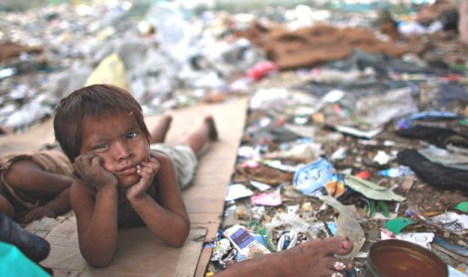
It generally is very difficult for Americans… to comprehend the realities of daily life for the billion-plus people who constitute “the poorest of the poor.” For these people, the question “What Is Enough?” has a very different meaning.

This little exercise – adapted from the U.N. Food and Agriculture Organization’s magazine Freedom from Hunger, and based on excerpts from The Great Ascent by Robert L. Heilbroner (New York Harper & Row, 1963) – may help to get you in touch with the reality of life in the shadows cast by our relative wealth.

* First, take out the furniture: leave a few old blankets, a kitchen table, maybe a wooden chair. You’ve never had a bed, remember?

* Second, throw out your clothes. Each person in the family may keep the oldest suit or dress, a shirt or blouse. The head of the family has the only pair of shoes.

* Third, all kitchen appliances have vanished. Keep a box of matches, a small bag of flour, some sugar and salt, a handful of onions, a dish of dried beans. Rescue those moldy potatoes from the garbage can: those are tonight’s meal.

* Fourth, dismantle the bathroom, shut off the running water, take out the wiring and the lights and everything that runs by electricity.

* Fifth, take away me house and move the family into the tool shed.

* Sixth, by now all the other houses in the neighborhood have disappeared; instead there are shanties – for the fortunate ones.

* Seventh, cancel all the newspapers and magazines. Throw out the books. You won’t miss them – you are now illiterate. One radio is now left for the whole shantytown.

* Eighth, no more postman, fireman, government services. The two-classroom school is 3 miles away, but only 2 of your 7 children attend anyway, and they walk.

* Ninth, no hospital, no doctor. The nearest clinic is now 10 miles away with a midwife in charge. You get there by bus or bicycle, if you’re lucky enough to have one.

* Tenth, throw out your bank books, stock certificates, pension plans, insurance policies. You now have a cash hoard of $5.

* Eleventh, get out and start cultivating your three acres. Try hard to raise $300 in cash crops because your landlord wants one-third and your moneylender 10 percent.

* Twelfth, find some way for your children to bring in a little extra money so you have something to eat most days. But it won’t be enough to keep bodies healthy – so lop off 25 to 30 years of life. http://www.context.org/iclib/ic26/3rdwrld/

Generally I consider myself a grateful and positive person. However, regularly something like the article above crosses my path and serves as a wake up call to how very fortunate I am. The more grateful I become the more I find to be thankful for. In this holiday season of plenty I am humbled by the ‘wealth’ life has afforded me.

We can only be said to be alive
in those moments when our hearts
are conscious of our treasures.
Thornton Wilder
Carry on, Santa, it’s Christmas Day, All Secure…

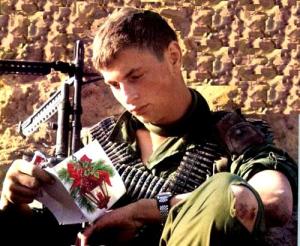
MilitaryXmasReadily I admit I fought through watery eyes to get this retyped here. Though I did not serve in the military, I have known many good men and women who did. While the poem was written specifically by a Marine for Marines, I have placed it here as a tribute to all military men and women, past and present. I honor and thank you. By your efforts I am able to celebrate Christmas quietly and without fear.


“Merry Christmas, My Friend”
T’was the night Before Christmas, he lived all alone,
In a one bedroom house made of plaster and stone.

I had come down the chimney with presents to give
and to see just who in this home did live.

I looked all about, a strange sight did I see,
no tinsel, no presents, not even a tree,
No stockings by the mantle, just boots filled with sand,
On the wall hung pictures of a far distant land.

With medals and badges, awards of all kinds,
a sobering thought soon came to my mind.
For this house was different, unlike any I’d seen,
This was the home of a U.S. Marine.

I heard stories about them, I had to see more
so I walked down the hall and pushed open the door.
And there he lay sleeping, silent, alone,
Curled up on the floor in his one-bedroom home.

He seemed so gentle, his face so serene,
Not how I pictured a U.S. Marine.
Was this the hero, of whom I’d just read,
Curled up in his poncho, a floor for his bed?

His head was clean-shaven, his weathered face tan,
I soon understood this was more than a man.
For I realized the families that I saw that night
owed their lives to these men, who were willing to fight.

Soon around the Nation, the children would play,
And grown-ups would celebrate on a bright Christmas day.
They all enjoyed freedom, each month and all year,
because of Marines like this one lying here.

I couldn’t help wonder how many lay alone
on a cold Christmas Eve, in a land far from home.
Just the very thought brought a tear to my eye
I dropped to my knees and I started to cry.

He must have awoken, for I heard a rough voice,
“Santa, don’t cry, this life is my choice.
I fight for freedom, I don’t ask for more.
My life is my God, my country, my Corps.”

With that he rolled over, drifted into sleep
I couldn’t control it, I continued to weep.

I watched him for hours, so silent and still
I noticed he shivered from the cold nights chill.
I took off my jacket, the one made of red,
and I covered this Soldier from his toes to his head.
Then I put on his T-shirt of scarlet and gold,
with an eagle, globe and anchor emblazoned so bold.
And although it barely fit me, I began to swell with pride,
and for one shining moment, I was Marine Corps deep inside.

I didn’t want to leave him so quiet in the night,
this guardian of honor so willing to fight.
But half asleep he rolled over and in a voice clean and pure,
said, “Carry on, Santa, it’s Christmas Day, all secure.”
One look at my watch and I knew he was right
Merry Christmas my friend, Semper Fi and good night.

Although attributed to many and often amended, what I have included here is the original poem in its original form written by James M. Schmidt in 1986. In December 2002, he set the record straight about the poem’s origin when he wrote “The true story is that while a Lance Corporal serving as Battalion Counter Sniper at the Marine Barracks 8th and I, Washington, DC, under Commandant P.X. Kelly and Battalion Commander D.J. Myers, I wrote this poem to hang on the door of the Gym in BEQ. When Colonel Myers came upon it, he read it and immediately had copies sent to each department at the Barracks and promptly dismissed the entire battalion early for Christmas leave. The poem was placed that day in the Marine Corps Gazette, distributed worldwide and later submitted to Leatherneck Magazine”.

Please share this blog with others in honor of our veterans and soldiers.

From the bitter cold winter at Valley Forge,
to the mountains of Afghanistan and the deserts of Iraq,
our soldiers have courageously answered when called,
gone where ordered, and defended our nation with honor.
Solomon Ortiz

Posted originally on Christmas 2012

With Open Eyes

butt collector

One day last week the streets around the Super Wal-Mart were clogged with cars much like ants swarming from a ‘stomped-on-anthill’. Inwardly lost in my own thoughts about what I needed to buy and yet had to do, my view of things was narrow and self oriented.

As I walked toward the entrance of the store, out of the corner of my eye I saw a man kneeling down picking something up. From the back his clothes were kind of dirty and there we sores on his head. Fairly quickly I  surmised he was somewhere between down on his luck and homeless. As I moved into present moment awareness, it hit me what he was doing.

The cover was off a large cigarette disposal and the man was selectively gathering partially smoked butts. He’d pick up each used cigarette, glance to see how much was left and then put the ones with a few puffs left into a ‘baggie’. I quickly took a single phone photo (just above) just after he stood up and began to place the top back on the container.

Being a smoker is in my past. I remember the cravings that once in a while caused me scour my ashtrays for a cigarette butt with a few puffs remaining. Only once in a while did that happen and only until I could get to the store to buy a fresh pack. The guy collecting from the Wal-Mart ashtray was gathering the only smokes he could afford: free butts. Smoking is a bad habit; no doubt. I feel sorry for anyone who still smokes, but even more so for someone who has to collect what has been in other’s mouths to satisfy his habit.

In this season of giving, the wish I send out to the ‘butt collector’ is one of love and good wishes that life improves for him. But then, maybe he was an angel sent to make me more present, aware and rooted in ‘now’. Or possibly he was both destitute and angelic. I’ll never know for certain, but will long remember what he left me with.

All that’s needed to elevate my level of gratitude is pay attention. With open eyes there is always something to behold that reminds me how good my life is. In recollecting my most difficult times and bearing witness to those of others, I find reflections that make me better grasp the richness I am blessed with today.

And hard times are good in their own way, too.
Because the only way you can achieve true happiness
is if you experience true sadness as well.
It’s all about light and shade.
Balance.
Gabrielle Willams

I’m Happy

happiness-222

An interesting personal phenomena is the happier I have become, the more I understand what makes me happy. Living for years with a somewhat disgruntled attitude while searching for happiness never brought me closer to being happy. Only deep personal growth and an altered view of life allowed me to find it.

Researchers at the University of Minnesota have tracked identical twins who were separated as infants and raised by separate families. As genetic carbon copies brought up in different environments, these twins are a social scientist’s dream, helping us disentangle nature from nurture. These researchers found that we inherit a surprising proportion of our happiness at any given moment — around 48 percent.

If about half of our happiness is hard-wired in our genes, what about the other half? It’s tempting to assume that one-time events — like getting a dream job or an Ivy League acceptance letter — will permanently bring the happiness we seek. And studies suggest that isolated events do control a big fraction of our happiness — up to 40 percent at any given time.

But while one-off events do govern a fair amount of our happiness, each event’s impact proves remarkably short-lived. People assume that major changes like moving to California or getting a big raise will make them permanently better off. They won’t. Huge goals may take years of hard work to meet, and the striving itself may be worthwhile, but the happiness they create dissipates after just a few months. So don’t bet your well-being on big one-off events. The big brass ring is not the secret to lasting happiness.

That leaves just about 12 percent. That might not sound like much, but the good news is that we can bring that 12 percent under our control. It turns out that choosing to pursue four basic values of faith, family, community and work is the surest path to happiness, given that a certain percentage is genetic and not under our control in any way. The first three are fairly uncontroversial. Empirical evidence that faith, family and friendships increase happiness and meaning is hardly shocking. Few dying patients regret over-investing in rich family lives, community ties and spiritual journeys.

Work, though, seems less intuitive. Popular culture insists our jobs are drudgery, and one survey recently made headlines by reporting that fewer than a third of American workers felt engaged; that is praised, encouraged, cared for and several other gauges seemingly aimed at measuring how transcendently fulfilled one is at work.

More than 50 percent of Americans say they are “completely satisfied” or “very satisfied” with their work. This rises to over 80 percent when we include “fairly satisfied.” This shouldn’t shock us. Vocation is central to the American ideal, the root of the aphorism that we “live to work” while others “work to live.” When Frederick Douglass rhapsodized about “patient, enduring, honest, unremitting and indefatigable work, into which the whole heart is put,” he struck the bedrock of our culture and character. From an article by Arthur C. Brooks http://www.nytimes.com/2013/12/15/opinion/sunday/a-formula-for-happiness.html?_r=0

With great gratitude I can say, “I’m happy”. While there are purely joyous moments now, I don’t exist in a constantly blissful bubble. Instead, I simply choose not to have “bad days” any more. Difficult ones certainly, but never a “bad one”. Any day alive is a “good day”. The best lives ever lived contained “a great deal of joy and happiness with a lot of heartache and grief mixed in”. Coming to see the wisdom of that statement and living it has been life changing.

The difference between a Good day and a Bad day
has less to do with the circumstances
than the power we have over our thoughts.
Neil Sutton

A Little Positive Trail Behind Me

1`1 tumblr_m4h1l9vcq31r837ebo1_500

The innocence of a child can be especially touching. For me that’s true partly because some of my innocence was stolen as a kid and partially because living has softened me over time. While the story below is just that, a “story”, it illustrates how naively wise children can be.

A little boy wanted to meet God. He knew it was a long trip to where God lived. So he packed a backpack with Twinkies and six-pack of pop, then started his journey. When he had gone about three blocks, he met an old man with a flowing beard, sitting on a bench in the park just staring at some pigeons.

The boy sat down next to him and opened his bag. He noticed that the old man looked hungry. So he offered him a Twinkie. The old man gratefully accepted it and smiled at the boy.

His smile was so pleasant that the boy wanted to see it again. So he offered him a can of pop. The old man smiled again. The boy was delighted! They sat there all afternoon eating and smiling but never said a word.

As it started growing dark, the boy realized how tired he was and got up to leave. But before he had gone few steps, he turned around and gave the old man a hug. The old fellow gave the boy a big bright smile.

A short while later when the boy opened the door of his house his mother was surprised by the look of joy on his face. She asked him, “What did you do today that make you so happy?” He replied, “I had lunch with God”. But before his mother could respond, he added, “You know, He’s got the most beautiful smile I have ever seen”.

Meanwhile, the old man, radiant with joy, returned home. His son was stunned by the look of peace on his face and asked, “Dad, what did you do today that makes you so happy?”

He replied, “I ate Twinkies in the park with God”. And before his son could respond, he added, “He is so much younger than I expected”.

As the holidays approach I am grateful for a polishing of the sensitivity of my heart that parable gives me. I hope the refreshed shine makes me a bit more open to the humanity of others and helps me to show mine to them. To leave something of a positive trail behind me is my highest aspiration.

I am only one, but still I am one.
I cannot do everything,
but still I can do something;
and because I cannot do everything,
I will not refuse to do something that I can do.
Edward Everett Hale

First posted on November 16, 2012

Riddle: “Who Am I?”

Chain%20of%20supply

The following ‘riddle’ was written by an anonymous writer. The answer did not automatically come for me when I read it, but the solution made perfect sense once I got to the bottom. I encourage you to give it a try (the answer is at the very bottom of this blog entry).

I am your constant companion.

I am your greatest helper or heaviest burden.

I will push you onward or drag you down to failure.

I am completely at your command.

Half of the things you do you might as well turn over
to me and I will do them – quickly and correctly.

I am easily managed – you must be firm with me.

Show me exactly how you want something done
and after a few lessons, I will do it automatically.

I am the servant of great people, and alas,
of all failures as well.

Those who are great, I have made great.

Those who are failures, I have made failures.

I am not a machine though I work with the precision
of a machine plus the intelligence of a person.

You may run me for profit or run me for ruin,
it makes no difference to me.

Take me, train me, be firm with me,
and I will place the world at your feet.

Be easy with me and I will destroy you.

Who am I?

The best of these I have kept. A good bit of the worst I have shed or else diminished their impact. I am grateful to be the person I have deliberately grown into and the one I was led to be. (riddle answer below the Gandhi quote below)

Your beliefs become your thoughts,
Your thoughts become your words,
Your words become your actions,
Your actions become your habits,
Your habits become your values,
Your values become your destiny.
Mahatma Gandhi

I am Habit.

Seeing Beyond Just Looking

old couple in woods

I have no certainty where exactly I got the idea.  It may have been from something I read or several things I came across blended together.  It may have even been a spontaneous realization.  But in the last 10 years I have learned to “see beyond just looking”.  I can’t do it all the time.  Actually that is probably impossible for a human being.  If I could I suspect I’d end up over dosed in goodness like Woody Allen was with the “orb” in the movie Sleeper.  Seeing beyond looking does happen for me frequently and the more I intentionally try the more frequent the activity comes without thought or effort.

My discovery was I mostly only acknowledged what came into view.  I walked without really noting  what was right before me.  Mine was a bad habit of hardly never really “truly seeing” much of anything.  My mind seemed to always be racing forward thinking about where I was going, what I had to do and what issues I needed to deal with.  Or else, I was looking backwards trying to solve some past emotional riddle or find some meaning in an episode of life I wanted an explanation for.

What I began to do, inconsistently at first, was to just stop and really take in visually what I was looking at.  There was amazement the first intentional time I took 30 seconds to study a beautiful tulip, to see its unique form and texture and to take in its vibrant red color.  I was stunned to look and see so much always detail missed before.  It was during the early times of having these experiences with intention when I noticed how beautifully blue the sky really is (which is still one of my favorites to marvel at).

How touched I became when I locked my vision on an elderly couple watching the man help the fragile woman out of the car and attending to her to get into a restaurant.  Eating at the same place as they were I watched the smiles they exchanged while eating and from a distance the conversation they were having.  I saw a couple deeply in love just moving in slow motion;  true romance at half speed.  Without looking closely I would have dismissed them mentally as “old people” and hardly noticed them at all.

I found delight in watching a toddler in a park giggling wildly while chasing a grasshopper like it was the greatest find of the year.  Truly sitting and watching birds through a window enjoy a feast of crumbled bread I put out for them on top of a big snow allowed me to notice the quirky uniqueness of each breed and what appeared to be joy in the abundance they had found.  And then there is nature!  A walk in the woods or a park became a sensory banquet.

When was the last time you sat and watched a sunset or sunrise?  When was the last time you actually “saw” a person instead of just looking at them.  How long since you gazed in a mirror and actually saw yourself instead of just acknowledging your reflection?  How long has it been since you focused on something to the point to where you found sheer delight in what you were looking at?  For me I am glad to say “no long ago”.   I am grateful to have stumbled across this activity and to have cultivated the habit.  As time passes with consistent effort I find I am able to more truly see with greater depth and frequency.  If life is a feast, then this is the seasoning for the meal.

Taken from “Seeing Past Myself” – Don Iannone

Sometimes I have trouble
Seeing past myself
Blindsided by who I think I am
…oblivious
To the vast world of possibilities…
I clean my glasses twice a day
Unfortunately it’s to see what I want to see
And not beyond that
I guess I’m no different –
Than you, or anyone else.
My self-image directs my eyes.
There’s a solution you know
It’s not as hard as we think
Open our hearts to unknown possibilities
Accept that our version of reality
Is but one of many out there.

The real voyage of discovery consists of not in
seeking new landscapes but in having new eyes.
Marcel Proust

First Posted on May 25, 2011

A State of Being

miracle of gratitude

Today I chose just “to be”… and took a day off. Hope your Monday went well, and if it didn’t I hope you found ample strength to cope with what came your way.

We think we have to do something to be grateful
or something has to be done in order for us to be grateful,
when gratitude is a state of being.
Iyanla Vanzant

“Three Good Things”

Once upon a time I believed achieving happiness was the purpose of my life.  Experience has since taught the pursuit of happiness actually leads to a good deal of unhappiness.  My vantage point of today tells me happiness is actually a consequence of a very different pursuit in life – the pursuit of the evolution of my ability to love myself and others.

In days past my pursuit of happiness has included many different, but unsuccessful approaches including:

1. The pursuit of momentary pleasure drove me for a long while during the time when I believed happiness was the same as pleasure.  It took empty experience over decades to teach me that sex is not happiness nor is sex love.

2. The pursuit of money, the control it gives and the things money can buy was a catalyst for achievement for much of my adult life.  I thought having then what I did not have as a child would fill in some missing parts within.  Once I had an over abundance I found I felt more hallow than even before.

3.  I realize now my pursuit of happiness included a burning need to be valued as a human being by others.  My childhood environment provided almost none of that reinforcement and instead I felt a need to impress others, to be admired and thought well of.  In that thinking my happiness was attached to what others thought as I attempted to get love, attention and admiration in an impossible way.

Today the fact rings true within that true happiness is not the result of DOING, but of a way of BEING. Rather than being a result of the momentary pleasures or money or even other people, it is the result of my intention to evolve daily as a loving human being.

As a further aid in my positive evolution I am cultivating a new habit.  Each morning I focus on what I am grateful for and ask myself “what three good things happened yesterday”.  This practice comes directly from the book “Flourish” by Martin Seligman whose work I admire and has found a great help to me personally.

Anytime I focus on what I am thankful for and get away from what I wish were different, my life experience improves.  And the more I do that, the greater and more lasting the improvement is. “What three good things” is a simple method of redirecting attention towards positive thoughts and away from negative thinking. It works wonders for me.

We human beings evolved spending much more time thinking about negative experiences and possibilities than positive ones. That’s what kept us safe in the wild and from becoming some animal’s lunch.  Starting when we lived in caves the instinct was strong to spend a lot of time thinking about what could go wrong and how to avoid it.  Once upon a time there was an evolutionary advantage to this dominant way of thinking, but for modern humans this negative bias is a source of a lot of anxiety, depression, and general lack of wellbeing.  Luckily, by re-directing my thoughts intentionally towards positive events, I have found I can do a lot to correct this negative bias.

Dr. Deborah Barnett, Ph.D. writes the “3 Good Things” exercise, also known as the “3 Blessings” exercise, is a great Positive Psychology technique that has been well-tested. It has been shown to increase well-being and decrease depression and anxiety. Martin Seligman, Ph.D., conducted a study using this exercise. The results were that 94% of very depressed people became less depressed and 92% became happier in 15 days. Furthermore, the results lasted for at least 6 months.

“The good things” is simple to do.  Each morning soon after I first get up I pick out 3 things that went well the previous day (many prefer to do this in the evening at the end of the day).  In just a few words I write down three events or experiences that went well and why they went well or what felt good about the experiences. I’ve learned what I choose does not have to be spectacular or dramatic.  Something as simple as being grateful for the sweet strawberries at dinner, appreciating a cool, misty morning or a call from a good friend the night before are good examples of simple, but meaningful reasons for me to be grateful.

Growing my awareness of gratitude has been a profound life-changer.  Always I felt I was thankful, but looking back now I realize before I spent 90% or more of my time focused on what needed to be improved, what needed to change, what I needed to be wary of, what had gone wrong or what might go wrong.  While I can’t say the percentage has reversed to be vastly all gratitude, there is balance now.  My life today contains at least as much thankfulness and well-being as it does worry and anxiety.   I am grateful for my gratitude!

If you don’t get everything you want,
think of the things you don’t get that you don’t want
Oscar Wilde

Free download of “3 good things” log page show in image at top.  No strings attached.
http://papernstitchblog.com/wp-content/uploads/2011/06/3goodthingslist1.pdf

Originally Posted here on October 27, 2011


The Occupation of Childhood

Happy child with painted hands

Play is the most important activity in the lives of children.
Sometimes it seems more important than eating and sleeping.
Sometimes play is easy and fun.
Sometimes play is trying hard to do something right.
Play is the work, the occupation of childhood.
L.S. Lagoni

The ‘occupation of childhood’ is just as important to adults, but most of us have lost that knowledge in responsibility, ‘real work’, worry and generally being grownups. It’s been more than a decade since I had playtime regularly with my son as he grew up. I had nearly forgotten the joy of playing and how healthy it is.

Scoff at the thought of playing with finger paint, coloring in a coloring book or making a collage from magazine cut-outs for no particular purpose if you want. You don’t know what you’re missing. A unique and artistic friend and I got together for ‘playtime’ yesterday. We had planned to make collages for a couple of months, but our adult lives gave us excuses to kept it from happening.

We warmed up with finger paints and then moved on to the serious business of cutting pieces that moved us from magazines for our collages. It was interesting that the longer we did that, the quieter we became; each intently focused on finding just the right things to cut out. As we were scissoring stuff from the pages, each was understood completely in the moment by the other. Without speaking hardly a word it was clear between she and I that what we were doing was not just for children. This was serious and meaningful business for grownups: PLAY! We were doing the simple, enjoying the uncomplicated while being completely at home with each other and enjoying the ‘Now’. How very cool!

Play is simultaneously a source of relaxation and stimulation for the brain and body. A sure (and fun) way to develop your imagination, creativity, problem-solving abilities, and mental health is to play with your romantic partner, office-mates, children, grandchildren, and friends.

Play is often described as a time when we feel most alive, yet we often take it for granted and may completely forget about it. But play isn’t a luxury—it’s a necessity. Play is as important to our physical and mental health as getting enough sleep, eating well, and exercising. Play teaches us how to manage and transform our “negative” emotions and experiences. It supercharges learning, helps us relieve stress, and connects us to others and the world around us. Play can also make work more productive and pleasurable.

Despite the power of play, somewhere between childhood and adulthood, many of us stop playing. We exchange play for work and responsibilities. When we do have some leisure time, we’re more likely to zone out in front of the TV or computer than to engage in creative, brain-stimulating play. By giving ourselves permission to play with the joyful abandon of childhood, we can continue to reap its benefits throughout life. http://www.helpguide.org/life/creative_play_fun_games.htm

Thanks for the play-day K.! It was big fun and the positive effects are still bouncing within now a day later. My collage (below) is still hanging up in the kitchen. I still don’t have a clue what it means, but know what I randomly chose and glued down speaks from my heart and soul. Maybe it all has no meaning except I was able to feel contented like a child. And that’s a huge gift. How wonderful to feel seven years-old again!

What do most Nobel Laureates, innovative entrepreneurs, artists
and performers, well-adjusted children, happy couples and families,
and the most successfully adapted mammals have in common?
They play enthusiastically throughout their lives.
Stuart Brown

IMG_1874CLOSE