Richly Blessed

Region Capture image 96

Teeth are always in style.
Dr. Seuss

Oral disease has been a problem for humans since the beginning of time. Skulls of the Cro-Magnon people, who inhabited the earth 25,000 years ago, show evidence of tooth decay.

“Things have certainly changed from the Middle Ages to the early 1700s, when most dental therapy was provided by so-called ‘barber surgeons‘,” said Academy of General Dentistry spokesperson Eric Curtis, DDS, renowned dental historian. “These jacks-of-all-trades would extract teeth and perform minor surgery, in addition to cutting hair, applying leeches and performing embalming.”

Dental practitioners migrated to the American colonies in the 1700s and devoted themselves primarily to the removal of diseased teeth and the insertion of artificial dentures. In the 1800s, dental practices included such duties as extracting teeth with a turnkey (a primitive tool like a ratchet wrench, used for extracting teeth), cleaning the teeth with scrapers and removing cavities with hand instruments. The filling materials used then were tin, gold foil, lead and silver. Dentures were carved from ivory or fashioned from the teeth of cattle.

In the past century, human life expectancy has almost doubled and immense changes in quality of life have occurred. An increase in people over the age of 65 who retain their teeth also has affected dentistry, with more attention being paid to the complex needs of this older population. A more knowledgeable and affluent U.S. population has resulted in an increase in dental visits for an improved smile, in sharp contrast to the reasons for dental visits 100 years ago, i.e., to alleviate pain and restore function. http://www.greatsmilesbaltimore.com/dental_information/millenium_dentistry.htm

Novocain was first introduced into U.S. dental offices only a little more than a hundred years ago. Penicillin wasn’t invented until 1929 and had a major impact on treatment protocols for dental infections. The first white composite fillings were invented in my lifetime.

I was born with genetics that gave me attractive straight teeth, but not strong enamel on them. Consequently I have spent lots of time in dental offices since my teens which has only increased in quantity as I have gotten older.

This week I embarked on having four implants done to replace broken down teeth that will take better than half a year to complete. It’s no fun what so ever, but I am immensely grateful for what dentistry can do today. Even with the missing teeth I have an “appliance” that fills in the spaces and protects my dignity. When the implanting is done I will have permanent replacement teeth that will last the rest of my life if cared for properly.

I am richly blessed to live in a time when modern dental restorative work is possible and grateful to have the resources to be able to have it done!

The man with a toothache
thinks everyone happy
whose teeth are sound.
The poverty-stricken man
makes the same mistake
about the rich man.
George Bernard Shaw
We All Have Twenty-Four Hour Days

habit0001

You can do anything,
but you can’t do everything.
David Allen

What has my attention at this moment? My thoughts are directed at words surfacing in my mind and typing them with a considerably lesser amount of awareness of music playing on Pandora. I’m vaguely aware of the surroundings of my home office, the art and posters on the wall and the noise of an occasional neighborhood car that drives by. That’s all my mind can take on at the moment.

People have a fixed amount that must be allocated according to need. To use a popular analogy, attention is like a bucket of water. People draw upon it as needed, but every dipper full and every teaspoon full leaves less for other purposes. Marc Green

Two interesting components have arisen with the increase of discretionary time I now have: 1) my perception of the world outside me has increased. I notice more, see things more deeply and generally feel good because of it. 2) With a richness of time, it is easy to let hours and days slip by with little to show for them. Some of that is good. Some of it is not so positive.

Zig Ziglar said, “Lack of direction, not lack of time, is the problem. We all have twenty-four hour days.” My conclusion is that expecting myself to settle into new routines within my first 60 days of semi-retirement was too much to ask. Already I feel better letting myself off the hook of that unrealistic expectation.

…the allocation of attention is largely automatic and occurs without awareness. As a result, it is not easily brought under conscious control. You may direct someone’s attention by saying “watch the step,” and temporarily cause a conscious allocation of attention to the step. However, there is a good chance that within a few minutes or even seconds, the memory trace will disappear and the next time the person will fail to notice the step. The same automatic factors that directed attention away from the step in the first instance have not changed. Marc Green

The paragraph from Marc Green helps me a good deal because it tells me that keeping a keen awareness of my desire to form new routines is a great start to having them. All I have to do is follow through on what I have concluded and stay aware with a sense of priority. Then new routines will simply fall into place. Whew. I am grateful to “get off my own case”.

I didn’t pay attention to time or distance,
instead focusing on how it felt just to be in motion,
knowing it wasn’t about the finish line
but how I got there that mattered.
Sarah Dessen

 Originally Posted on September 17, 2013

Judgments

two kinds of judgment C Joybell C

For my mistaken judgments that were profound teachers and for the correct judgments that caused me to take chances that paid off… I am forever grateful.

Good judgment comes from experience,
and a lot of that comes from bad judgment.
Will Rogers

The Five Love Languages

5-languages

At times I had told others “I am my own lab rat”. Such a strange statement has a fairly simple meaning; I experiment and try things on myself in a quest to improve and grow. From self-hypnosis (which I got decent results from), to lucid dreaming (never could get in the habit of doing it) to meditation (which I get great results from) to lots of other experimentation I remain open to finding what can make a positive difference in my life.

Several months back someone told me about the book “The Five Love Languages: How to Express Heartfelt Commitment to Your Mate” by Gary Chapmen. I got a copy of the book and on my current business trip brought it along. It has been difficult to put down. The concepts are presented in a down to earth manner that makes complete sense to me. I have gained a lot of insight into relationship difficulties in the past and opportunity for the future. While the book’s frame of reference leans toward married couples, it is applicable to anyone in a serious relationship. I have had several strong “ah ha moments” so far and will complete the book before I get home.

The primary concept of the book is that each person has a specific love language (sometimes two) that is essential for him/her to feel loved. If a partner “speaks” the language the other needs, the relationship is far more rewarding, comfortable, intimate and resilient. Even when difficulty comes it is more readily and constructively dealt with when both partners are speaking/hearing each other’s language. Otherwise one person in the relationship figuratively ends up speaking “Dutch” while the other is using “Italian”. Then neither understands the other at all.

Here are the 5 languages of love outlined in the book:

Quality time: For one who needs things spoken to them in this language, things like spending time together, eye contact, deep and meaningful conversations and shared activities are needed to feel loved. Bonding time with their partner is what is most important to them.

Receiving gifts: When you are with a partner who relishes little gifts and surprises, this is precisely what you will get. You will constantly be showered with new clothes, flowers or other presents. This is how they want to be loved and is exactly what they do for their partners. This doing for another person is expressing what they actually need themself. Giving the gift of one’s own time is also an important symbol of love to these people.

Words of affection: This works by giving your partner near constant reinforcement, compliments, sweet love notes and lots of encouragement. This is important because those who speak this language are sensitive people and need reassurance on a highly consistent basis. They thrive on being told they are loved and are important. Such a person can become fearful and uncertain without it.

Physical touch: If this is the language of your partner they will be very affectionate or, as some like to call it, touchy-feely. Sex to them means much more than just an orgasm – it is a way to connect. However, they desire contact far beyond sexual activity. Holding hands, hugs, and caresses are very important to these men and women. Without physical contact a person who needs the language of Physical Touch can feel unloved.

Acts of service: Some people find pleasure in doing things for others. By doing these people are actually illustrating what they want and need themself. Such a man or woman may show love by helping out, doing chores, running errands or gladly doing things for a partner, whether desired or not. However, the only acts that matter are those done out of love, not obligation.

While I still have about a third of the book to go, the “Languages” of love I personally need spoken to me are already apparent. I was able to confirm my initial impressions with a quiz you can take at this link to find the language of love you need: http://www.beliefnet.com/Love-Family/Relationships/Quiz/The-5-Love-Languages-Quiz.aspx

Here are my Love Language Scores:
10 Words of Affirmation
10 Physical Touch
7 Quality Time
2 Acts of Service
1 Receiving Gifts

The highest score possible is 12. I scored a high need to be spoken to in two distinct “Languages”: Words of Affirmation and Physical Touch. Accordingly to the book two is not unusual but more than two is. Simply, its Affirmation and Touch that make me feel loved. Quality Time matters some, but Acts of Service and Gifts really are not my needs. That all rings true for me.

Now it’s easy to see I played to my own need in every past love relationship. If those things were the needs of the other person, that was a good thing. If I was involved with someone who needed one of the three other Languages spoken to her, I never fulfilled her needs. I was too busy giving what I wanted, thinking I was showing love by doing that. That all seems so simple now to the point of “duh, why did I not see that before?” I am very grateful to have this insight!

Love makes your soul
crawl out from its hiding place.
Zora Neale Hurston

More about Gary Chapmen’s “The Five Love Languages”: http://www.5lovelanguages.com/learn-the-languages/the-five-love-languages/

First posted here on November 16, 2011

To Laugh Often and Much


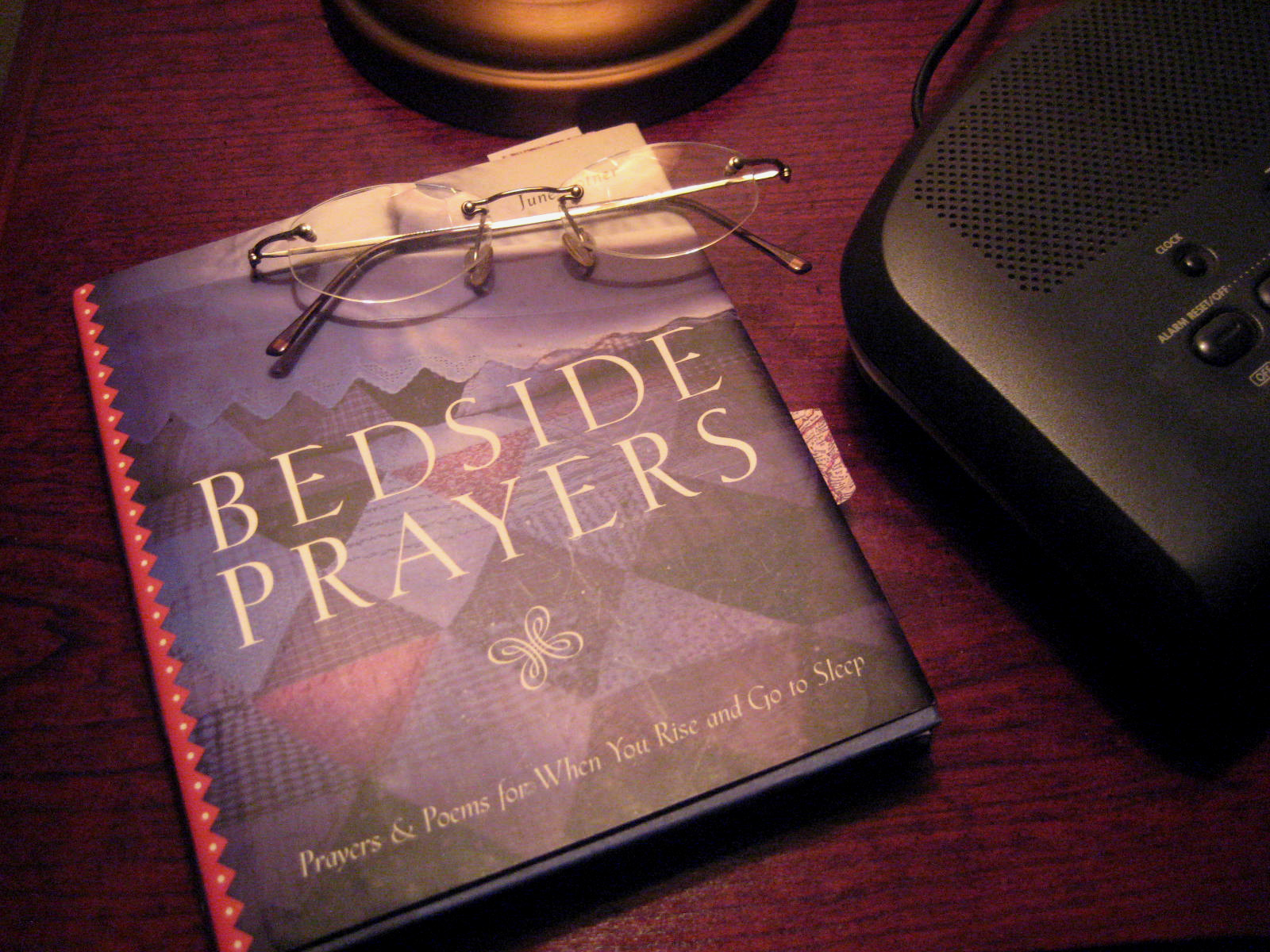
I found a used copy of the book pictured above a few weeks ago:  “Bedside Prayers, Prayers and Poems for When You Rise and Go to Sleep” collected by June Cotner.  It has found a convenient home on my night stand.  With decent regularity it finds its way into my hands just before lights out at night to put some meaningful thoughts to put into my head before sleep.

“Bedside Prayers” has these words of description on its dust cover:  a marvelous collection of prayers, meditations, sentiments, and quiet celebrations.  Drawing from a rich spectrum of traditions and writers – from Rainer Maria Rilke to Robert Louis Stevenson, and from Buddha to contemporary writers with fresh insights… for spiritual seekers of any tradition… a charming companion that encourages us to recognize the divine gifts all around us each day.  I find something meaningful every time I pick the book up and read a random page.

Among my favorites found in “Bedside Prayers” is thirteen lines by George Eliot that encourage me to be grateful for each day and to live with courage and intent to leave the world a little better than I find it.

May every soul that touches mine—
Be it the slightest contact—
Get from there some good;
Some little grace; one kindly thought;
One aspiration yet unfelt;
One bit of courage
For the darkening sky;
One gleam of faith
To brave the thickening ills of life;
One glimpse of brighter skies
Beyond the gathering mists—
To make this life worthwhile,
And heaven a surer heritage.

In a poem written almost a hundred years ago Ranier Maria Rilke described the power of being in the moment long before it was a popular notion.  Being aware of one’s “aliveness” is the message he left to be printed in “Bedside Prayers”.

You see, I want a lot.
Maybe I want it all:
The darkness of each endless fall,
The shimmering light of each ascent.
So many are alive who don’t seem to care.
Casual, easy, they move in the world
As though untouched.
But you take pleasure in the faces
Of those who know they thirst.
You cherish those
Who grip you for survival.
You are not dead yet, it’s not too late
To open your depths by plunging into them
And drink in the life
That reveals itself quietly there.

First time through the following eight lines by Joseph Byron seemed to be only be a play on words.  Then as I read them a second and third time it became apparent that simply changing the order of words added great meaning. I get the most from Byron when I read his forty-five word poem slowly and savor each line before moving to the next.

Feeling strong and strongly feeling.
Being glad and glad of being.
Care for need and needing caring.
Sharing self and selfless sharing.
Full of spirit, spirit filling.
Will is warm and warmly willing.
Give joy, enjoy the giving
Life is love and love is living.

Those eight lines really touch me!

There is nothing new or original in what I offer gratitude for today.  What is stated, I have written about before.  Here again is my thankfulness expressed for the work of others that touch my heart and spirit and make me think.  The canvas of an artist can have that effect on me and so can the notes of a musician.  A script well acted can move me deeply as can the words of a writer, but few things touch me as quickly or as profoundly as a well written poem.

Maybe I am old-fashioned. Maybe my soul has remnants within of the Victorian Era.  Or maybe I feel deeply which allows my sensitive self to receive in great dimension the feelings, thoughts and sentiments in poetry.  Whatever the reason may be, my gratitude is deep for the writers who put pieces of themself into measured word for me to discover, for my ability to feel what the poets left behind and for books like June Cotner’s “Bedside Prayers” that bring poetry into my life.

To laugh often and much;
To win the respect of intelligent people
And the affection of children;
Earn the appreciation of honest critics
And endure the betrayal of false friends;
To appreciate beauty,
To find the best in others;
To leave the world a bit better,
Whether by a healthy child,
A garden patch,
Or a redeemed social condition;
To know even one life has breathed easier
Because you have lived.
This is to have succeeded.
This old favorite by Ralph Waldo Emerson is included in “Bedside Prayers”

Originally Posted on November 30, 2011

A Hasty Word You Can’t Recall

ml_tears_wide3_20130830101005937831-620x349

Once in a while a realization comes of how perception was distorted or incorrect. In the times of anger or hurt, things get said one regrets; things that can’t be taken back. And the humbling part of such behavior is those closest to us suffer.

You always hurt the one you love,
the one you should not hurt at all;
You always take the sweetest rose,
and crush it till the petals fall;
You always break the kindest heart,
with a hasty word you can’t recall;
So if I broke your heart last night,
it’s because I love you most of all.
From an old Mills Brothers song

In situations in which we have nothing of value to lose, we seldom experience disappointment. In love, which involves our happiness and many of our most precious experiences, there is a great deal to lose. Hence, disappointment and frustration, and consequently hurt, are common. It has been said that completely blissful love does not exist. Indeed, in a survey of over 500 lovers, almost all of them assumed that passionate love is a bittersweet experience. Similarly, it has been found that people low in defensiveness have more experiences of love than do highly defensive people. This link suggests that to love is to make oneself vulnerable in ways that enhance the possibility of pain.

Since the beloved is a major source of happiness, this person is also a major threat to our happiness: more than anyone else, the beloved can ruin our happiness. Similarly, the security involved in love goes together with the fear of losing that security. Feeling happy is often bound up with the fear of losing that happiness. Caring for the beloved sometimes goes together with hurting the beloved. From article by Aaron Ben-Zeév, Ph.D., http://www.psychologytoday.com/blog/in-the-name-love/201010/you-always-hurt-the-one-you-love

Perhaps we should say “I’m sorry.” “I love you.” “You are the only person who really knows me, and who still wants to be my friend even when I am terrible.” “Your love is something that allows the rest of the world and all of its small aggressions to not feel so cold.” Chelsea Fagan

To “not hurt the ones I love” is a lesson I still trying to master and consistently practice. Old abandonment issues from childhood conditioned me to anticipate being hurt. The problem with that is a manifestation of expectation can sometimes actually be the cause of what I fear. I am grateful for the reminder that I have not arrived and never will. Life is a classroom and school is never out.

It’s ironic how we ignore the ones that adore us,
adore the ones that ignore us,
hurt the ones that love us,
and love the ones that hurt us.
Unknown