The Nail on the Head

marco

Of my favorite things few come close to two of them: 1) Finding good music I have not heard before 2) Discovering the meaningful work of an author I was previously unaware of. This week a writer unknown to me named Dan Millman came across my path. Dan’s a former world champion athlete, university coach, martial arts instructor, and college professor. His story goes that after an intensive, twenty-year spiritual quest, his thoughts formed into something he calls the “Peaceful Warrior’s Way”. He is an insightful man and his thoughts about life hit the nail on the head for me.

Life has three rules: Paradox, Humor, and Change.

– Paradox: Life is a mystery; don’t waste your time trying to figure it out.

– Humor: Keep a sense of humor, especially about yourself. It is a strength beyond all measure

– Change: Know that nothing ever stays the same.

So be gentle with yourself; show yourself the same kindness and patience you might show a young child – the child you once were. If you won’t be your own friend, who will be? If, when playing an opponent, you are also opposing yourself, you will be outnumbered.

There is no need to search; achievement leads to nowhere. It makes no difference at all, so just be happy now! Love is the only reality of the world, because it is all One, you see. And the only laws are paradox, humor and change. There is no problem, never was, and never will be. Release your struggle, let go of your mind, throw away your concerns, and relax into the world. No need to resist life, just do your best. Open your eyes and see that you are far more than you imagine. You are the world, you are the universe; you are yourself and everyone else, too! It’s all the marvelous Play of God. Wake up, regain your humor. Don’t worry, just be happy. You are already free!

Finding new expressive material that can help me gain new insight makes me feel like a kid  who received the birthday gift he wished for. I am grateful for the work of Dan Millman and look forward to knowing him better through his writing. Dan’s webiste can be found here: http://www.peacefulwarrior.com/

Be happy now,
without reason;
or you never will be at all.
Dan Millman

Nobility of Spirit

Just_Momements_Before_Sunrise

In a quiet moment after my morning meditation I began thinking about those people who have most influenced my spirituality. A prominent person on that list whose writing I began to read about a decade ago is religious studies scholar, Huston Smith. He was raised by Methodist missionary parents and became a minister. Later for more than ten years each he practiced Vedanta, Zen Buddhism and Sufi Islam.

Huston Smith studied long, walked many spiritual paths and is considered one of the foremost authorizes in the world on the common threads running through all religions. He has said of these commonalities, “If we take the world’s enduring religions at their best, we discover the distilled wisdom of the human race. ”

Huston Smith lost his oldest daughter Karen about ten years ago and I remember clearly reading about it. Later in 2009 John Blake of CNN wrote:

Smith… was struggling. He said his daughter’s illness forced him to call upon the spiritual traditions he had studied for much of his life.

He thought about the “Five Remembrances” that some Buddhist monks chant each day: I will lose my youth, my health, my loved ones, everything I hold dear and, finally, life itself by the very nature of being human.

Smith said those remembrances told him that the transient nature of life does not mean people should love others less but more. Smith then recalled a quote from Buddha: “Suffering, if it does not diminish love, will transport you to the furthest shore.”

Karen died one night as Smith sat beside her bed. Smith sobbed uncontrollably. He said that at the moment of his daughter’s death, he had trouble believing in what he had long written about: God’s “justice and perfection.”

Yet even when he was doubled over in anguish beside his daughter’s bed, she seemed to be reaching out to him. As he sat alone with Karen’s body, in the moments after her death, he suddenly stopped crying.

He could somehow sense her presence in the room.

“The sensation was so palpable I almost turned around, expecting to see her,” he said.

“Nobody wants to learn from a child how to die well, but I learned it from Karen,” he said.

Smith traveled around the world to study under some of the most famous spiritual masters. But it was his daughter who became one of his greatest teachers.
“She taught me nobility of spirit,” he said.

My daily meditation practice has returned to be what I do most mornings while the coffee is brewing. There’s something special about my not fully awake mind that’s yet to be crowded with thoughts of the day that makes this time the best for contemplation. I am grateful for the inspiration to return to meditating. It does me a lot of good!

Quiet the mind,
and the soul will speak.
Ma Jaya Sati Bhagavati

The “Just War Theory”

ELT200803171822515783026

On a semi-regular basis I attend a local Unitarian church and always benefit from each visit. This morning the minister talked about a concept I had not heard of called “Jus Ad Bellum” which in Latin translates to “The Law to War Theory”. Some refer to it as “The Just War Theory”.

At a time my country is considering making war in another country (again) I hope many will go through the seven criteria for a “Just War” and come to their own conclusion concerning possible new military action in the Middle East.

Just Cause: The reason for going to war needs to be just and cannot therefore be solely for recapturing things taken or punishing people who have done wrong; innocent life must be in imminent danger and intervention must be to protect life.

Comparative Justice: While there may be rights and wrongs on all sides of a conflict, to overcome the presumption against the use of force, the injustice suffered by one party must significantly outweigh that suffered by the other

Competent Authority: Only duly constituted public authorities may wage war. “A just war must be initiated by a political authority within a political system that allows distinctions of justice. Dictatorships are typically considered as violations of this criterion.

Right Intention: Force may be used only in a truly just cause and solely for that purpose… correcting a suffered wrong is considered a right intention, while material gain or maintaining economies is not.

Probability of Success: Arms may not be used in a futile cause or in a case where disproportionate measures are required to achieve success.

Last Resort: Force may be used only after all peaceful and viable alternatives have been seriously tried and exhausted or are clearly not practical..

Proportionality: The anticipated benefits of waging a war must be proportionate to its expected evils or harms. In modern terms, just war is waged in terms of self-defense, or in defense of another (with sufficient evidence).

“The Just War Theory” has Catholic roots, but in my mind stands as wisdom unbound by any dogma. War is something that has always been difficult for me to sort out and I often been a fence straggler. I have grateful that “Jus Ad Bellum’ has been made known to me. It will a useful yardstick from now on when the politicians and generals start talking about making war, not matter how limited in scope.

There is no such thing
as a little war.
It’s like trying to say someone
is a little pregnant.
unknown

Heard, Understood and Touched

IMG_1867edit2

I have no idea who “K.” was but Virginia Satir was an influential 20th century psychotherapist and notable author. She described her work as helping others in “Becoming More Fully Human”. What is below Ms. Satir wrote for a twelve-year old patient who said “What is life about anyway. Life makes no sense. What is the meaning of it all?”

I am Me.
In all the world,
there is no one else exactly like me.
Everything that comes out of me
is authentically mine, because I alone chose it.
I own everything about me:
my body, my feelings, my mouth, my voice,
all my actions, whether they be to others or myself.
I own my fantasies, my dreams, my hopes, my fears.
I own my triumphs and successes, all my failures and mistakes.
Because I own all of me,
I can become intimately acquainted with me.
By so doing, I can love me and be friendly with all my parts.
I know there are aspects about myself that puzzle me,
and other aspects that I do not know,
but as long as I am friendly and loving to myself,
I can courageously and hopefully look for solutions
to the puzzles and ways to find out more about me.
However I look and sound, whatever I say and do,
and whatever I think and feel at a given moment
in time is authentically me.
If later some parts of how I looked, sounded,
thought, and felt turn out to be unfitting,
I can discard that which is unfitting,
keep the rest, and invent something new
for that which I discarded.
I can see, hear, feel, think, say, and do.
I have the tools to survive, to be close to others,
to be productive, and to make sense
and order out of the world of people
and things outside of me.
I own me, and therefore,
I can engineer me.
I am me,
and I am Okay.

I am grateful for my favorite used bookstore (Gardner’s) where I found Virginia Satir’s simple book filled with the insightful words above. Her thoughts give me sharpened insight here at the start of a new month.

I believe the greatest gift I can conceive
of having from anyone is to be seen by them,
heard by them, to be understood and touched by them.
Virginia Satir

Photo credit: Pol Ubeda Hervas
(“I am not there” series)

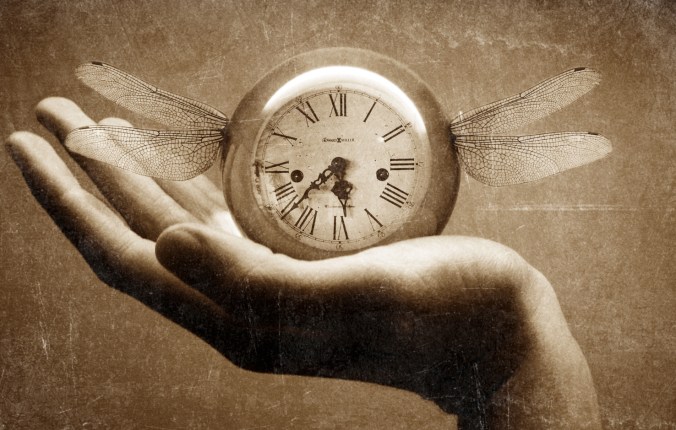
Wasting Time Well

time-travel2-photo-courtesy-of-junussyndicate-on-deviantART

Time is an equal opportunity employer.
Each human being has exactly the same
number of hours and minutes every day.
Rich people can’t buy more hours.
Scientists can’t invent new minutes.
And you can’t save time
to spend it on another day.
Denis Waitley

Until recently losing track of time was mostly restricted to great moments of a vacation, being totally engrossed in a good conversation or activity, being stunned by beauty or becoming caught up in the rapture of love. In those instances my awareness of the day and/or hour was fleeting and lasted for no more than seconds and minutes.

The fact that I lose track of time more now in semi-retirement is a wonderful thing. What’s meaningful is the experience of being so absorbed and so immersed is no longer restricted to “doing”. With increasing regularity I find myself wasting time without much care about its passage. It feels like I have been freed from a prison where time was my jailer.

One of my newly founded beliefs of the last decade is modern wealth is more about time than money. It was not that long ago rushing from one endeavor to another, one meeting to the next one and seeing this person and then the next person occupied the majority of my awake time. For a long while being so involved in work gave me a sense of importance that today I don’t find significant.

Time goes faster the more hollow it is. Lives with no meaning go straight past you, like trains that don’t stop at your station. Carlos Ruiz Zafon

Today I am discovering time has only the amount of importance I place on it. My experience of being alive is better when I can stop having thoughts like “what should I be doing?”, “I should be working on ___” or “I’ve got to be productive”. Such things are all in my head and broken down to their essence are actually borderline crazy! My time is mine to spend any way I choose and if ‘wasting’ it feels best, then I will do just that.

I had the mistaken belief that value should be placed based on rarity. My finding concerning time is my value of it is now placed based on the quantity of it I have. It is my hope that I can become as proficient at wasting time well as I once was at being productively time conscious.

For the wealth of time life has brought me to, I am grateful. To realize wasting time well is a good thing brings a smile of happiness and peace.

Free time is the most expensive time you have,
because nobody pays for it but you.
But that also makes it the most valuable time you have,
as you alone stand to reap the profits from spending it wisely.
Jarod Kintz

Knowledge, Wisdom, and Insight

knowledge 001

Knowledge is really about facts and ideas that we acquire through study, research, investigation, observation, or experience.

Wisdom is the ability to discern and judge which aspects of that knowledge are true, right, lasting, and applicable to your life. It’s the ability to apply that knowledge to the greater scheme of life. It’s also deeper; knowing the meaning or reason; about knowing why something is, and what it means to your life.

Insight is the deepest level of knowing and the most meaningful to your life. Insight is a deeper and clearer perception of life, of knowledge, of wisdom. It’s grasping the underlying nature of knowledge, and the essence of wisdom. Insight is a truer understanding of your life and the bigger picture of how things intertwine.

In a nutshell: If knowledge is information, wisdom is the understanding and application of that knowledge and insight is the awareness of the underlying essence of a truth. Sadly we can gain a lifetime of knowledge, yet never see the wisdom in it. We can be wise, but still miss the deeper meaning.

Knowledge is knowing how to manage your money, budgeting, spending, saving.
Wisdom is understanding how money impacts the quality of your life and your future.
Insight is realizing that money is simply a tool to be used, that it has no inherent meaning beyond its usefulness.

Knowledge is learning how to paint and using that skill to cultivate a livelihood.
Wisdom is expressing your passion through painting and understanding that art is a form of communication that touches the lives of others.
Insight is perceiving that all things can be art and that creating your art contributes to the understanding and the expression of the essence of the world around you.

Knowledge is knowing which things, practices, people, and pleasures make you happy.
Wisdom is knowing that while those things may bring you pleasure, happiness is not derived from things or situations or people. It’s understanding that happiness comes from within, and that it’s a temporary state of mind.

Insight is knowing that happiness is not the purpose of life, that it’s not the marker of the quality of life—it’s merely one of the many fleeting states of mind in the spectrum of full emotions. Those emotions don’t make up our lives; they are merely experiences.

Knowledge, wisdom and insight all are valuable and all have a place in our lives. The difficulty lies in the fact that many of us are unclear as to their differences, often perceiving the terms and their application to be interchangeable. Being clear and consciously aware of how our minds are engaged may be important to getting the most out of all three. While acquiring and applying information is valuable in and of itself, we also need to distill and judge that information, and ultimately find the deeper meaning and relevance to the whole of our lives. Perhaps the truest form of knowing is in acquiring all three, and understanding how they each enhance the quality and experience of life. Taken from an article by Royale Scuderi, http://www.lifehack.org/articles/communication/what-are-the-differences-between-knowledge-wisdom-and-insight.html

Ever read something that was stunning in its clarity? Did every word seem like it was written for you? Did the message alter your way of seeing things? For the better? The words above did just that. The writer is Royale Scuderi who specializes in cultivating human potential for happiness, health and fulfillment. I am grateful to have come in contact with her thoughts. They truly widened my perspective and sharpened it at the same time.

I am strong, because I’ve been weak.
I am beautiful, because I know my flaws.
I am a lover, because I’ve been a fighter.
I am fearless, because I’ve been afraid.
I am wise, because I’ve been foolish.
And I can laugh, because I’ve known sadness.
Anonymous

When You Look Back

C_-S_-Lewis-Desk-and-StudyThis morning browsing for a quotes something C.S. Lewis wrote came into my view: When I was ten, I read fairy tales in secret and would have been ashamed if I had been found doing so. Now that I am fifty, I read them openly. When I became a man I put away childish things, including the fear of childishness and the desire to be very grown up. Those words started me thinking how absurd a good bit of what society defines adulthood is.


Long ago I grew tired of being young although our society holds youth as it’s holy grail. The 20s and 30s were exhausting as I tried to fit in, succeed and act like I knew what I was doing when I really didn’t. Somewhere in it all, I started to become ‘me’. In some ways mature for my years and in others quite childish for my age. That was the start of becoming a man. Lesson: Don’t be in too big a rush to lose everything behind related to childhood. Innocence is often a clear scope for looking at things accurately.

To be concerned about being grown up, to admire the grown up because it is grown up, to blush at the suspicion of being childish; these things are the marks of childhood and adolescence. And in childhood and adolescence they are, in moderation, healthy symptoms. Young things ought to want to grow. But to carry on into middle life or even into early manhood this concern about being adult is a mark of really arrested development. C.S. Lewis

The changes from twenty-one to thirty years of age exceed all my combined changes of all other years. What level of maturity I did  attain came mostly from painful experience and no other place. Lesson: The only real ‘truth’ anyone can ever know for certain comes from their own experiences, especially the painful ones.

Pain insists upon being attended to. God whispers to us in our pleasures, speaks in our consciences, but shouts in our pains. It is his megaphone to rouse a deaf world. C.S. Lewis

Most of my life I have been afraid of love; fearful of being hurt. What life taught is love always bring suffering to balance its joy. Without that certainty, the love I have come to know would have far less meaning. Lesson: The greatest and deepest love will in time bring the greatest pain. To fear the latter is to deny one’s self the former.

To love at all is to be vulnerable. Love anything and your heart will be wrung and possibly broken. If you want to make sure of keeping it intact you must give it to no one, not even an animal. Wrap it carefully round with hobbies and little luxuries; avoid all entanglements. Lock it up safe in the casket or coffin of your selfishness. But in that casket, safe, dark, motionless, airless, it will change. It will not be broken; it will become unbreakable, impenetrable, irredeemable. To love is to be vulnerable. C.S. Lewis

My heart and mind are buzzing now with the lines of thinking C.S. Lewis put me on today. I was only ten years old when he passed away, but his legacy lives on for me as a favored writer, teacher and adviser. I owe a debt of gratitude to C.S. Lewis’ best friend, JRR Tolkien, for introducing me to Lewis in an article I read about the two men when I was at a young, impressionable age. Within the fantasies they spun I found wisdom I will always be grateful for.

Isn’t it funny how day by day nothing changes,
but when you look back, everything is different…
C.S. Lewis

To Better Practice What I Already Know – Part Two

RealityCheck_display_image

Tomorrow Part Two of Ms. Marshall’s “Twenty Six Ways To Love Life

Eight months ago my post here ended with those words. It was my intention was for a back to back ‘two-part’er’ but the second installment got lost on my hard drive and was never posted. Albeit late, I am making good on posting the remaining half.

14.Travel. Explore different places. If you can’t afford to fly, drive. You don’t have to go far. just go. Learn how to travel on a budget and go twice as much.
15. Celebrate Mondays. Mondays are 1/7 of your life. Do something special on Mondays so they feel like Fridays. Notice the attitude you have on Friday compared to Monday. How can you make Mondays special.
16. Volunteer. This will add to your mental and emotional health. It’s a feeling money can’t buy. Do your part to make the world a better place.
17. Play. Balance life with play. Play cards. Play with children. Play outside. Play games. Play for fun. Play to improve yourself.
18. Live in the present moment. When we are anxious we are either living in the pain of the past or the fear of the future. Learn to take one moment at a time. Live in the present.
19. Respect elderly people. Spend time with them. They are worthy and wise. You will be old someday yourself.
20. Read. You can learn something new everyday. Never stop learning. Never stop growing.
21. Breathe. Learn to breathe properly. Breathe deeply and often. It will decrease your tension and anxiety.
22. Be patient. Learn to wait patiently. We spend between 3-5 years of our life waiting in line. Learn to be patient with others. We don’t all grow at the same pace. Learn to be patient with your children, it is a wonderful gift to give them.
23. Learn to deal with your emotions. It’s a scientific fact that the center for emotional control is not in someone else’s behavior it’s in your brain.
You can talk with a friend, journal or exercise, these are a few methods for dealing with your emotions. Anger covers up pain, pain covers fear. Recognize your feelings, emotions and know how to remain calm in chaos.
24. Take the high road. Know what your values are and live by them. If a cashier gave you an extra five dollars back in change would you give it back?
25. Simplify. List the areas of your life that need to be simplified. Choose one area of your life and begin. Keep it simple.
26. Love. Learn how to express your love to others. Speak loving words and take loving action. Decide to contribute love to the world.
http://theboldlife.com/2009/01/26-ways-to-love-life/

I’m glad items number 14 through 26 came back into my field of consciousness. No time will be spent regretting my forgetfulness that caused close to a year to pass between part one and part two being posted. I have faith that part two was something I needed to read NOW. Several of the items are precisely on target for what I needed to be reminded of this morning.

I am grateful for a rich and rewarding life. It’s sometimes grueling, complicated, and agonizingly painful… but my life is ALWAYS good even at its most difficult.

Always be fearless. Walk like lion,
talk like pigeons, live like elephants
and love like an infant child.
Santosh Kalwar

Mac and The Banger (repost)

It’s been a year  later since I posted this originally. I’m thinking about the friends who inspired it (one of them passed about this time a few years ago). https://goodmorninggratitude.com/2012/07/12/mac-and-the-banger/

rope-wider

While not a first-hand personal experience, I have had friends who knew they were in the last few months of their life and had them share some of the wisdom facing death brought them. To a person the near end of days brought a kinder and a gentler nature.

My friends who were faced with a soon to come reality of dying seemed to love more deeply and express how they felt more openly. Things mattered little and people were about all they cared about. Their primary regrets I recall them sharing were not doing things they had wanted to do, working/chasing money too much and not spending more time with people they loved.

No one close to me wrote down their thoughts as death drew near, but what is just below I believe expresses what they left behind in their own way.

– STOP
Give yourself permission to take a moment to really look at yourself & where you are.

– CLEAR
Create some room for those voices in your head to speak their mind, & then try to hear them.

– SHIFT
Be fearless with change – it might be the best thing you ever did.

– RELEASE
Let go those things that aren’t a reflection of who you want to be & who you really are.

– EMBODY
Be what you were meant to be in all its crazy shapes and guises – why wait?

– ADORE
Love who you have been, who you are now & who you are going to be – it’s all you.

– ENRICH
Move in a direction that enhances, empowers and deepens your life.

It turns out that no one can imagine what’s really coming in our lives. We can plan, and do what we enjoy, but we can’t expect our plans to work out. Some of them might, while most probably won’t. Inventions and ideas will appear, and events will occur, that we could never foresee. That’s neither bad nor good, but it is real.

From a last post by Derek K Miller of Vancouver, Canada on May 4, 2011, shortly before his death from cancer.

Two friends now gone taught me a great deal about living by how they acted facing death. Tears well up as I think about Mac and Bill (better know as “The Banger”) and how much I love them still, even in their absence, and how grateful I am my life was blessed with their presence.

Somebody should tell us, right at the start of our lives, that we are dying.
Then we might live life to the limit, every minute of every day.
Do it! I say. Whatever you want to do, do it now!
There are only so many tomorrows.”
Pope Paul VI


I Have Arrived

Dirt Road Africatw2011

I want to grow old without facelifts…
I want to have the courage to be loyal to the face I’ve made.
Sometimes I think it would be easier to avoid old age, to die young,
but then you’d never complete your life, would you?
You’d never wholly know you.
Marilyn Monroe

T-minus four days and counting… In less than a hundred hours I will officially be sixty years old. It’s interesting that internally I feel about half that age, but am reminded in the mirror that in reality is I am entering the outer boundaries of old age.

For at least fifteen years I have tried to sneak up on birthdays. Within three or four months of the anniversary of my birth I’d answer the question “how old are you?” with the age I was about to be, not what I presently was. In some off-beat way that helped me acclimate to being another year older. Just realizing this year I did not do that the previous practice fells silly to me. Yeah for me! I’m finally growing up and accepting of the present chapter of life just ahead.

Pew Research Center Social & Demographic Trends did a survey in 2009 of close to three thousand people and asked different demographic groups “What age does the average person become old?” In their data respondents from 18-29 years of age said 60 was old. Gulp! No wonder so many people in that age group refer to me as “Sir”. The perception of ‘old’ changes with age: 30-49 year-olds see 69 as old; 50-64 year-old folks see 72 as old while 65+ thought 74 was old. Whew! That means to anyone thirty or older I won’t be ‘old’ for at least another ten years!

Back to being called “Sir” by younger people; I have to admit it really bothered me when it began happening with greater and greater frequency about ten years. I thought “Oh, no. He/she thinks I’m an old fart”. I have grown up some though, and now take the reference as respect. Once past the shock of being a “Sir” and becoming accustomed to it, I accepted that people were simply being respectful. None of us gets too much respect at any age.

Another finding in the Pew Research Center survey was the older people get, the younger they feel–relatively speaking. Among 18 to 29 year-olds, about half say they feel their age, while about quarter say they feel older than their age and another quarter say they feel younger. By contrast, among adults 65 and older, fully 60% say they feel younger than their age, compared with 32% who say they feel exactly their age and just 3% who say they feel older than their age.

And one of the best parts for me in the Pew survey was nearly half (45%) of adults ages 75 and older say their life has turned out better than they expected, while just 5% say it has turned out worse (the remainder say things have turned out the way they expected or have no opinion). All other age groups also tilt positive, but considerably less so, when asked to assess their lives so far against their own expectations. I agree completely. My life so far has turned out to be far more interesting, rewarding and fulfilling that I could have ever imagined when younger.

It seems I have arrived at the place I have long needed to be. About to finish my 6th decade on Earth by retiring from professional life and moving into a phase filled with a list of “always wanted to-dos”, I am genuinely excited at the prospect of experiences to come; exhilarated actually!

Everything is not exactly what I hoped for or dreamed of, but my life is rich and rewarding in a myriad of ways. It humbles me when I let the life possibilities ahead take shape in my thoughts. Finally, I have arrived at where I have been headed all my life. I am grateful to be here.

Wrinkles should merely indicate
where the smiles have been.
Mark Twain