Years of Friction

tree adapting to friction

It is not work that kills men, it is worry.
…worry is rust upon the blade.
It is not movement that destroys
the machinery, but friction.
Henry Ward Beecher

In Colorado last week visiting my son, I was waiting in the car when I noticed the little tree in the photo. No only had the sapling accepted to its position in life and had adapted to it, the tree had begun to use the adaptation to its benefit against the winds in Boulder.

Years of friction of the tree trunk rubbing against a cable caused the sapling to adapt. Now as the tree gets older it has begun to grow around the source of friction making itself stronger in the process. It changed and now benefits from what once was the source of injury.

And so it is with life. Resistance to life as it is, does not benefit a person. The injury is to the thinker and not the subject of the thoughts. Things improve when one allows them self to be adapted to real life. The little tree does not think. It only does what is the most healthful for survival. For the tree, like humans, adaptation is often he different between a good life and a difficult one.

The sapling could not know the Serenity Prayer, but practices its principles implicitly.
God, grant me the serenity to accept the things I cannot change,
The courage to change the things I can,
And wisdom to know the difference.
From a poem by Reinhold Niebuhr

I am grateful to the small tree. It “spoke to me” with a reminder to adapt to one’s circumstance when there is not other option.

A gem cannot be polished
without friction,
nor a man perfected
without trials.
Lucius Annaeus Seneca

We All Have Twenty-Four Hour Days

habit0001

You can do anything,
but you can’t do everything.
David Allen

What has my attention at this moment? My thoughts are directed at words surfacing in my mind and typing them with a considerably lesser amount of awareness of music playing on Pandora. I’m vaguely aware of the surroundings of my home office, the art and posters on the wall and the noise of an occasional neighborhood car that drives by. That’s all my mind can take on at the moment.

People have a fixed amount that must be allocated according to need. To use a popular analogy, attention is like a bucket of water. People draw upon it as needed, but every dipper full and every teaspoon full leaves less for other purposes. Marc Green

Two interesting components have arisen with the increase of discretionary time I now have: 1) my perception of the world outside me has increased. I notice more, see things more deeply and generally feel good because of it. 2) With a richness of time, it is easy to let hours and days slip by with little to show for them. Some of that is good. Some of it is not so positive.

Zig Ziglar said, “Lack of direction, not lack of time, is the problem. We all have twenty-four hour days.” My conclusion is that expecting myself to settle into new routines within my first 60 days of semi-retirement was too much to ask. Already I feel better letting myself off the hook of that unrealistic expectation.

…the allocation of attention is largely automatic and occurs without awareness. As a result, it is not easily brought under conscious control. You may direct someone’s attention by saying “watch the step,” and temporarily cause a conscious allocation of attention to the step. However, there is a good chance that within a few minutes or even seconds, the memory trace will disappear and the next time the person will fail to notice the step. The same automatic factors that directed attention away from the step in the first instance have not changed. Marc Green

The paragraph from Marc Green helps me a good deal because it tells me that keeping a keen awareness of my desire to form new routines is a great start to having them. All I have to do is follow through on what I have concluded and stay aware with a sense of priority. Then new routines will simply fall into place. Whew. I am grateful to “get off my own case”.

I didn’t pay attention to time or distance,
instead focusing on how it felt just to be in motion,
knowing it wasn’t about the finish line
but how I got there that mattered.
Sarah Dessen

Nobility of Spirit

Just_Momements_Before_Sunrise

In a quiet moment after my morning meditation I began thinking about those people who have most influenced my spirituality. A prominent person on that list whose writing I began to read about a decade ago is religious studies scholar, Huston Smith. He was raised by Methodist missionary parents and became a minister. Later for more than ten years each he practiced Vedanta, Zen Buddhism and Sufi Islam.

Huston Smith studied long, walked many spiritual paths and is considered one of the foremost authorizes in the world on the common threads running through all religions. He has said of these commonalities, “If we take the world’s enduring religions at their best, we discover the distilled wisdom of the human race. ”

Huston Smith lost his oldest daughter Karen about ten years ago and I remember clearly reading about it. Later in 2009 John Blake of CNN wrote:

Smith… was struggling. He said his daughter’s illness forced him to call upon the spiritual traditions he had studied for much of his life.

He thought about the “Five Remembrances” that some Buddhist monks chant each day: I will lose my youth, my health, my loved ones, everything I hold dear and, finally, life itself by the very nature of being human.

Smith said those remembrances told him that the transient nature of life does not mean people should love others less but more. Smith then recalled a quote from Buddha: “Suffering, if it does not diminish love, will transport you to the furthest shore.”

Karen died one night as Smith sat beside her bed. Smith sobbed uncontrollably. He said that at the moment of his daughter’s death, he had trouble believing in what he had long written about: God’s “justice and perfection.”

Yet even when he was doubled over in anguish beside his daughter’s bed, she seemed to be reaching out to him. As he sat alone with Karen’s body, in the moments after her death, he suddenly stopped crying.

He could somehow sense her presence in the room.

“The sensation was so palpable I almost turned around, expecting to see her,” he said.

“Nobody wants to learn from a child how to die well, but I learned it from Karen,” he said.

Smith traveled around the world to study under some of the most famous spiritual masters. But it was his daughter who became one of his greatest teachers.
“She taught me nobility of spirit,” he said.

My daily meditation practice has returned to be what I do most mornings while the coffee is brewing. There’s something special about my not fully awake mind that’s yet to be crowded with thoughts of the day that makes this time the best for contemplation. I am grateful for the inspiration to return to meditating. It does me a lot of good!

Quiet the mind,
and the soul will speak.
Ma Jaya Sati Bhagavati

Promises, Promises

promises ave and realiry way

A promise kept is a healthy, living thing. A broken promise lives in the land of the dead.

Wikipedia explains a “promise” to be: commitment by someone to do or not do something. As a noun promise means a declaration assuring that one will or will not do something. As a verb it means to commit oneself by a promise to do or give.

Unfortunately I learned about promises as a child from parents and adults who made them easily and broke them with even less thought. The flimsy guarantees behind what the grownups pledged taught me it was ‘normal’ to make and break my word in romantic relationships.

Is this what sadness is all about? Is it what comes over us when beautiful memories shatter in hindsight because the remembered happiness fed not just on actual circumstances but on a promise that was not kept? Bernhard Schlink

After I point I can’t blame childhood caregivers at all. It’s my belief we can only hold our parents responsible into our 20’s at the latest for bad habits and behaviors they taught us by example. After that age being an ‘adult trainee’ should be over and the fiber of one’s character should become choice rather than conditioning. I was a slow learner.

Some of my usual behavior looks to be anything but admirable in hindsight. It took time, but the difference between habit and what is honorable slowly came into focus. My childhood conditioning fostered many of my typical practices that were in fact dysfunctional. Just because I do something with regularity does not make it good. A habit is just a habit.

As a fully grown man, cultivating healthy habits and behaviors was not an easy process. It was a bit like preparing overgrown land for growing crops. First what is already growing had to be cut back or removed. The rocks and roots had to be cleared from the soil before successful planting. Likewise, my first task was recognizing the unwanted and unhealthy tendencies that had grown with in me. Afterwards the clearing out of “rocks and roots” could begin. Only when those two steps were practiced could I successfully plant and nurture new ways of behaving.

Words can be twisted into any shape. Promises can be made to lull the heart and seduce the soul. In the final analysis, words mean nothing. They are labels we give things in an effort to wrap our puny little brains around their underlying natures, when ninety-nine percent of the time the totality of the reality is an entirely different beast. The wisest man is the silent one. Examine his actions. Judge him by them. Karen Marie Moning

On my left upper arm is a tribal tattoo that means “honor”. At the time it was created I did not yet fully deserve it. It was something for me to grow into. While imperfect, today I endeavor every day to deserve the symbol permanently etched on my arm. I’m grateful for each bump in the road that taught me, every peer in recovery who listened without judgment and to my Higher Power who has made possible that which I could not do alone.

I  know it is a bad thing to break a promise,
but I think now that it is a worse thing
to let a promise break you.
Jennifer Donnelly

Who Am I?

3789365159_74c3abfc4e

Please don’t be fooled by me. Don’t be fooled by the face I wear, for I wear a mask. I wear a thousand masks, masks that I’m afraid to take off and none of them are me. Pretending is an art that is second nature to me, but don’t be fooled, for God’s sake don’t be fooled.

I give you the impression I’m secure and that all is sunny and unruffled with me, within as well as without, that confidence is my name, coolness my game, that water is calm and I’m in command and that I need no one, but don’t believe me, please don’t believe me.

My surface may be smooth, but my surface is a mask–my every varying and ever concealing mask. Beneath it dwells the real confusion, fear and aloneness. Beneath lies my smugness, my complacently, but I hide this–I don’t want anyone to know it.

I panic at the thought of my weakness and fear being exposed. That’s why I frantically created a mask to hide behind– nonchalant sophisticated facades to help me pretend– to shield me from the glance that knows– but such a glance is precisely my salvation, my only salvation and I know it. That is if it’s followed by acceptance. If it’s followed by love, it’s the only thing that can liberate me from myself, from my own self built prison walls and from the barriers that I so painstakingly erect. It’s the only thing that will assure me of what I cannot assure myself, that I’m really worth while, but I don’t tell you this, I don’t dare–I’m afraid to.

I’m afraid that your glance will not be followed by acceptance and love. I’m afraid you’ll think less of me and you’ll laugh and your laugh will kill me. I’m afraid that deep down, I’m nothing and that I’m just no good and that you’ll see this and reject me.

So I play my game; my desperate pretending; with the facade of assurance without and a trembling child within. And so begins the parade of masks, the glittering, but empty parade of masks and my life becomes a front. I idle chatter to you in suave tones of surface talk. I tell you everything that’s really nothing and nothing of what’s everything and what’s crying within me.

So when I’m through going through my routine, do not be fooled by what I’m saying. Please listen carefully and try to hear what I’m not saying–what I’d like to be able to say, but for survival I need to say, but what I can’t say.

I dislike hiding, honestly, I dislike the superficial game I’m playing, the superficial phony game. I’d really like to be genuine, spontaneous and me, but you’ve got to help me, you’ve got to hold out your hand, even when it’s the last thing I seem to want or need.

You can help wipe away from my eyes–the blank stare of grieving dead. You can help call me into aliveness each time you’re kind, gentle and encouraging. Each time you try to understand because you really care, my heart begins to grow wings, very small wings, very feeble wings, but wings.

If you choose to, please choose to. You can help break down the wall behind which I tremble. You can encourage me to remove my mask. You can help release me from my shadowed world of panic and uncertainty. From my lonely prison.

So do not pass me by– please don’t pass me by. It will not be easy for you. A lone conviction of worthlessness builds strong walls. The nearer you approach me, the blinder I may strike back.

It’s irrational, but despite what books say about man, I am irrational, I fight against the very things that I cry out for, but I am told love is stronger than strong walls. In this lies my hope, my only hope, please help beat down those walls with firm hands, but with gentle hands–for a child is very sensitive.

Who am I, you may wonder? I am someone you know very well. For I am every man you meet and I am every women you meet. “Don’t Be Fooled By Me” by Charles C. Finn

Once in a while I find something to share that brings me to a loss for words. I have no comments or thoughts that can embellish what is above. So I won’t try. Instead I will just say thank you Mr. Finn. I am grateful to you for writing this piece that speaks to me so clearly and deeply.

Never miss a good chance to shut up.
Will Rogers

Heard, Understood and Touched

IMG_1867edit2

I have no idea who “K.” was but Virginia Satir was an influential 20th century psychotherapist and notable author. She described her work as helping others in “Becoming More Fully Human”. What is below Ms. Satir wrote for a twelve-year old patient who said “What is life about anyway. Life makes no sense. What is the meaning of it all?”

I am Me.
In all the world,
there is no one else exactly like me.
Everything that comes out of me
is authentically mine, because I alone chose it.
I own everything about me:
my body, my feelings, my mouth, my voice,
all my actions, whether they be to others or myself.
I own my fantasies, my dreams, my hopes, my fears.
I own my triumphs and successes, all my failures and mistakes.
Because I own all of me,
I can become intimately acquainted with me.
By so doing, I can love me and be friendly with all my parts.
I know there are aspects about myself that puzzle me,
and other aspects that I do not know,
but as long as I am friendly and loving to myself,
I can courageously and hopefully look for solutions
to the puzzles and ways to find out more about me.
However I look and sound, whatever I say and do,
and whatever I think and feel at a given moment
in time is authentically me.
If later some parts of how I looked, sounded,
thought, and felt turn out to be unfitting,
I can discard that which is unfitting,
keep the rest, and invent something new
for that which I discarded.
I can see, hear, feel, think, say, and do.
I have the tools to survive, to be close to others,
to be productive, and to make sense
and order out of the world of people
and things outside of me.
I own me, and therefore,
I can engineer me.
I am me,
and I am Okay.

I am grateful for my favorite used bookstore (Gardner’s) where I found Virginia Satir’s simple book filled with the insightful words above. Her thoughts give me sharpened insight here at the start of a new month.

I believe the greatest gift I can conceive
of having from anyone is to be seen by them,
heard by them, to be understood and touched by them.
Virginia Satir

Photo credit: Pol Ubeda Hervas
(“I am not there” series)

Franklin’s 13 Virtues

aa_franklinb_printer_1_e

1726, at the age of 20, Benjamin Franklin created a system to develop his character. In his autobiography, Franklin listed his thirteen virtues as:

1. Temperance. Eat not to dullness; drink not to elevation.
2. Silence. Speak not but what may benefit others or yourself; avoid trifling conversation.
3. Order. Let all your things have their places; let each part of your business have its time.
4. Resolution. Resolve to perform what you ought; perform without fail what you resolve.
5. Frugality. Make no expense but to do good to others or yourself; i.e., waste nothing.
6. Industry. Lose no time; be always employed in something useful; cut off all unnecessary actions.
7. Sincerity. Use no hurtful deceit; think innocently and justly, and, if you speak, speak accordingly.
8. Justice. Wrong none by doing injuries, or omitting the benefits that are your duty.
9. Moderation. Avoid extremes; forbear resenting injuries so much as you think they deserve.
10. Cleanliness. Tolerate no uncleanliness in body, clothes, or habitation.
11. Tranquility. Be not disturbed at trifles, or at accidents common or unavoidable.
12. Chastity. Rarely use venery (sex) but for health or offspring, never to dullness, weakness, or the injury of your own or another’s peace or reputation.
13. Humility. Imitate Jesus and Socrates.

Seems a tall order to live up to this list every day, but then Franklin said he never did. Ben admitted that he was never able to live the virtues perfectly, but felt he had become a better and happier man for having made the attempt. It occurred to me if I pick one each day and focus on bringing more of it in my life I will benefit. I am grateful to you Mr. Franklin for the idea!

It’s about living in the moment
and appreciating the smallest things.
Surrounding yourself with the things that
inspire you and letting go of the obsessions
that want to take over your mind.
It is a daily struggle sometimes and
hard work but happiness begins
with your own attitude
and how you look at the world.
Gretchen Rubin

Into the Void

voids DARK

If life is so short,

why do we do so many things

we don’t like

and like so many things we don’t do?

I looked into the image and let my mind, heart and soul rest while the unguided remainder of me went into the void. There a response came without my intentional help and amazingly it was clearer than thought, emotion or feeling.

My answers to the BIG question are personal and matter primarily to me, so I won’t list them. What matters is I am becoming able to put my ‘self control mechanism’ into neutral at times and allow solutions to come from the outside in. Like a randomly caught virus that can bring healing, more often than I thought possible I find a remedy floating outside me.

Or maybe it’s from a Higher Power… Or maybe it’s the power of allowing solutions to manifest them self… Or maybe it’s my subconscious… Or maybe it doesn’t matter how.

I am grateful to realize that sorting out where needed answers outside me come from is irrelevant. What does matter is an awareness that guidance can come from beyond me if I humble myself and realize I don’t have control of everything. For a person used to controlling everything and everyone, the realization that I am not my own God is a break through.

A human being is part of the whole, called by us ‘universe’,
a part limited in time and space.
He experiences himself, his thoughts and feelings,
as something separate from the rest –
a kind of optical delusion of consciousness.
This delusion is a kind of prison for us,
restricting us to our personal desires
and to affection for a few persons nearest to us.
Our task must be to free ourselves from this prison
by widening our circle of compassion
to embrace all living creatures
and the whole of nature in its beauty.
Albert Einstein

Knowledge, Wisdom, and Insight

knowledge 001

Knowledge is really about facts and ideas that we acquire through study, research, investigation, observation, or experience.

Wisdom is the ability to discern and judge which aspects of that knowledge are true, right, lasting, and applicable to your life. It’s the ability to apply that knowledge to the greater scheme of life. It’s also deeper; knowing the meaning or reason; about knowing why something is, and what it means to your life.

Insight is the deepest level of knowing and the most meaningful to your life. Insight is a deeper and clearer perception of life, of knowledge, of wisdom. It’s grasping the underlying nature of knowledge, and the essence of wisdom. Insight is a truer understanding of your life and the bigger picture of how things intertwine.

In a nutshell: If knowledge is information, wisdom is the understanding and application of that knowledge and insight is the awareness of the underlying essence of a truth. Sadly we can gain a lifetime of knowledge, yet never see the wisdom in it. We can be wise, but still miss the deeper meaning.

Knowledge is knowing how to manage your money, budgeting, spending, saving.
Wisdom is understanding how money impacts the quality of your life and your future.
Insight is realizing that money is simply a tool to be used, that it has no inherent meaning beyond its usefulness.

Knowledge is learning how to paint and using that skill to cultivate a livelihood.
Wisdom is expressing your passion through painting and understanding that art is a form of communication that touches the lives of others.
Insight is perceiving that all things can be art and that creating your art contributes to the understanding and the expression of the essence of the world around you.

Knowledge is knowing which things, practices, people, and pleasures make you happy.
Wisdom is knowing that while those things may bring you pleasure, happiness is not derived from things or situations or people. It’s understanding that happiness comes from within, and that it’s a temporary state of mind.

Insight is knowing that happiness is not the purpose of life, that it’s not the marker of the quality of life—it’s merely one of the many fleeting states of mind in the spectrum of full emotions. Those emotions don’t make up our lives; they are merely experiences.

Knowledge, wisdom and insight all are valuable and all have a place in our lives. The difficulty lies in the fact that many of us are unclear as to their differences, often perceiving the terms and their application to be interchangeable. Being clear and consciously aware of how our minds are engaged may be important to getting the most out of all three. While acquiring and applying information is valuable in and of itself, we also need to distill and judge that information, and ultimately find the deeper meaning and relevance to the whole of our lives. Perhaps the truest form of knowing is in acquiring all three, and understanding how they each enhance the quality and experience of life. Taken from an article by Royale Scuderi, http://www.lifehack.org/articles/communication/what-are-the-differences-between-knowledge-wisdom-and-insight.html

Ever read something that was stunning in its clarity? Did every word seem like it was written for you? Did the message alter your way of seeing things? For the better? The words above did just that. The writer is Royale Scuderi who specializes in cultivating human potential for happiness, health and fulfillment. I am grateful to have come in contact with her thoughts. They truly widened my perspective and sharpened it at the same time.

I am strong, because I’ve been weak.
I am beautiful, because I know my flaws.
I am a lover, because I’ve been a fighter.
I am fearless, because I’ve been afraid.
I am wise, because I’ve been foolish.
And I can laugh, because I’ve known sadness.
Anonymous

Worth the Risk

ship_storm SIZED

Once in a while a thought comes so strong it blocks out all other thinking temporarily. Even when I move on to other considerations and ideas, the over-riding concept blazes back into my mind frequently.

It was scary as hell when I was deliberating about walking away from my profession with no concrete thought of what was next. There was a dumpster of cranky inquiries as my ego fought the possibility.

What happens if your hopes don’t come true?
What if you run out of money?
What if you’re wrong?
What if others think you are crazy?
What if you want back in and no one wants you?
When are you going to start this new life?
When will you know if you’ve done the right thing or not?
Why do you think you’ll succeed at something new?
Why do you really want to do quit your career?

Five when’s and a pair of when’s and why’s are only the beginning of the consternation I want through. Ultimately there was no logic to walking away from a successful career of decades. Rather it was a feeling in my heart and gut that I just had to. I would suffocate emotionally if I kept on doing the same thing and denying myself a chance at other aspirations. Finally I just said “F’ it”. I know this is what I need to do, although I can’t explain it to anyone else.

Even if no one is watching you, lighting out for new, unmarked territories is terrifying. “We impute a lot of power to the unknown, because it was life-threatening for much of human history… Putting that fear in its proper perspective can help. You are probably not going to fall down a ravine or get eaten by a lion if you move to the opposite coast.”

… the human spirit wants to break out of habitual constraints. Studies confirm… We tend to regret the things we didn’t try more than those we did—even when we fail. http://www.psychologytoday.com/articles/200611/you-20

Don’t ask me to explain why I resigned years before my planned retirement. I can’t tell you why the desire to travel the world, weeks at a time, burns so hot in my soul. Where I got the idea I could be a writer I am clueless. There is no logic to walking away from a flourishing professional life when all I have are dreams.

And there was the answer. Screw logic and follow your heart! Stop paying so much attention to you mind.

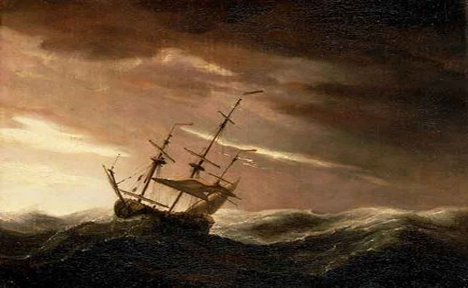
My conclusion became I will find a new path as long as I am speeding 100 miles down the old one. So here I am uncertain, but joyful; a bit perplexed but happy. I cast the lines off and am sailing into what I hope is a ‘new world’. I am grateful for the fortitude and belief in myself that made my new expedition possible. I am worth the risk!

I wondered about the explorers who’d sailed their ships
to the end of the world. How terrified they must have been
when they risked falling over the edge; how amazed
to discover, instead, places they had seen only in their dreams.
Jodi Picoult