A Long Dark Shadow

To all of you who hate yourselves, I promise this: There is a place where you’d hate yourself less. Somewhere out there, it waits. Each of us has one, whether we know it or not, whether we have found it or not, whether we have seen it with our own eyes or not. It is a nation or a city block, a mountain or a room. It is the Mekong Delta or the Prado, shopping malls or Prague.

It is highly specific and one-of-a-kind — a certain park, say, or a certain cinema — or else it is not a place but a type of place: caves, say, or hole-in-the-wall Chinese restaurants. In the latter case, two caves, one in Laos and one in Canada, or two hole-in-the wall Chinese restaurants, one in Rome and one in Shanghai, are equally your place.

Maybe you already know where it is, the place where you hate yourself less. Maybe you know this place and why you love it, crave it, dream of it and picture it while stuck in traffic or awaiting surgery. Maybe you go there every March. Or maybe you know where it is and yet have never been there in the flesh.

Or maybe you have no idea that such a place exists. It does. The formula for finding it is simple:
1. What makes you hate yourself?
2. Where do those things occur least?
3. What makes you feel inspired, serene, amused, excited (in a good way), unself-conscious, passionate, compassionate and more or less at home?
4. Where are those things?
From “There Is a Place Where You’d Hate Yourself Less… by Anneli Rufus http://www.psychologytoday.com/blog/stuck/201211/there-is-place-where-youd-hate-yourself-less

Yes, I am one of those who hates themself. Oh, don’t worry. It’s not nearly so bad as it once was and now only drifts upon me at random. Usually it is brought on by fatigue which brings on worry which ignites self-loathing. In some ways I don’t think of it as even being self-induced. Anymore it seems like some foreign adversary that attacks jumps on me when I’m down.

When is my place where I hate myself less? There are three; one specific and two general.

Specifically in my home with my things I feel safe and protected from just about everything including self dislike.

The second place of safety is traveling in foreign places. There is nothing like unfamiliar culture and language to make me forget any negative thoughts about myself. On the road experiencing something new and different I am fully in the moment taking in all the sensory information coming my way. My sense of being alive is heightened to an acute level and I am fully present in the ‘now”.

The third place self-hatred disappears is when I am with those I love and who love me. When friends and family who know the good and not so good about me, yet care about me anyway are near I find no reason to fall into self-loathing. Simply I feel safe to be just the unaffected “me” I truly am.

The glow of gratitude is within for the learned ability to throw off hating myself most of the time. And even when I can’t make it go away completely, almost always I can diminish it to a dull, short-lived level.

If you had a person in your life
treating you the way you treat yourself,
you would have gotten rid of them a long time ago…
Cheri Huber
Like Smoke Through a Keyhole

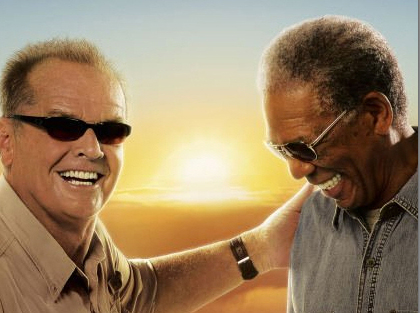
Last night I watched the movie “The Bucket List” again with someone who had never seen it. On the big screen in 2007 the film touched me, but this time it meant even more. First time around I laughed until my ribs hurt and found tears in my eyes several times. Last night this was true to an even greater degree. Five years of life have passed in a hurry since I saw “The Bucket List’ originally. Thoughts of retiring are kicking around strong in my head. My mortality is both more real and better accepted than ever before.

There are a several pieces of dialogue from the movie I find especially meaningful. One is when Morgan Freeman’s character says “Forty-five years goes by pretty fast”. The response from Jack Nicholson is “Like smoke through a keyhole”. Never have heard a more accurate description of how life speeds by so quickly.

Watching Freeman and Nicholson acting last evening confirmed even more pointedly to me I need to let go of work while there is enough of me left to enjoy what’s on my bucket list. My thinking is moving to align more with Masanobu Fukuoka who was a Japanese farmer and philosopher. He wrote several books including “The One-Straw Revolution” where the following comes from.

I do not particularly like the word ‘work.’ Human beings are the only animals who have to work, and I think that is the most ridiculous thing in the world. Other animals make their livings by living, but people work like crazy, thinking that they have to in order to stay alive. The bigger the job, the greater the challenge, the more wonderful they think it is. It would be good to give up that way of thinking and live an easy, comfortable life with plenty of free time.

I think that the way animals live in the tropics, stepping outside in the morning and evening to see if there is something to eat, and taking a long nap in the afternoon, must be a wonderful life. For human beings, a life of such simplicity would be possible if one worked to produce directly his daily necessities. In such a life, work is not work as people generally think of it, but simply doing what needs to be done.

No longer do I have this burning need to succeed and make money. After a point success frequently leaves one empty and is often its own undoing. Succeeding leaves most with a yearning for more. Likewise with money. After one’s needs are met and a comfortable life is possible, money can be a person’s downfall. Or more accurately, the relentless pursuit of more does the harm and eventually brings disillusionment. Yearning brings only more yearning.

When I combine what life has taught me, the encouragement of friends and those who care about me along with inspiration that comes from a power beyond me the need to change direction is obvious. The future’s not clearly in focus beyond a few steps, but the joy and excitement in my heart and soul tells me I am moving in the correct direction. I am grateful for such clarity.

God gave us the gift of life;
it is up to us to give ourselves
the gift of living well.
Voltaire

A Little Positive Trail Behind Me

The innocence of a child can be especially touching. For me that’s true partly because some of my innocence was stolen as a kid and partially because living has softened me over time. While the story below is just that, a “story”, it illustrates how naively wise children can be.

A little boy wanted to meet God. He knew it was a long trip to where God lived. So he packed a backpack with Twinkies and six-pack of pop, then started his journey. When he had gone about three blocks, he met an old man with a flowing beard, sitting on a bench in the park just staring at some pigeons.

The boy sat down next to him and opened his bag. He noticed that the old man looked hungry. So he offered him a Twinkie. The old man gratefully accepted it and smiled at the boy.

His smile was so pleasant that the boy wanted to see it again. So he offered him a can of pop. The old man smiled again. The boy was delighted! They sat there all afternoon eating and smiling but never said a word.

As it started growing dark, the boy realized how tired he was and got up to leave. But before he had gone few steps, he turned around and gave the old man a hug. The old fellow gave the boy a big bright smile.

A short while later when the boy opened the door of his house his mother was surprised by the look of joy on his face. She asked him, “What did you do today that make you so happy?” He replied, “I had lunch with God”. But before his mother could respond, he added, “You know, He’s got the most beautiful smile I have ever seen”.

Meanwhile, the old man, radiant with joy, returned home. His son was stunned by the look of peace on his face and asked, “Dad, what did you do today that makes you so happy?”

He replied, “I ate Twinkies in the park with God”. And before his son could respond, he added, “He is so much younger than I expected”.

As the holidays approach I am grateful for a polishing of the sensitivity of my heart that parable gives me. I hope the refreshed shine makes me a bit more open to the humanity of others and helps me to show mine to them. To leave something of a positive trail behind me is my highest aspiration.

I am only one, but still I am one.
I cannot do everything,
but still I can do something;
and because I cannot do everything,
I will not refuse to do something that I can do.
Edward Everett Hale

Work and the Ability to Change

I’m packing and getting ready to rush to the airport to return home after a business trip that has taken up the majority of the week. I find myself asking “why I work” a lot these days. And more so, why do I work in the same profession I have been in for many years. While clear answers are difficult to come by, I do find guides along the way like the article just below titled “Why Do We Work” from the Washington Post by Michael Maccoby.

Many people would be happier with jobs that make better use of their abilities. Even so, people do not work for money or survival alone. Even when necessity forces us to take a job, financial need is not the only reason we work.

Work ties us to a real world that tells us whether our ideas make sense; it demands that we discipline our talents and master our impulses. To realize our potentialities, we must focus them in a way that relates to the human community. We need to feel needed. And to feel needed, we must be evaluated by others in whatever coinage, tangible or not, culture employs. Our sense of dignity and self-worth depends on being recognized by others through our work. Without work, we deteriorate. We need to work.

In this still fragile economy, many people will be motivated at work they do not like mainly to keep their jobs for the sake of income and mental health. But a leader who wants enthusiastic collaborators needs to engage them in work that is meaningful to them. This can be done by focusing on four Rs: responsibilities, relationships, rewards and reasons.

We are motivated when our responsibilities are meaningful and engage our abilities and values. The most meaningful responsibilities stretch and develop us. Caring people are motivated by work that helps others. Craftsmen are motivated by producing high quality products.

We are motivated by good relationships with bosses, collaborators, and customers. Fun at work is motivating. So is appreciation for helping others.

Rewards can be motivating, but they can be overvalued. Of course, investment bankers will exhaust themselves for huge pay offs. And piece workers, sewing garments or assembling gadgets, will work harder producing more finished products for the extra dollars. But there is no evidence that teachers will teach better to make more money. Incentive pay focuses a person on particular tasks, like teaching to the tests. It can stimulate a doctor to see more patients, but not treat them any better. Or it can strengthen a boss’s authority by rewarding a subordinate for following orders. But if someone does not feel fairly rewarded compared to peers, incentive pay becomes de-motivating. People may be more motivated by public recognition and appreciation for their work than by money.

Reasons can be the most powerful motivators. Workers doing repetitive work on an assembly line during World War II were highly motivated because they were helping to win the war. The same work in peace time would be boring. People take pride in work that contributes to the well-being of others and the common good. Leaders who articulate a meaningful purpose, support good relationships, give people responsibilities that engage and develop them, and recognize exceptional work will most certainly gain enthusiastic collaborators.

For the moment I am content to do the work at the job I have, yet I know big changes are ahead for me. For so long change was unnerving, but today I am grateful to say I am excited about the possibilities and open to where the future takes me!

What people have the capacity to choose,
they have the ability to change.
Madeleine Albright

Presence in the Present

So much of what we think about and are encouraged toward revolve around getting ahead. In general there is nothing wrong with that except it has a tendency to keep one constantly focused on the future with little presence in the present.

We wonder where our love, friend and family relationships are going. We wonder how to move our livelihood forward and brood over making more money. We think about all the things we should do, the projects we intend to take on.

We crave growth to feel a sense of purpose and progress, but why? Is it born in us? Or something we’re conditioned to believe. Quite possibly some of both, but the latter is a stronger force in my opinion. All around us we are coerced into putting so much energy into pushing and striving; so much so we frequently miss out on the joy of being where we are.

There are reminders of this for everyone in experiences that cause us to pause and fully absorb it. When one has climbed a mountain for hours and takes a moment to stand proudly on the peak is one of those times. Seeing my son born was such an experience I described in a journal as being one “that helped me to better understand life at an intuitive level I could not put into words”.

See a child become enamored with something they perceive as amazing can do it; a spectacular sunrise can cause one to stop; an outstanding performance or great art can stop one in their tracks; and one of the most powerful is simply kindness shown at a critical moment which moves one down deep emotionally. All are moments when a person can arrive in the “present”, notice it and for a few moments stay there.

From a purely mathematic viewpoint, it’s obvious we have fewer opportunities to enjoy arriving in the moment than we will have to enjoy the journey. Growing intention to notice the richest moments of life brings more of them. And this awareness brings more special moments to the journey of life. For the school of hard knocks that was my mentor in this learning, I am unassumingly grateful.

It’s not the answers you get from others that will heal you,
But the questions you ask of yourself:
What part of my life feels broken?
What do I need to heal, to learn, to accept, to reject,
Or embrace before I can give myself permission
To simply do what feels right?
Anonymous

Right Here, Right Now

Once upon a time there was a man who spent his life in a hurry. He was always headed toward something or getting away from something else, but never seemed to arrive anywhere.

He would drop things because he’d bump into stuff or accidentally let his hand brush against what he was walking by just enough to dislodge what was in his hand. He was not drunk, didn’t have balance issues nor was particularly uncoordinated. He was just never mentally precise about where his body was.

The man often thought about where he should be and who he should be with. He yearned for love, yet had walked through being loved many times.  His habit was to always run past love before he actually realized how deeply he cared about someone and they about him. Only when the present became the past could he see much of anything with clarity.

There were small scars and scruffs on his hands and legs from moving in haste. Working with his hands he’d often get ahead of himself and end up with a small wound to show for the haste. His legs were often bruised in small places. When he noticed one usually he had no idea what he did to get the bruise.

Was he running toward what was in his mind or running away from something lodged there? Could it be he was doing both at the same time? Yes, I think. Stretched between the past and the future there was so little of him actually in the present.

Eckhart Tolle wrote exactly what going on with the man,  You cannot be both unhappy and fully present in the Now. Why does the mind habitually deny or resist the Now? Because it cannot function and remain in control without time, which is past and future, so it perceives the timeless Now as threatening.

The year, the day, or the time,
It is not important,
Yesterday is gone,
Tomorrow does not yet exist.
Only now do you have the chance
To be whoever you are.
Only now can you live
With the passion of spirit
And the spark of inspiration.
This is where everything ends,
And where everything begins,
Right here, right now
In the flow of what is.
This is all that you have.
Hold on, but let go.
Connect, but be separate.
There is pain in growth,
But there is also wisdom.
To know is to know not.
Every movement, every transition is a risk,
It is an opportunity to transform.
It does not matter what it all means,
It is a play that exists in eternity.
From “The Play” by Conny Jasper

The man written here about is mostly me as I used to be. While far from perfect and constantly bouncing from ‘Now” into the past and the future, I do spend a lot of time in the present than ever before. And it is those moments when I am happiest, enjoy life most and feel gratefulness the deepest.

The past gives you an identity
and the future holds the promise of salvation,
of fulfillment in whatever form.
Both are illusions.
Eckhart Tolle

Peace Within the Riddle

What do you want? Or is what you want always just something you don’t have.

Those spoken words actually came falling out of my mouth this morning from a source I am unsure of. Since I live alone, saying such a thing aloud actually caught me by surprise. Only after speaking them did I start to wonder where they came from. Nothing specific happened. No particular thought was bouncing in my head.

All I did was go stand on my porch for about a minute taking in the cooler weather. Enjoying the view of the big cyprus tree out front decked out in its rich fall brown I watched the needed autumn rain drizzle down. Listening to the soft splatters on my driveway and the gentle ringing of drops falling in the gutters, I felt contented in the moment. Then as I came back in my home and was walking down the entry hall, those words arrived for me to say aloud to no one except myself: What do you want… or is what you want always just something you don’t have?

Neil Gaiman wrote, I don’t want whatever I want. Nobody does. Not really. What kind of fun would it be if I just got everything I ever wanted just like that, and it didn’t mean anything? What then? So does that mean I will always be malcontented and never at peace with where I am and what I have? I hope not. Such a cyclical truth going round and a round in my brain would be maddening like a dog chasing, but never catching, his tail!

A lot of people get so hung up on what they can’t have that they don’t think for a second about whether they really want it, was Lionel Shriver’s view of things. In that case I’d like NOT to be in the group he called “a lot of people…” and believe I have escaped the usual simply by asking my question; What do you want… or is what you want always just something you don’t have?

Thinking redemption and happiness can never be found in “what is” and instead only achieved within “what might be” is the near raving of a lunatic. In his novel “Lullaby” Chuck Palahnuik stated his version of this thought when he wrote, Are these things really better than the things I already have? Or am I just trained to be dissatisfied with what I have now?

Possibly the continual search for more, different and new is a natural insanity that is innate with being human. Dan Millman wrote in “Way of the Peaceful Warrior…”  If you don’t get what you want, you suffer; if you get what you don’t want, you suffer; even when you get exactly what you want, you still suffer because you can’t hold on to it forever. That brings me back at my original quandary: What do you want… or is what you want always just something you don’t have?

I found an explanation that sets my mind at ease to some degree in an article written in Psychology Today by Alex Lickerman, M.D., a practicing Buddhist for over twenty years. He wrote: Research suggests that our conscious minds aren’t so much in charge of the decisions we make as they are great rationalizers of them. Which means they often collude with our unconscious minds to craft stories about why we do things and even why we feel things that are just blatantly untrue. We often have far more invested in seeing ourselves as virtuous, noble, fair-minded, and good than we do in recognizing the truth: that we often want things and therefore do things that make us base, selfish, self-righteous, and unjust. All of which is to say that sometimes we may not actually know what we want. Or, even more commonly, we may not know why we want it.

What do you want… or is what you want always just something you don’t have? That thought I spoke aloud this morning has no precise answer, except to find peace within the riddle through accepting what is and trying to keep hope for a future with no specific definition. For the calming effect of the experience of writing this, I am humbly grateful.

As soon as you stop wanting something,
you get it.
Andy Warhol

Gone Fishin’

If any ask, where have you been
I’ll say gone fishin’ – not a sin
Left my writing on the shelf
Went wandering off to meet myself.

Ask some questions of my heart
Seek some answers, quite apart
I’m not so sought or even known
I cannot steal this time alone.

I’ve gone to check the stock in store
Take stock of my long stored-up lore
Sort out things I have long forgot
Throw out some things begun to rot.

Try to be wise and bring that to bear
On what and when and who and where
Bring order back to things askew
And by such order, see anew

So I open doors a long time locked
Push through hallways long time blocked
Finger ideas, look through thoughts
Shuffle maybes, mights and oughts

Linger long at problem spots
Work at angers tied in knots
Shine a light on cracks and stains
Gaze again at love’s remains

Then slept on memories piled in heaps
Dreamt restless dreams in restless sleeps
Got blackened fingers from the dust
Snorted, sneezed and even cussed

And then I set about the chore
Of making choices and — what’s more
Making wishes and pagan prayers
That I’ll remember — life’s lived in layers

So my fishing trip was all I wished
Because when I sat down and fished
I conjured up the past and more
All of my legends, fables, and lore

But my fishing nets are now set to dry
We reached concord, myself and I
In doubt I left, assured return
Restored in what I found to learn

The present stands now, raw but clean
What was hidden, now been seen
Order again is now manifest
I am at peace, my heart at rest

So I am back to writing out
Things I know a bit about
I put words down to tell my stories
Trailing fishing nets and past glories
Taken from “Gone Fishin” by ‘Wilbur’ http://www.booksie.com

I’ve not really gone fishin’ and am buried in work instead. Just reading the poem freshens my resolve to finish what I’ve started and stay on the path forward. Today that feels like a massive gift I am grateful for.

When you’re unhappy, you get to pay a lot of attention to yourself. And you get to take yourself oh so very seriously. Your truly happy people, which is to say, your people who truly like themselves, they don’t think about themselves very much. Your unhappy person resents it when you try to cheer him up, because that means he has to stop dwellin’ on himself and start payin’ attention to the universe. Unhappiness is the ultimate form of self-indulgence. Tom Robbins

Most Loving Family I Have Known


Last evening my Codependence Anonymous ‘family’ celebrated my fifth year in recovery from codependency.  It was a moving experience just like each anniversary before. “Blessed Are They” below originally posted on April 5, 2012 https://goodmorninggratitude.com/2012/04/05/blessed-are-they/

Codependency is a behavior pattern in which a person tends to form unhealthy relationships. People like me who have engaged in codependent behavior almost always appear to place the needs and desires of other people before their own. These other people often have unresolved emotional issues and sometimes addictions which the codependent person tries to repair, ignore or avoid. That is certainly true with me as I often picked people who needed “fixing”.

Ironically, the source of codependency isn’t about other people – it’s about the relationship with one’s self. Generally this manifests in things like insecurity, deficient self-confidence and even self-loathing. At the core of it all is a scarcity of self-love. Within that condition I spent many years feeling “less than” and that I didn’t measure up. I hid those feelings well and they were rarely noticed by anyone.

One of the tendencies of codependency is difficulty accepting gifts. When someone gives me something, that gift is far from unappreciated. Actually I am thankful beyond my ability to express gratitude. It’s a conflicted feeling of unworthiness in one sense, yet being hugely grateful at the same moment. Talk about bewildering!

Gifts received with difficulty are not just tangible items, but compliments and pats on the back as well. The latter two can be especially hard to accept with a tendency to deflect the good that has been expressed in my direction. At the least there is often some sort of discounting expressed. An example is someone saying to me “you did a great job on that project” with my reply being “no big deal” or “most anyone could have done it”. Receiving positive feedback is highly prized within me but even today I am uncomfortable receiving it. However I have learned to just say “thank you” even though I often blush a little when I do.

There is a tradition in most 12-Step groups to celebrate the annual anniversary of a when a person first got into recovery. Codependents Anonymous is no exception. A brass coin is given which is first “charged” with a few encouraging comments said by each group member one at a time while holding the coin.

The date marking the end of my fourth fifth year was last October, but when it came up in the group to award my coin I always found some excuse to put off the award. I’d say I wanted to make sure “so and so” was at the meeting or something of the sort. Of course I always picked someone who rarely came to the meetings any more as my way of putting it off.

Why I kept dragging my feet on the simple little celebration of my anniversary was simple: Listening to good things said about me on other “recovery birthdays” embarrassed me. I LOVED HEARING THEM but reception of those “gifts of love in words” from the group members conflicted with the conditioning of codependence of not being “worthy”.

Such kindness and love expressed toward me last night brought fidgeting, teared up eyes and even a red face of positive embarrassment more than one. The latter coming from the simple fact that it is still hard to imagine that people like and respect me as much as they said. Yet, I know all spoke honest words from their heart. A day latter the joy still dances in me for the sincere people who said such loving things to me. The little boy who rarely if ever got such praise as a child is happily frolicking within today. I am grateful beyond words to my Wednesday Codependence Anonymous group!

Blessed are they who see beautiful things
in humble places where other people see nothing.
Camille Pissarro

So What…

Life is what we make it,
always has been,
always will be.

American painter ‘Grandma Moses’ (Anna Mary Robertson 1860-1961) did not write that, begin painting or become famous until she was over seventy years old. I read an article about her recently and was inspired to write the following:

Life is hard; so what…
It would be taken for granted without difficulty.

Life is crammed with deceit; so what…
The constant possibility lends value to truth.

Life is filled with doubt; so what…
If all was certain existence would be colorless.

Life is painful; so what…
Pain is the mirror reflection of joy. It lends depth to the good.

Life is temporary; so what…
The impermanence of living makes time precious.

Life is a demanding teacher; so what…
Experience is the only truth we accept fully.

Life contains failure; so what…
Possibility of failing makes succeeding worthwhile.

Life is crammed with loss; so what…
It is the possibility of losing that makes ‘having’ meaningful.

In the book “The Road Less Traveled” M. Scott Peck wrote Life is difficult. This a great truth, one of the greatest truths. It is a great truth because once we truly see this truth, we transcend it. Once we truly know that life is difficult — once we truly understand and accept it — then life is no longer difficult. Because once it is accepted, the fact that life is difficult no longer matters.

Time has taught me to do my best to embrace life’s struggles; to see each heartbreak as a valuable mentor; that light is just beyond the next dark hill and there’s no growth with pain. Life’s difficulties are necessary for my development, so when troubles come along  I do my best to accept them; embrace them. The quick fix and easy way out to escape difficulty temporarily is no longer my constant ally. With each discomfort it is the old, inferior me dying so a new better me can be born. My gratitude is deep for the wisdom of knowing that pain means growth. It always points forward.

Don’t wish it was easier;
wish you were better.
Don’t wish for less problems;
wish for more skills.
Don’t wish for less challenges;
wish for more wisdom.
Jim Rohn