We All Have Twenty-Four Hour Days

habit0001

You can do anything,
but you can’t do everything.
David Allen

What has my attention at this moment? My thoughts are directed at words surfacing in my mind and typing them with a considerably lesser amount of awareness of music playing on Pandora. I’m vaguely aware of the surroundings of my home office, the art and posters on the wall and the noise of an occasional neighborhood car that drives by. That’s all my mind can take on at the moment.

People have a fixed amount that must be allocated according to need. To use a popular analogy, attention is like a bucket of water. People draw upon it as needed, but every dipper full and every teaspoon full leaves less for other purposes. Marc Green

Two interesting components have arisen with the increase of discretionary time I now have: 1) my perception of the world outside me has increased. I notice more, see things more deeply and generally feel good because of it. 2) With a richness of time, it is easy to let hours and days slip by with little to show for them. Some of that is good. Some of it is not so positive.

Zig Ziglar said, “Lack of direction, not lack of time, is the problem. We all have twenty-four hour days.” My conclusion is that expecting myself to settle into new routines within my first 60 days of semi-retirement was too much to ask. Already I feel better letting myself off the hook of that unrealistic expectation.

…the allocation of attention is largely automatic and occurs without awareness. As a result, it is not easily brought under conscious control. You may direct someone’s attention by saying “watch the step,” and temporarily cause a conscious allocation of attention to the step. However, there is a good chance that within a few minutes or even seconds, the memory trace will disappear and the next time the person will fail to notice the step. The same automatic factors that directed attention away from the step in the first instance have not changed. Marc Green

The paragraph from Marc Green helps me a good deal because it tells me that keeping a keen awareness of my desire to form new routines is a great start to having them. All I have to do is follow through on what I have concluded and stay aware with a sense of priority. Then new routines will simply fall into place. Whew. I am grateful to “get off my own case”.

I didn’t pay attention to time or distance,
instead focusing on how it felt just to be in motion,
knowing it wasn’t about the finish line
but how I got there that mattered.
Sarah Dessen

 Originally Posted on September 17, 2013

Fundamental to Living Well

TheEverygirl_LivingWell_AccessIntuition

I came across what’s below in an email a friend sent several years ago and found it particularly meaningful. Hope it serves others as well as it did me.

Checklist of 50 Characteristics & Views to Continually Live Better & Better:
1. You are absolutely confident that you can achieve what you desire
2. You believe that things will always work out the way they should
3. You are optimistic about the people around you and opportunities
4. You are loving
5. You are kind
6. You are generous
7. You are trusting and trustworthy
8. You refuse to let the past define or limit your current reality
9. You are easily able to let things go and get over things that bothered or upset you
10. You are open-minded
11. You are flexible
12. You refuse to reflect on all the things that can possibly go wrong
13. You are confident about the future and how it will unfold
14. You are appreciative of the big things…and the small ones too
15. You are thankful
16. You are humble
17. You consistently rely on and trust your good intuition and insights
18. You realize that everything happens for a reason
19. You aim to live and learn from everything around you and all that happens
20. You never lose your cool enough to get out of control
21. You refuse to waste energy on petty issues
22. You never complain
23. You are empathetic
24. You are helpful
25. You don’t brag
26. You always bring positive energy to every situation
27. You know how to control thoughts and ensure they’re positive and constructive
28. You are peaceful
29. You are pleasant
30. You continually choose to feel good regardless of what is going on around you
31. You know how to elevate your mood when necessary and get to a better place
32. You are inspired and inspiring
33. You are motivated
34. You genuinely want the best for other people
35. You have lots of great positive energy
36. You don’t judge others
37. You never gossip
38. You have no need to win an argument or be right
39. You are never really offended by anything or anyone
40. You are patient
41. You are satisfied with the time it takes things to play out
42. You have lots of great relationships
43. You are grateful to be exactly where you are at the current moment
44. You are inquisitive
45. You are understanding
46. You are able to tap into your innate brilliance
47. You are healthy
48. You are in good physical condition
49. You are able to truly enjoy silence
50. You consistently observe and notice things you like and what is working
We currently may not have all of these characteristics and views, but if we are interested in having more and more positive momentum and more positive results appear in our lives, we will work to develop and strengthen each and everyone one of these things. There are certain things that are just fundamental to living well. Original source unknown

Since moving stored knowledge into intention and action, slowly but surely my living experience has consistently gotten better. My forward movement is far from perfect but like a work being sculptured, I am my own chisel and hammer that shapes me and all I perceive about being alive. I am grateful to the person who sent the list to me three years ago and to have rediscovered it this morning.

A man sooner or later discovers
that he is the master-gardener of the soul,
the director of his life.
James Allen

Seeing Beyond Just Looking

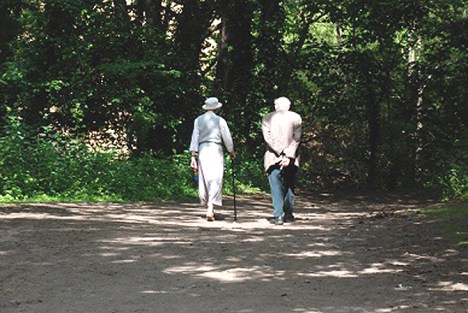
old couple in woods

I have no certainty where exactly I got the idea.  It may have been from something I read or several things I came across blended together.  It may have even been a spontaneous realization.  But in the last 10 years I have learned to “see beyond just looking”.  I can’t do it all the time.  Actually that is probably impossible for a human being.  If I could I suspect I’d end up over dosed in goodness like Woody Allen was with the “orb” in the movie Sleeper.  Seeing beyond looking does happen for me frequently and the more I intentionally try the more frequent the activity comes without thought or effort.

My discovery was I mostly only acknowledged what came into view.  I walked without really noting  what was right before me.  Mine was a bad habit of hardly never really “truly seeing” much of anything.  My mind seemed to always be racing forward thinking about where I was going, what I had to do and what issues I needed to deal with.  Or else, I was looking backwards trying to solve some past emotional riddle or find some meaning in an episode of life I wanted an explanation for.

What I began to do, inconsistently at first, was to just stop and really take in visually what I was looking at.  There was amazement the first intentional time I took 30 seconds to study a beautiful tulip, to see its unique form and texture and to take in its vibrant red color.  I was stunned to look and see so much always detail missed before.  It was during the early times of having these experiences with intention when I noticed how beautifully blue the sky really is (which is still one of my favorites to marvel at).

How touched I became when I locked my vision on an elderly couple watching the man help the fragile woman out of the car and attending to her to get into a restaurant.  Eating at the same place as they were I watched the smiles they exchanged while eating and from a distance the conversation they were having.  I saw a couple deeply in love just moving in slow motion;  true romance at half speed.  Without looking closely I would have dismissed them mentally as “old people” and hardly noticed them at all.

I found delight in watching a toddler in a park giggling wildly while chasing a grasshopper like it was the greatest find of the year.  Truly sitting and watching birds through a window enjoy a feast of crumbled bread I put out for them on top of a big snow allowed me to notice the quirky uniqueness of each breed and what appeared to be joy in the abundance they had found.  And then there is nature!  A walk in the woods or a park became a sensory banquet.

When was the last time you sat and watched a sunset or sunrise?  When was the last time you actually “saw” a person instead of just looking at them.  How long since you gazed in a mirror and actually saw yourself instead of just acknowledging your reflection?  How long has it been since you focused on something to the point to where you found sheer delight in what you were looking at?  For me I am glad to say “no long ago”.   I am grateful to have stumbled across this activity and to have cultivated the habit.  As time passes with consistent effort I find I am able to more truly see with greater depth and frequency.  If life is a feast, then this is the seasoning for the meal.

Taken from “Seeing Past Myself” – Don Iannone

Sometimes I have trouble
Seeing past myself
Blindsided by who I think I am
…oblivious
To the vast world of possibilities…
I clean my glasses twice a day
Unfortunately it’s to see what I want to see
And not beyond that
I guess I’m no different –
Than you, or anyone else.
My self-image directs my eyes.
There’s a solution you know
It’s not as hard as we think
Open our hearts to unknown possibilities
Accept that our version of reality
Is but one of many out there.

The real voyage of discovery consists of not in
seeking new landscapes but in having new eyes.
Marcel Proust

First Posted on May 25, 2011

The Thankful Heart

grateful_yellow

It’s easy to become immune to, and much less grateful for, the small things in our lives. We allow our feelings of being overwhelmed and our yearning for achievement and material satisfaction to overshadow the precious little gems of life that are all around us.

In our quest to experience the more seductive and exciting “highs,” we have lost sight of the fact that most of life, indeed a vast majority of it, is made up of small things and moments, one right after the other.

Learning to appreciate these things and moments play a huge role in creating a peaceful and happy life. Although the things themselves may be small, failing to appreciate them has really big ramifications!

The failure to acknowledge and, indeed, appreciate the small things breeds an inability to be touched by life. The wonder and awe of life is diminished, the feelings associated with appreciation and gratitude are missed, and, perhaps more than anything, you’ll be sweating the small stuff all the time. The reason this happens is that when your attention isn’t on what’s right, beautiful, special and mysterious, it will be on what’s wrong, what’s irritating, and what’s missing. Your focus of attention will encourage you to be “on edge” and on the lookout for problems instead of the small things that bring you big joy and are right in front of you.

Unfortunately, this type of attention feeds on itself and becomes a way of seeing and experiencing the world. You’ll be too busy thinking about the condescending remark you over heard at lunch or the way your blouse doesn’t look quite right to notice the friendly smile of the checkout clerk or the beautiful art on the classroom wall.

On the other hand, when the bulk of your attention is on what’s right with your life, what’s precious and special, the payoff is enormous. You’ll re-experience the feeling that life is magical and every moment is to be treasured. Instead of complaining about the litter on the side of the road, you’ll notice the colors of the trees and plants. Again, your attention will feed on itself and, over time, you’ll notice more and more things to be grateful for. Your habit becomes a self-fulfilling prophecy.

When you talk to anyone who is very sick or who has had a near death experience, they will tell you that the things you usually think are “big” are, in fact, relatively insignificant; whereas the things you think are small are, in fact, what’s most important. Money, for example, or physical beauty, or an accomplishment, or a material possession can seem to be the end-all, feeling extremely important, even more than life and death issues. Yet, when looking back on your life, it’s very likely that these things that once were in clear focus have lost their luster. They will seem less important, maybe even superficial. On the other hand, the beauty of nature, the touch of newborn fingers wrapped around your own, a lovely smile, or the gift of friendship, will be precious and indeed priceless. From an online article by Kristine Carlson http://www.positivelypositive.com/2012/07/20/be-grateful-for-the-small-things/

Never will I be as grateful as I could be. Any reminder to focus on the meaningful things is always welcome. No matter how much I improve my practice of thankfulness there is ALWAYS room to grow my gratitude.

The unthankful heart… discovers no mercies;
but let the thankful heart sweep through the day
and, as the magnet finds the iron,
so it will find, in every hour, some heavenly blessings!
Henry Ward Beecher

The Occupation of Childhood

Happy child with painted hands

Play is the most important activity in the lives of children.
Sometimes it seems more important than eating and sleeping.
Sometimes play is easy and fun.
Sometimes play is trying hard to do something right.
Play is the work, the occupation of childhood.
L.S. Lagoni

The ‘occupation of childhood’ is just as important to adults, but most of us have lost that knowledge in responsibility, ‘real work’, worry and generally being grownups. It’s been more than a decade since I had playtime regularly with my son as he grew up. I had nearly forgotten the joy of playing and how healthy it is.

Scoff at the thought of playing with finger paint, coloring in a coloring book or making a collage from magazine cut-outs for no particular purpose if you want. You don’t know what you’re missing. A unique and artistic friend and I got together for ‘playtime’ yesterday. We had planned to make collages for a couple of months, but our adult lives gave us excuses to kept it from happening.

We warmed up with finger paints and then moved on to the serious business of cutting pieces that moved us from magazines for our collages. It was interesting that the longer we did that, the quieter we became; each intently focused on finding just the right things to cut out. As we were scissoring stuff from the pages, each was understood completely in the moment by the other. Without speaking hardly a word it was clear between she and I that what we were doing was not just for children. This was serious and meaningful business for grownups: PLAY! We were doing the simple, enjoying the uncomplicated while being completely at home with each other and enjoying the ‘Now’. How very cool!

Play is simultaneously a source of relaxation and stimulation for the brain and body. A sure (and fun) way to develop your imagination, creativity, problem-solving abilities, and mental health is to play with your romantic partner, office-mates, children, grandchildren, and friends.

Play is often described as a time when we feel most alive, yet we often take it for granted and may completely forget about it. But play isn’t a luxury—it’s a necessity. Play is as important to our physical and mental health as getting enough sleep, eating well, and exercising. Play teaches us how to manage and transform our “negative” emotions and experiences. It supercharges learning, helps us relieve stress, and connects us to others and the world around us. Play can also make work more productive and pleasurable.

Despite the power of play, somewhere between childhood and adulthood, many of us stop playing. We exchange play for work and responsibilities. When we do have some leisure time, we’re more likely to zone out in front of the TV or computer than to engage in creative, brain-stimulating play. By giving ourselves permission to play with the joyful abandon of childhood, we can continue to reap its benefits throughout life. http://www.helpguide.org/life/creative_play_fun_games.htm

Thanks for the play-day K.! It was big fun and the positive effects are still bouncing within now a day later. My collage (below) is still hanging up in the kitchen. I still don’t have a clue what it means, but know what I randomly chose and glued down speaks from my heart and soul. Maybe it all has no meaning except I was able to feel contented like a child. And that’s a huge gift. How wonderful to feel seven years-old again!

What do most Nobel Laureates, innovative entrepreneurs, artists
and performers, well-adjusted children, happy couples and families,
and the most successfully adapted mammals have in common?
They play enthusiastically throughout their lives.
Stuart Brown

IMG_1874CLOSE

The Power of Hopeful Wisdom

angelyes1

*Voice 1: You have been given a second chance to start your life over.

Voice 2: How can that be? I’m late middle age… hell, I’m old.

Voice 1: You can’t throw this opportunity away. If you do you will be a colossal fool.

Voice 2: I’m tired and don’t believe in things like I once did. Leave me alone.

Voice 1: If you get the chance to do something and don’t do it then you’ll simply live with regret.

Voice 2: I have failed so many times I am tired of even thinking about starting new.

Voice 1: That’s a worse situation than trying something daring and maybe not succeeding. At least you tried. Dare to dream!

Voice 2: Why should I believe I still have the ability to make what I wish for come true?

*Voice 1: If you did not have the capability to make your wildest wishes come true, your mind would not have the capacity to conjure such ideas in the first place.

Voice 2: But I am emotionally beat up and battle-scarred.

Voice 1: There is no limitation on what you can potentially achieve, except for the limitation you choose to impose on your own imagination.

Voice 2: So you’re saying if it is to be it’s up to me?

Voice 1: What you believe to be possible will always come to pass – to the extent that you deem it possible. It really is as simple as that.

The voice in my head was naively hopeful in my youth (Voice 1). In middle age, the experienced voice became wiser, but cynical (Voice 2). By fighting my tendencies and stirring both Voices together I was able to connect a measure of wisdom and hope. It took intention and a lot of effort to change my perceptions, but was worth the struggle.

To be wise to some extent and hopeful at the same time, now that’s a great life. I am grateful it is mine.

I am old and I have had
more than my share of good and bad.
I’ve had love and sorrow, seen sudden death
and been left alone and of love bereft.
I thought I would never love again
and I thought my life was grief and pain.
The edge between life and death was thin,
but then I discovered discipline.
I learned to smile when I felt sad,
I learned to take the good and the bad,
I learned to care a great deal more
for the world about me than before.
I began to forget the “Me” and “I”
and joined in life as it rolled by:
this may not mean sheer ecstasy
but is better by far than “I” and “Me.
Meryl Gordon

*Voice 1 borrowed from the writings of Anthon St. Maarten and Lorena Bathey

Being Whole

sunrise-screensaver copy2

Reflecting back there was never a time where I actually hated myself. There have been frequent times I have hated something I did and held myself overly responsible for a long time. It was from a collection of such things that I ended up with a very mediocre view of myself. That came from including credit for the good but neutralizing it with my negative deeds.

Giving myself credit for the good I have done is important to have a decent self-image, but such things should be kept far away from those I perceive as bad. Each is a far different thing and has little to do with the other. Good does not cancel bad any more that the reverse is true.

In photography a “gray card” is used to take light readings as it represents the colors of the average scene all melted down into one color. This medium “gray” does not attract the eye and is boring and plain. Life is not best lived like that. I should not try to stir all my good and bad together. Rather like a bold painting that has dark grungy areas and bright beautiful colors is how I should view my life.

In my view the opposite of being bad is not “being good”, but being whole; wholly human and a unique combination of dark and light. I am grateful to grasp that point and be able to use it to slow myself down when I start weighing out my ‘goods’ and ‘bads’.

There is so much good in the worst of us,
and so much bad in the best of us,
that it hardly becomes any of us to talk
about the rest of us.
G.E. Cooke

The Year’s Last, Loveliest Smile

The first day of fall was a week ago, but until today the weather was still very much summer like. Today is the first ‘fall like” day we’ve had. It’s overcast, rainy and cool. The following originally posted almost a year ago on October 8, 2012 shows a true ove of autumn. 
——————————————————————————————-

The first chill of fall has hung around for three days now and there is change in the air. Lawns and bushes are still holding their green, but leaves are coming down. The time of autumn’s grand display is not far away when frost turns most everything into bright yellow, vibrant orange and brilliant red.

The seasons have long suited me in a different manner than is typical where Spring is the first season, Summer comes after, Fall arrives third and Winter comes at the end. Autumn is the season I love best and comes first in line for me. Fall to me is the awakening; a new beginning. Winter comes afterward as a time of growth, study and reflection. Spring growth comes with a general bursting forward followed by Summer which is just Spring in old clothes; over-grown. After all a season with two names, Fall and Autumn, must be special!

Fall has always been my favorite season. The time when everything bursts with its last beauty, as if nature had been saving up all year for the grand finale. Lauren DeStefano

Squeeze your eyes closed, as tight as you can, and think of all your favorite autumns, crisp and perfect, all bound up together like a stack of cards. That is what it is like… the wonderful brightness of Fairy colors. Catherynne M. Valente

Delicious autumn! My very soul is wedded to it, and if I were a bird I would fly about the earth seeking the successive autumns. George Eliot

Use what you have, use what the world gives you. Use the first day of fall: bright flame before winter’s deadness; harvest; orange, gold, amber; cool nights and the smell of fire. Our tree-lined streets are set ablaze, our kitchens filled with the smells of nostalgia: apples bubbling into sauce, roasting squash, cinnamon, nutmeg, cider, warmth itself. The leaves as they spark into wild color just before they die are the world’s oldest performance art, and everything we see is celebrating one last violently hued hurrah before the black and white silence of winter. Shauna Niequist

Autumn is a second spring when every leaf is a flower. Albert Camus

Gratitude overflows on these cool days and chilly nights of Autumn. Feeling the fresh air of Fall on my skin and seeing the landscape unfold in an abundance of color is truly one of my favorite things. It is some of God’s greatest art.

Autumn…the year’s last, loveliest smile.
William Cullen Bryant

Years of Friction

tree adapting to friction

It is not work that kills men, it is worry.
…worry is rust upon the blade.
It is not movement that destroys
the machinery, but friction.
Henry Ward Beecher

In Colorado last week visiting my son, I was waiting in the car when I noticed the little tree in the photo. No only had the sapling accepted to its position in life and had adapted to it, the tree had begun to use the adaptation to its benefit against the winds in Boulder.

Years of friction of the tree trunk rubbing against a cable caused the sapling to adapt. Now as the tree gets older it has begun to grow around the source of friction making itself stronger in the process. It changed and now benefits from what once was the source of injury.

And so it is with life. Resistance to life as it is, does not benefit a person. The injury is to the thinker and not the subject of the thoughts. Things improve when one allows them self to be adapted to real life. The little tree does not think. It only does what is the most healthful for survival. For the tree, like humans, adaptation is often he different between a good life and a difficult one.

The sapling could not know the Serenity Prayer, but practices its principles implicitly.
God, grant me the serenity to accept the things I cannot change,
The courage to change the things I can,
And wisdom to know the difference.
From a poem by Reinhold Niebuhr

I am grateful to the small tree. It “spoke to me” with a reminder to adapt to one’s circumstance when there is not other option.

A gem cannot be polished
without friction,
nor a man perfected
without trials.
Lucius Annaeus Seneca

Intention, Decision and Chance

windingPath

Does the walker choose the path,
or the path the walker?
Garth Nix

When I was younger destiny seemed out of my control.; a predetermined path to eventual destinations. I grew up, became an adult and stopped thinking much about fate. My mantra was “if it is to be it is up to me”. I was lord and master of my life in those days, or so I thought.

A false sense of clarity is a frequent symptom of youth and my case of the “Mr. Know-It-All” virus was worse than most. Growing up in the chaos of a dysfunctional family caused me to end up with an over developed sense of self-reliance. I learned to survive. My belief was only person I could rely on was me. I entered adulthood believing what Ralph Waldo Emerson wrote, “The only person you are destined to become is the person you decide to be.”

What worked for a while when life was simpler, did not serve me as well when life became complicated with career, marriage and a child. Well into my thirties I began to see that where destiny had placed me had a lot to do with my decisions.

My problem was choices made in my 20s and 30s were too often not the best ones. Good or bad choices, they helped shape my fate just the same. “Destiny is a name often given in retrospect to choices that had dramatic consequences”, wrote J.K. Rowling. Over time I came to make better decisions because I tired of living with and trying to fix choices made recklessly. Better decisions made my destiny better. Seems simple now, but arriving at that realization was anything but simple.

Today I think of destiny as a cosmic soup of intention, decision and chance seasoned with the divine. In the throes of making a big decision it’s never clear exactly what is influencing me. The best I can do is take my time, pay attention to my feelings and ask for outside input from friends and my higher power.

I am grateful for the wisdom life lends a person who is open to learn.

There’s nowhere you can be
that isn’t where you’re meant to be…
John Lennon