Independence Day Declaration of Gratitude

Each year, the United States celebrates its decision to declare independence from Great Britain on July 4, 1776. “Independence Day” established the United States of America as a new country.  Until 1776, the U.S. was a collection of colonies and territories under the rule of several different nations. France, England, Spain and Denmark all held territory throughout the new world. The Northeastern seaboard of the Atlantic Ocean was largely controlled by the British, who divided the land into thirteen separate colonies of the British Empire.

After decades of British rule and being subject to British taxes, citizens of the colonies grew eager for a new government. Unlike the monarchy in Britain, The United States would be ruled by elected officials and devote itself to the rights of the people. Powerful representatives of the colonies joined together in the Second Continental Congress, and drafted a document announcing their independence from Britain. At this point, the American Revolutionary War was well under way, and the resulting Declaration of Independence was really more of a formality as colonial forces were already fighting the British throughout the colonies.

My country is far from perfect, but it is my home that I love.  I am grateful to be a citizen of the United States of America!

You have to love a nation that celebrates its independence every July 4,
not with a parade of guns, tanks, and soldiers
who file by the White House in a show of strength and muscle,
but with family picnics where kids throw Frisbees,
the potato salad gets iffy,and the flies die from happiness.
You may think you have over-eaten, but it is patriotism.
Erma Bombeck
Blog from last year on the 4th of July, 2012:  https://goodmorninggratitude.com/2011/07/04/235th-anniversary-of-our-declaration-of-independence-4th-of-july-2011/
My Aloneness Disappears

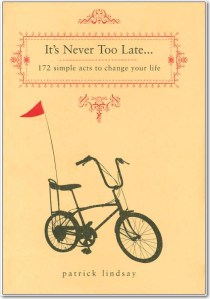
In the bargain section at the front of the store of a local Barnes and Nobles, I bought a cool book yesterday. “It’s Never Too Late… 172 simple acts to change your life” is by Patrick Lindsay.  Here’s two samples of what appears on its pages:

It’s never too late…
to say sorry.
It takes courage
but it’s worth the effort.
It releases you.
It enriches the other person.
It ennobles you.
It gives you both a new beginning.

“To see what is right and not to do it is want of courage.” Confucius

It’s never too late…
to tell the truth.
Lies are a burden.
They entangle us and weight us down.
Truth always fights to break out.
It usually succeeds anyway.
It’s not worth the struggle.
Telling the truth clears the air.
Lifts the burden.
Liberates.

“When in doubt, tell the truth.” Anonymous

I truly enjoy little books with a concise and clear thought on each page. I can pick one up, thumb to any part and spend only seconds reading to find something that gives me direction. Such little things are often what I find the most gratitude for. It tells me others feel and have felt as I do and my aloneness disappears.

Books are the quietest and most constant of friends;
they are the most accessible and wisest of counselors,
and the most patient of teachers.
Charles W. Eliot

Through Their Eyes

Rudyard Kipling passed away just short of twenty years before I was born.  As a kid I loved the wonderful mental journeys I took reading the stories in “The Jungle Book” and the great adventures I went on with “Kim” and “Captains Courageous”. I didn’t discover Kipling’s poetry until well into adulthood and admittedly haven’t laid eyes on any of it in years. So when I came across “If” by Kipling it was an enjoyable reminder of what I aspired to be as a child and in some manner succeeded in being here and there.

“If” by Rudyard Kipling
If you can keep your head when all about you
Are losing theirs and blaming it on you,
If you can trust yourself when all men doubt you,
But make allowance for their doubting too;
If you can wait and not be tired by waiting,
Or being lied about, don’t deal in lies,
Or being hated, don’t give way to hating,
And yet don’t look too good, nor talk too wise:

If you can dream — and not make dreams your master;
If you can think — and not make thoughts your aim;
If you can meet with Triumph and Disaster
And treat those two imposters just the same;
If you can bear to hear the truth you’ve spoken
Twisted by knaves to make a trap for fools,
Or watch the things you gave your life to, broken,
And stoop and build `em up with worn-out tools:

If you can make one heap of all your winnings
And risk it on one turn of pitch-and-toss,
And lose, and start again at your beginnings
And never breathe a word about your loss;
If you can force your heart and nerve and sinew
To serve your turn long after they are gone,
And so hold on when there is nothing in you
Except the Will which says to them: ‘Hold on!’

If you can talk with crowds and keep your virtue,
Or walk with Kings — nor lose the common touch,
If neither foes nor loving friends can hurt you,
If all men count with you, but none too much;
If you can fill the unforgiving minute
With sixty seconds’ worth of distance run,
Yours is the Earth and everything that’s in it,
And — which is more — you’ll be a Man, my son!

For all the writers who have inspired me, and yet will, with their poetry, novels and thoughts in word of all sorts, I am extraordinarily grateful.  Through their eyes I have witnessed a world for beyond any I could have known without their work. 

The role of a writer is not to say what we all can say,
but what we are unable to say.
Anaïs Nin