


Be thankful for your allotment
in an imperfect world.
Though better circumstances
can be imagined,
far worse are nearer misses
than you probably care to realize.
Richelle E. Goodrich
Be thankful for your allotment
in an imperfect world.
Though better circumstances
can be imagined,
far worse are nearer misses
than you probably care to realize.
Richelle E. Goodrich
 The day is overcast and the sky is slate gray. Light rain is falling making the air moisture laden and foggy. For some people such a morning might set off a tinge of sadness, or even depression. But not for me. Wet and misty mornings are usually inspiration filled, often bringing deep introspection. During my morning meditation by a window that looks out onto my backyard, today I read some of Rumi’s seven hundred year old work on “love”. It’s as contemporary today as when he wrote it. Three that rang strongest in my heart and mind are below and posted with thankfulness for what the words mean to me.
I want to see you.
Know your voice.
Recognize you when you
first come ’round the corner.
Sense your scent when I come
into a room you’ve just left.
Know the lift of your heel,
the glide of your foot.
Become familiar with the way
you purse your lips
then let them part,
just the slightest bit,
when I lean in to your space
and kiss you.
I want to know the joy
of how you whisper
“more”.
Rumi
There is a candle in your heart, ready to be kindled.
There is a void in your soul, ready to be filled.
You feel it, don’t you?
Rumi
Jalāl ad-Dīn Muhammad Balkhī known in the English-speaking world simply as “Rumi” was a 13th-century Persian poet, theologian, and Sufi mystic. Today his work transcends national and ethnic borders more than ever. Whatever subject I desire a little insight on or inspiration for, I always find a nugget to carry with me in Rumi’s work. Expressed again today, as many times before, I am grateful for Rumi. Through his astute perceptions he is my a dear friend and teacher.
I, you, he, she, we
In the garden of mystic lovers,
these are not true distinctions.
Rumi
 A best friend is one of life’s greatest gifts. It’s one sometimes taken for granted until a moment comes when he or she does or says something amazingly insightful; something you need to hear, but are avoiding; something essential that you have not been able to find alone; something you need to see but are blind to.
Best friends are wonderful to share some of life’s greatest moments with, but their greatest worth is in the gray times; the days when no one else would understand but they do or else try very hard to. I am blessed to have such a friend.

There is no name necessary. All that is needed to say is I have a best friend who I admire. He is wise for me when I am not, strong when I am weak and always there when I need him even if what he speaks is not always what I want to hear. I love you M. and am grateful for your friendship.
A best friend can see the different between
your fake smile and the real one.
unknown
 December 19, 1932 — March 9, 2013
Harry Weathersby Stamps, ladies’ man, foodie, natty dresser, and accomplished traveler, died on Saturday, March 9, 2013.
Harry was locally sourcing his food years before chefs in California starting using cilantro and arugula (both of which he hated). For his signature bacon and tomato sandwich, he procured 100% all white Bunny Bread from Georgia, Blue Plate mayonnaise from New Orleans, Sauer’s black pepper from Virginia, home-grown tomatoes from outside Oxford, and Tennessee’s Benton bacon from his bacon-of-the-month subscription. As a point of pride, he purported to remember every meal he had eaten in his 80 years of life.
The women in his life were numerous. He particularly fancied smart women. He loved his mom Wilma Hartzog (deceased), who with the help of her sisters and cousins in New Hebron reared Harry after his father Walter’s death when Harry was 12. He worshipped his older sister Lynn Stamps Garner (deceased), a character in her own right, and her daughter Lynda Lightsey of Hattiesburg. He married his main squeeze Ann Moore, a home economics teacher, almost 50 years ago, with whom they had two girls Amanda Lewis of Dallas, and Alison of Starkville. He taught them to fish, to select a quality hammer, to love nature, and to just be thankful. He took great pride in stocking their tool boxes. One of his regrets was not seeing his girl, Hillary Clinton, elected President.
He had a life-long love affair with deviled eggs, Lane cakes, boiled peanuts, Vienna [Vi-e-na] sausages on saltines, his homemade canned fig preserves, pork chops, turnip greens, and buttermilk served in martini glasses garnished with cornbread.
He excelled at growing camellias, rebuilding houses after hurricanes, rocking, eradicating mole crickets from his front yard, composting pine needles, living within his means, outsmarting squirrels, never losing a game of competitive sickness, and reading any history book he could get his hands on. He loved to use his oversized “old man” remote control, which thankfully survived Hurricane Katrina, to flip between watching The Barefoot Contessa and anything on The History Channel. He took extreme pride in his two grandchildren Harper Lewis (8) and William Stamps Lewis (6) of Dallas for whom he would crow like a rooster on their phone calls. As a former government and sociology professor for Gulf Coast Community College, Harry was thoroughly interested in politics and religion and enjoyed watching politicians act like preachers and preachers act like politicians. He was fond of saying a phrase he coined “I am not running for political office or trying to get married” when he was “speaking the truth.” He also took pride in his service during the Korean conflict, serving the rank of corporal–just like Napoleon, as he would say.
Harry took fashion cues from no one. His signature every day look was all his: a plain pocketed T-shirt designed by the fashion house Fruit of the Loom, his black-label elastic waist shorts worn above the navel and sold exclusively at the Sam’s on Highway 49, and a pair of old school Wallabees (who can even remember where he got those?) that were always paired with a grass-stained MSU baseball cap.
Harry traveled extensively. He only stayed in the finest quality AAA-rated campgrounds, his favorite being Indian Creek outside Cherokee, North Carolina. He always spent the extra money to upgrade to a creek view for his tent. Many years later he purchased a used pop-up camper for his family to travel in style, which spoiled his daughters for life.
He despised phonies, his 1969 Volvo (which he also loved), know-it-all Yankees, Southerners who used the words “veranda” and “porte cochere” to put on airs, eating grape leaves, Law and Order (all franchises), cats, and Martha Stewart. In reverse order. He particularly hated Day Light Saving Time, which he referred to as The Devil’s Time. It is not lost on his family that he died the very day that he would have had to spring his clock forward. This can only be viewed as his final protest.
Because of his irrational fear that his family would throw him a golf-themed funeral despite his hatred for the sport, his family will hold a private, family only service free of any type of “theme.” Visitation will be held at Bradford-O’Keefe Funeral Home, 15th Street, Gulfport on Monday, March 11, 2013 from 6-8 p.m.
In lieu of flowers, the family asks that you make a donation to Mississippi Gulf Coast Community College (Jeff Davis Campus) for their library. Harry retired as Dean there and was very proud of his friends and the faculty. He taught thousands and thousands of Mississippians during his life. The family would also like to thank the Gulfport Railroad Center dialysis staff who took great care of him and his caretaker Jameka Stribling.
Finally, the family asks that in honor of Harry that you write your Congressman and ask for the repeal of Day Light Saving Time. Harry wanted everyone to get back on the Lord’s Time. http://www.legacy.com/obituaries/sunherald/obituary.aspx?n=harry-stamps&pid=163538353&fhid=4025#fbLoggedOut#storylink=cpy
Penned by his daughter Amanda Lewis as she was making her way from Dallas to Stamps’ final resting place in Long Beach, Mississippi, the late custom bacon sandwich lover’s death notice has been hailed as the “best obit ever” as it has made the rounds of social networks since it was first posted yesterday. I am grateful to get to read about a one of a kind man who loved and was loved so deeply.
 One heavy day I ran away from the grim face of society and the dizzying clamor of the city and directed my weary step to the spacious alley. I pursued the beckoning course of the rivulet and the musical sounds of the birds until I reached a lonely spot where the flowing branches of the trees prevented the sun from the touching the earth.
I stood there, and it was entertaining to my soul – my thirsty soul who had seen naught but the mirage of life instead of its sweetness.
I was engrossed deeply in thought and my spirits were sailing the firmament when an hour, wearing a sprig of grapevine that covered part of her naked body, and a wreath of poppies about her golden hair, suddenly appeared to me. As she realized my astonishment, she greeted me saying, “Fear me not; I am the Nymph of the Jungle.”
“How can beauty like yours be committed to live in this place? Please tell me who you are, and whence you come?” I asked. She sat gracefully on the green grass and responded, “I am the symbol of nature! I am the ever virgin your forefathers worshipped, and to my honor they erected shrines and temples…” And I dared say, “But those temples and shrines were laid waste and the bones of my adoring ancestors became a part of the earth; nothing was left to commemorate their goddess save a pitiful few and the forgotten pages in the book of history.”
She replied, “Some goddesses live in the lives of their worshippers and die in their deaths, while some live an eternal and infinite life. My life is sustained by the world of beauty which you will see where ever you rest your eyes, and this beauty is nature itself; it is the beginning of the shepherds joy among the hills, and a villagers happiness in the fields, and the pleasure of the awe filled tribes between the mountains and the plains. This Beauty promotes the wise into the throne the truth.”
Then I said, “Beauty is a terrible power!” And she retorted, “Human beings fear all things, even yourselves. You fear heaven, the source of spiritual peace; you fear nature, the haven of rest and tranquility; you fear the God of goodness and accuse him of anger, while he is full of love and mercy.”
After a deep silence, mingled with sweet dreams, I asked, “Speak to me of that beauty which the people interpret and define, each one according to his own conception; I have seen her honored and worshipped in different ways and manners.”
She answered, “Beauty is that which attracts your soul, and that which loves to give and not to receive. When you meet Beauty, you feel that the hands deep within your inner self are stretched forth to bring her into the domain of your heart. It is the magnificence combined of sorrow and joy; it is the Unseen which you see, and the Vague which you understand, and the Mute which you hear – it is the Holy of Holies that begins in yourself and ends vastly beyond your earthly imagination.”
Then the Nymph of the Jungle approached me and laid her scented hands upon my eyes. And as she withdrew, I found me alone in the valley. When I returned to the city, whose turbulence no longer vexed me, I repeated her words: “Beauty is that which attracts your soul, and that which loves to give and not to receive.” “Before the Throne of Beauty XXVI” by Kahlil Gibran
Kahlil Gibran’s work has been deeply meaningful to me since my introduction to it back in my “hippie days” in the 70’s. More than most things, his words have stayed with me, inspired me, taught me and helped me through my most difficult times. I am grateful to Gibran for his writing that has brought me a better understanding of my sorrows and joys, has made the unseen seeable, has allowed the vague to be more understandable and allowed what is silent to be known.
Beauty is eternity
gazing at itself in a mirror.
But you are eternity
and you are the mirror.
Kahlil Gibran
Image by Tusi Roy
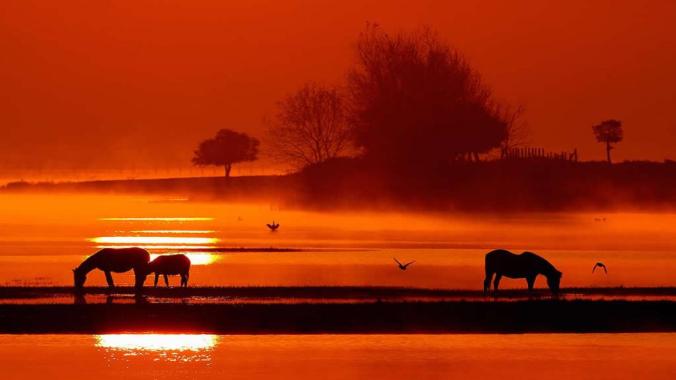 I have eyes that can see…

And ears that can hear…
A nose that can smell…

Hands that can touch…

And a mouth that can taste.
With such simple, but so very important abilities I am blessed and express my gratitude to the world here. I do not take them for granted.
Adapted from “The Rose Garden” by the Persian poet Sa’di
Some of us don’t know how well we have it
In this land of ours of good and plenty
While many say and think that their life is unfit
While their souls and stomachs are never empty.I once cried out for a new pair of shoes
Until I saw a man who had no feet
Then I heard a child cry for food that she refused
Then I saw another child that had nothing to eat.I once saw a man whom had everything
Then I saw a another man who had nothing at all
Then that homeless man to God he did sing
While the man with everything was afraid to fall.I once knew of a woman who pitied her life
Screaming out that no one had it as worse as her
Then I read of a woman whom died from her own knife
But of her own problems to no one did she say a word.I never had any holes in any of my pockets
Then once I saw a man carrying change in a can
Then I thought about mans own work dockets
I then realized, how lucky that I truly am.“Lucky I Am” by Randy McClave

The world has enough beautiful mountains
and meadows, spectacular skies and serene lakes.
It has enough lush forests, flowered fields and sandy beaches.
It has plenty of stars and the promise of a new sunrise and sunset every day.
What the world needs more of, is people to appreciate and enjoy it.
Michael Josephson
 There comes a time in life when you have to let go of all the pointless drama, and people who create it… And surround yourself with the people who make you laugh so hard… That you forget the bad, and focus solely on good. After all life is too short to be anything but happy. Justice Cabral

For a long time it had seemed to me that life was about to begin–real life. But there was always some obstacle in the way, something to be gotten through first, some unfinished business, time still to be served, a debt to be paid. Then life would begin. At last it dawned on me that these obstacles were my life. Alfred D. Souza

gratitude for life;
gratitude for good health;
gratitude for my education;
gratitude for the car I drive;
gratitude for the home I live in;
gratitude for the spiritual sense within;
gratitude for my friends and loved ones;
gratitude for a curious and seeking mind;
gratitude for the sun that rose this morning;
gratitude for the abundance and plenty in my life,
gratitude for the inspiration to write my thoughts down;
gratitude for knowledge and wisdom left behind by others.
All this and so much more I am thankful for. Writing down a simple list of twelve things I feel gratitude for this morning helps me embrace the day with enhanced appreciation. Taking a moment to say “thank you” is a powerful elixir.
God gave us the gift of life;
it is up to us to give ourselves the gift of living well.
Voltaire
 Grab your imagination hat and put on your best fantasy shoes.
Dress up in daydreams and set your mind on make-believe.
Then come along with me in a delicate journey of words arranged to inspire.
I wandered lonely as a cloud
That floats on high o’er vales and hills,
When all at once I saw a crowd,
A host, of golden daffodils;
Beside the lake, beneath the trees,
Fluttering and dancing in the breeze.
Continuous as the stars that shine
And twinkle on the milky way,
They stretched in never-ending line
Along the margin of a bay:
Ten thousand saw I at a glance,
Tossing their heads in sprightly dance.
The waves beside them danced; but they
Out-did the sparkling waves in glee:
A poet could not but be gay,
In such a jocund company:
I gazed–and gazed–but little thought
What wealth the show to me had brought:
For oft, when on my couch I lie
In vacant or in pensive mood,
They flash upon that inward eye
Which is the bliss of solitude;
And then my heart with pleasure fills,
And dances with the daffodils.
“I, Wander’d Lonely as a Cloud”
by William Wordsworth
 Old favorite memories are treasures carried invisibly inside. There is no one who has the same ones stored away as I do. My memories are mine and mine alone to keep as long as my mind works enough to recall them. The dearest ones don’t fade. Those memories grow more vivid over time, embellished perhaps, but more beautiful just the same.
Just as Wordsworth later remembered seeing “ten thousand daffodils” by a lake when he laid on his couch and daydreamed, I have my own cherished reminiscences. Memories are the great wealth of life. To realize that while I am not too old to remember them is something to be grateful for!
If you have true gratitude,
it will express itself automatically.
It will be visible in your eyes,
around your being, in your aura.
It is like the fragrance of a flower.
In most cases if there is a beautiful flower,
the fragrance will be there naturally.
The flower and its fragrance cannot be separated.
Sri Chinmoy
 I am been an emotional and sensitive person going back to as long as I can remember. Over time feedback from others (grown ups mostly when I was a kid) taught me to hold in my emotions. At times I felt as if I was going to combust with the feelings I held back.
Learning to deal properly anger came with learning that anger is fear turned inside out. Once I accepted and began to practice that wisdom expressing being angry in a healthy way followed.
Hiding happiness was not an issue for a long time simply because I rarely ever felt truly happy. Feeling like something was wrong with me (which it was) I faked happiness and got damn good at it. In the last decade getting to the roots of what was amiss inside me changed all that. Peace is within me about the happenings of my childhood. YEA!!!
In “finding myself” that was inside me all along, a full spectrum of emotions was freed to show themselves in healthy ways. One of the more important is no longer am I ashamed to cry. Of course, grief and sadness can bring tears, but happiness is just as likely. Being touched by something truly beautiful makes my eyes mist up. Movies bring tears frequently, but passages in books can do it just as easily. A hug from someone I care about touches me frequently to watery eyes as can a thoughtful card or an email. I am blessed to be as I am.
It is a grave injustice to a child or adult to insist that they stop crying. One can comfort a person who is crying which enables him to relax and makes further crying unnecessary; but to humiliate a crying child is to increase his pain, and augment his rigidity. We stop other people from crying because we cannot stand the sounds and movements of their bodies. It threatens our own rigidity. It induces similar feelings in ourselves which we dare not express and it evokes a resonance in our own bodies which we resist.
As adults, we have many inhibitions against crying. We feel it is an expression of weakness, or femininity or of childishness. The person who is afraid to cry is afraid of pleasure. This is because the person who is afraid to cry holds himself together rigidly so that he won’t cry; that is, the rigid person is as afraid of pleasure as he is afraid to cry. In a situation of pleasure he will become anxious. As his tensions relax he will begin to tremble and shake, and he will attempt to control this trembling so as not to break down in tears. His anxiety is nothing more than the conflict between his desire to let go and his fear of letting go. This conflict will arise whenever the pleasure is strong enough to threaten his rigidity.
Since rigidity develops as a means to block out painful sensations, the release of rigidity or the restoration of the natural motility of the body will bring these painful sensations to the fore. Somewhere in his unconscious the neurotic individual is aware that pleasure can evoke the repressed ghosts of the past. It could be that such a situation is responsible for the adage “No pleasure without pain.” From “The Voice of the Body” by Alexander Lowen
It’s a great gift to feel as deeply and profoundly as I do. Today, tears are to me like rain is to trees: water to grow on. Ever noticed how happy trees look after a good rain? I am affected the same way and grateful now for what I once hated about myself. And with that another two points goes up on the side of being happy with my self just the way I am.
But smiles and tears are so alike with me,
they are neither of them confined
to any particular feelings:
I often cry when I am happy,
and smile when I am sad.
From “The Tenant of Wildfell Hall” by Anne Brontë
 Good Morning Gratitude