 You realize that our mistrust of the future makes it hard to give up the past…
From “Survivor” by Chuck Palahniuk
Who am I now?
Who have I been?
Who will I become?
Those “who” questions rattle around my psyche on a regular basis although life experience has taught me it is the first one that matters most. “Who I have been” is a far distant second and the future (“Who will I become?”) is way, way, way back in third place. If I do the “now” part well the past relatively quickly begins to be something I am mostly satisfied with and my future unfolds primarily in a manner I can be content with. While who I am “now” rests on a foundation of my past, the present is all I have any control over.
Life has a way of going in circles. Ideally, it would be a straight path forward––we’d always know where we were going, we’d always be able to move on and leave everything else behind. There would be nothing but the present and the future. Instead, we always find ourselves where we started. When we try to move ahead, we end up taking a step back. We carry everything with us, the weight exhausting us until we want to collapse and give up.
We forget things we try to remember. We remember things we’d rather forget. The most frightening thing about memory is that it leaves no choice. It has mastered an incomprehensible art of forgetting. It erases, it smudges, it fills in blank spaces with details that don’t exist.
But however we remember it––or choose to remember it––the past is the foundation that holds our lives in place. Without its support, we’d have nothing for guidance. We spend so much time focused on what lies ahead, when what has fallen behind is just as important. What defines us isn’t where we’re going, but where we’ve been. Although there are places and people we will never see again, and although we move on and let them go, they remain a part of who we are.
There are things that will never change, things we will carry along with us always. But as we venture into the murky future, we must find our strength by learning to leave things behind. Brigid Gorry-Hines
Being in the “now” is a process of on-going wrestling I have to still do mentally; always will. However, the more I work at it the more successful I become at winning each bout. That sure beats how I once spent most of my life as John Green described it in “Looking For Alaska”; You spend your whole life stuck in the labyrinth, thinking how you’ll escape one day, and how awesome it will be, and imagining that future keeps you going, but you never do it. You just use the future to escape the present.
Most of the time I like living in the present and have been amazed how much better the future turns out when I do. I am grateful to understand my life tomorrow is being built by what I think and do today!
The past is a ghost,
the future a dream
and all we ever have is now.
Bill Cosby
 A man is as great as the dreams he dreams,
 Another new day has arrived I am blessed to get to live. Some things I do will be well done. Others mediocre at best. Through it all I will try to live the hours better than yesterday. I will do my best and be content with it, yet knowing life will continue to improve me day by day if I live with intention.
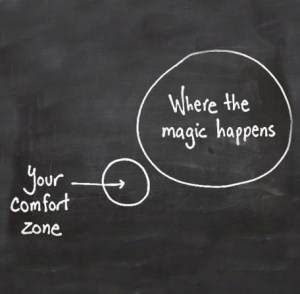 Over time my comfort zone has become something of a trap; safe and comfortable, but stifling to my growth and realization of my dreams. My ‘rut’ is a sweet pill similar to “Soma” that Aldous Huxley described in “Brave New World”: … a quite impenetrable wall between the actual universe and… mind…
 Writing yesterday about a great love of long ago and mentioning losing her was the beginning of my demise into dysfunction has turned out to be an interesting piece of serendipity. The spiral that began back then is illustrated by what I was writing in the early to mid 90s. Purely by chance while looking for an old file, I came across these last night
 Two psychologists, Michael McCollough of Southern Methodist University in Dallas, Texas, and Robert Emmons of the University of California at Davis, wrote an article about an experiment they conducted on gratitude and its impact on well-being. The study split several hundred people into three different groups and all of the participants were asked to keep daily diaries.
 Good Morning Gratitude