For Seekers and Searchers

JDDavis-letting-go-water-efict-gifFor a long while long I have labeled myself a “seeker” and a “searcher”. That comes from an earnest desire to garner more wisdom, to understand and embrace life more fully and to grow my level of contentment and happiness. I think I picked the right labels. How do dictionaries define Seeker or Searcher?

a person who inquires;
 one who looks for truth;
 someone who makes a thorough examination or investigation;
 those who look carefully in order to find something;
 a person who intentionally comes to know

Within my seeking and searching here’s a few random bits of wisdom that have I have assimilated,  backed up by a quote:

Living well takes consistent practice.
As a single footstep will not make a path on the earth, so a single thought will not make a pathway in the mind. To make a deep physical path, we walk again and again. To make a deep mental path, we must think over and over the kind of thoughts we wish to dominate our lives. Henry David Thoreau

You are the fix to whatever bothers you.
No one saves us but ourselves. No one can and no one may. We ourselves must walk the path. Buddha

There is only now. Nothing else.
What matters is to live in the present, live now, for every moment is now. It is your thoughts and acts of the moment that create your future. The outline of your future path already exists, for you created its pattern by your past. Sai Baba

Your difficulties are often your greatest teachers.
Adversity is the first path to truth. Lord Byron

If you keep going you’ll find the answer.
Over every mountain there is a path, although it may not be seen from the valley. Theodore Roethke

The easy way is usually a trap.
The path of least resistance and least trouble is a mental rut already made. It requires troublesome work to undertake the alternation of old beliefs. John Dewey

Experience is the only truth humans readily accept. No matter how often we are told or reminded we don’t accept a fact as 3-dimensional until we have first-hand experience.  I am grateful for the life lessons learned without having to repeat learning them a dozen times.  And for the ones I have yet to learn, I will keep trying until they sink in.

If you find a path with no obstacles,
it probably doesn’t lead anywhere.
Frank A. Clark

Why Does Criticism Bother Us?

!!~~!! morning-fogBenjamin Disraeli once wrote, “How much easier it is to be critical than to be correct.” That thought was illustrated clearly to me a few days ago. Someone I know, but not particularly well, jokingly said something like “you drive me crazy with all your stuff about optimism, gratitude and hope for the future. I think you make a lot of it up.”
He saw the look on my face and think that’s why he followed up “Don’t worry about it. I’m just kidding.” It had never occurred to me that it was even possible to fake happiness successfully and I was a bit put off by the comment. My reply was along the lines “think whatever you want. Its your loss if you don’t believe in such things”.

The comment continued to take up more space in my thoughts than it should have for a couple of days. I found myself randomly quizzing my psyche asking if I was pretending or imagining the lightness of being that I feel most of the time. The response has been the same each time the questioning surfaced. What echoed back was, “you know it’s all true. You feel it too strongly deep down for it not to be the real.”

It’s idiotic how a random casual comment by another person can sporadically occupy a lot of room in a another person’s internal space. Now being past giving any credence to the comment, still I find a curiosity about why it bothered me at all.

On her website ( http://www.namastepublishing.com ) Constance Kellough shared her perspective.

Why does criticism bother us? And, the flip side of the coin—and possibly the most important question of all—why do we let what others say bother us to the point that we in turn criticize them? Have you ever considered that the two might actually be proportional? In other words, we are upset by criticism to the degree we ourselves are critical of ourselves, and often in turn of others.

Some years ago an Ohio State University study found that those who make disparaging comments about others often are tarred with the same brush. It’s the old adage that when we point the finger, there are three fingers pointing back at us. What this means is that a person who accuses another of being controlling is either controlling in themselves or, which is often the case, lacks self-control.

It’s our insecurity that causes us to resent others, criticize them, put them down. Sarah Grand put her finger on what criticism is all about: Our opinion of people depends less on what we see in them than on what they make us see in ourselves. When someone can criticize us and we can “let it in,” we are finally becoming mature. If the criticism is baseless, we can hear it, feel its intent, and evaluate it as nothing to do with us. There’s no emotional wash from it.

What do we mean by “no emotional wash?” Well, for a start it doesn’t make us feel attacked. We don’t become defensive, compelled to argue against what’s being said. We have no inclination to respond in any kind of protective way, just to appreciate the person and their concern.

Ms. Kellough’s comments ring true to me. What echoes in my thoughts is 1) what others say is frequently much more of a reflection of their state of being than the person they are criticizing and 2) Past pain and self-doubt can make a person more susceptible to swallowing anothers criticism.

Reflecting on what was said to me I concluded: the speaker lacks what they accused me of having too much of (optimism, gratitude and hope) and my old hurts, while healed, remain sensitive to being criticized. While the latter is much improved, I am grateful for the reminder. In spite of how much I have grown, I am still vulnerable and can give in to other’s false thinking about me, even if only for a short while.

Don’t criticize
what you can’t understand.
Bob Dylan

http://www.namastepublishing.com/blog/compassionate-eye/why-does-criticism-bother-us-so-much

Kissed My Comfort Zone Goodbye

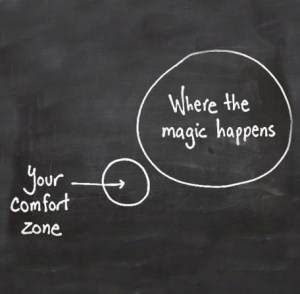
comfort zone2Over time my comfort zone has become something of a trap; safe and comfortable, but stifling to my growth and realization of my dreams. My ‘rut’ is a sweet pill similar to “Soma” that Aldous Huxley described in “Brave New World”: … a quite impenetrable wall between the actual universe and… mind…
A little rhyme Huxley included about “Soma” is:
Hug me till you drug me, honey;
Kiss me till I’m in a coma;
Hug me, honey, snuggly bunny;
Love’s as good as Soma.

Psychologists have long told us that “man tends toward pleasure and the path of least resistance”. There is some deep down desire to get benefits without any more work or discomfort than absolutely necessary. Given a choice between something that is neutral and something that gives pleasure, humans most often choose the latter.  Today I throw off another layer of the old to embrace the new that comes with a fresh year tomorrow. 2 0 1 3 is going to be a remarkable year!

I used to have a comfort zone
Where I knew I couldn’t fail.
Same four walls and busy work,
Were really more like jail.

I longed to do the things
I’d never done before,
But I stayed inside my comfort
Zone and paced the same old floor.

I claimed to be so busy with
The things inside my zone,
But deep down inside I longed
For something special of my own,

I took a step with new strength
I’d never felt before.
I kissed my comfort zone good-bye
And closed and locked the door.
Taken from “I Used to Have a Comfort Zone” – Author Unknown

Just because a tendency is “normal” does not mean I must succumb to it. However, it takes a conscious leap of faith to move past my comfort zone. I am ready to make it and grateful that 2013 will be the year where I take big steps to break free and embrace my dreams.

It does not take a new day
To make a brand new start,
It only takes a deep desire
To try with all our heart.
So never give up in despair
And think that you are through,
For there’s always a tomorrow
And the hope of starting new.
From “Another Chance” by Helen Steiner Rice

An Entirely Different View

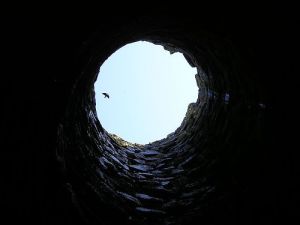
bottom-of-a-wellIt has been my personal discovery that letting go of outcome has a tendency to make things actually turn out better than they would have otherwise. Planning and hope along with an optimistic attitude and good effort are all I have to do to allow life to unfold as it best can. To attempt to steer what unfolds beyond those things is setting myself up for disappointment. It is impossible to see all of what might happen, not matter how hard I try. Too much focus on a single spot causes a look too close to see things in a broad sense. One explanation of this principle is found in the book “The Other Way: Meditation Experiences Based on the I Ching” by Carol K. Anthony:
I saw myself facing a tall stone wall and understood it to be a wall of obstruction. Wondering about the meaning, I suddenly noticed the outline of a camouflaged doorway in the wall; I realized that I could have passed by it many times without noticing it.

Pondering the presence of this hidden doorway, I realized that our way of viewing things is so habitually logical that we fail to see the principle of the hidden door.

I saw that in looking at those around me, I have judged this person as “habitually improvident (lacking foresight)”, that person as “having a blind spot,” another as “too involved in seeing negatives,” another as “too parsimonious (excessively frugal),” and another as “too set in his ways to ever change,” and so on. What I fail to do in all this activity is to see the operation of the hidden door, the one factor that often makes a thing possible that otherwise seems unlikely.

The principle of the hidden door is constantly in operation, upsetting our best assessments and preparations. We think we have everything mapped out, and well-planned, while in fact, the unexpected controls everything. Good sense and hard work can succeed, but there is not guarantee of this. The most unlikely people turn out to be successful in their work, and people to whom we attached great expectation often fail.

All things being put together correctly, the chances are good for success, but the chances are greatly enhanced if the person putting them together is consistently open-minded about the possibilities of the unlikely. Such as attitude is in harmony with events, for there is always a hidden doorway through difficult situations. Looking for this hidden doorway is like looking at a picture that has another picture hidden within it. The harder we try, the more difficult it is to see it.

The reason things sometimes do not work out as we expect is that we have stopped the hidden door principle by presuming that because some particular outcome is unlikely, it won’t happen. It is easy to assume that a 10% likelihood, for example is really a 0% likelihood. An unassuming attitude, however makes it possible for things to work out, in spite of appearances to the contrary. Our attitude creates the possibility, for Fate mocks our attitude. The surest way to guarantee ourselves failure is to have the Titanic Complex: to be firmly confident that we have figured out, and accounted for, everything.

Opening my mind beyond its tendencies is not easy, but I am discovering the rewards are rich and meaningful. Any time I am absolutely certain of something is when I am absolutely certain to be wrong. There are always more possibilities, reasons and ways of things that I will ever be able to see in advance. With an open mind and grateful heart I accept this and endeavor to broaden my openness to the unexpected.

We think too small,
like the frog at the bottom of the well.
He thinks the sky is only
as big as the top of the well.
If he surfaced,
he would have an entirely different view.
Mao Zedong

Love Versus Fear

Light_vs__Dark_by_environautLOVE IS UNCONDITIONAL (fear is conditional)

LOVE IS STRONG (fear is weak)

LOVE RELEASES (fear obligates)

LOVE SURRENDERS (fear binds)

LOVE IS HONEST (fear is deceitful)

LOVE TRUSTS (fear suspects)

LOVE ALLOWS (fear dictates)

LOVE GIVES (fear resists)

LOVE FORGIVES (fear blames)

LOVE IS COMPASSIONATE (fear pities)

LOVE CHOOSES (fear avoids)

LOVE IS KIND (fear is angry)

LOVE IGNITES (fear incites)

LOVE EMBRACES (fear repudiates)

LOVE CREATES (fear negates)

LOVE HEALS (fear hurts)

LOVE IS MAGIC (fear is superstitious)

LOVE ENERGIZES (fear saps)

LOVE IS AN ELIXIR (fear is a poison)

LOVE INSPIRES (fear worries)

LOVE DESIRES (fear Joneses)

LOVE IS PATIENT (fear is nervous)

LOVE IS BRAVE (fear is afraid)

LOVE IS RELAXED (fear is pressured)

LOVE IS BLIND (fear is judgmental)

LOVE RESPECTS (fear disregards)

LOVE ACCEPTS (fear rejects)

LOVE DREAMS (fear schemes)

LOVE WANTS TO PLAY (fear needs to control)

LOVE ENJOYS (fear suffers)

LOVE FREES (fear imprisons)

LOVE BELIEVES (fear deceives)

LOVE “WANTS” (fear “needs”)

LOVE versus fear: what do you feel?

“Love Versus Fear” by storyteller and filmmaker Sarah Nean Bruce
http://tinybuddha.com/blog/love-versus-fear/
http://www.sarahneanbruce.com/

On occasion it is the simple that makes the deepest impression. Reading the statement “LOVE versus fear: what do you feel?” painted itself into my memory. The question and the statements before it will be handy to recall when I need help centering and sorting my feelings. My gratitude goes to Ms. Bruce for her uncomplicated list of what love is and what is only fear pretending to be something it’s not.

Our deepest fear is not that we are inadequate.
Our deepest fear is that we are powerful beyond measure.
It is our Light, not our Darkness, that most frightens us.
Marianne Williamson

The Cloud and the Dune

A young cloud was born in the midst of a great storm over the Mediterranean Sea, but he did not even have time to grow up there, for a strong wind pushed all the clouds over towards Africa. As soon as the clouds reached the continent, the climate changed. A bright sun was shining in the sky and stretched out beneath them, lay the golden sands of the Sahara. Since it almost never rains in the desert, the wind continued pushing the clouds towards the forests in the south.

Meanwhile, as happens with young humans too, the young cloud decided to leave his parents and his older friends in order to discover the world. “What are you doing?” cried the wind. “The desert’s the same all over. Rejoin the other clouds, and we’ll go to Central Africa where there are amazing mountains and trees!”

But the young cloud, a natural rebel, refused to obey, and gradually, he dropped down until he found a gentle, generous breeze that allowed him to hover over the golden sands. After much to-ing and fro-ing, he noticed that one of the dunes was smiling at him.

He saw that the dune was also young, newly formed by the wind that had just passed over. He fell in love with her golden hair right there and then. “Good morning,” he said. “What’s life like down there?”

“I have the company of the other dunes, of the sun and the wind, and of the caravans that occasionally pass through here. Sometimes it’s really hot, but it’s still bearable. What’s life like up there?”

“We have the sun and the wind too, but the good thing is that I can travel across the sky and see more things.”

“For me”, said the dune, “life is short. When the wind returns from the forests, I will disappear.”

“And does that make you sad?”

“It makes me feel that I have no purpose in life.”

“I feel the same. As soon as another wind comes along, I’ll go south and be transformed into the rain; but that is my destiny.”

The dune hesitated for a moment, then said: “Did you know that here in the desert, we call the rain paradise?”

“I had no idea I could ever be that important,” said the cloud proudly.

“I’ve heard other older dunes tell stories about the rain. They say that, after the rain, we are all covered with grass and flowers. But I’ll never experience that, because in the desert it rains so rarely.”

It was the cloud’s turn to hesitate now. Then he smiled broadly and said: “If you like, I could rain on you now. I know I’ve only just got here, but I love you, and I’d like to stay here for ever.”

“When I first saw you up in the sky, I fell in love with you too”, said the dune. “But if you transform your lovely white hair into rain, you will die.” “Love never dies”, said the dune. “It is transformed , and besides, I want to show you what paradise is like.”

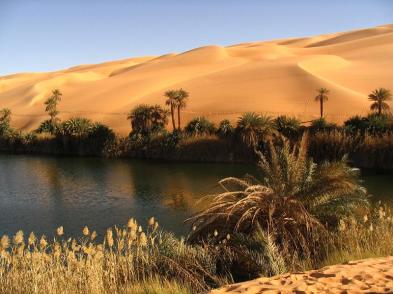
And he began to caress the dune with little drops of rain, so that they could stay together for longer, until a rainbow appeared. The following day, the little dune was covered in flowers. Other clouds that passed over, heading for Africa, thought that it must be part of the forest they were looking for and scattered more rain. Twenty years later, the dune had been transformed into an oasis that refreshed travelers with the shade of its trees.

And all because, one day, a cloud fell in love, and was not afraid to give his life for that love.

“The Cloud and the Dune” fable by priest and theologian Bruno Ferrero*, came to me unforeseen when doing a completely unrelated search. The story’s simplistic beauty and wisdom moved me to share this delightful teaching tale. For the second day in a row coincidence, or as I choose to think my Higher power, bought me an unexpected catalyst to grow my measure of morning gratitude.

True love is like ghosts,
which everybody talks about
and few have seen.
Francis Duc de La Rochefoucauld

*Find Bruno Ferrero’s blog “Circle of Joy” here: http://doina-touchinghearts.blogspot.com/2012/09/circle-of-joy-by-bruno-ferrero.html

Work and the Ability to Change

I’m packing and getting ready to rush to the airport to return home after a business trip that has taken up the majority of the week. I find myself asking “why I work” a lot these days. And more so, why do I work in the same profession I have been in for many years. While clear answers are difficult to come by, I do find guides along the way like the article just below titled “Why Do We Work” from the Washington Post by Michael Maccoby.

Many people would be happier with jobs that make better use of their abilities. Even so, people do not work for money or survival alone. Even when necessity forces us to take a job, financial need is not the only reason we work.

Work ties us to a real world that tells us whether our ideas make sense; it demands that we discipline our talents and master our impulses. To realize our potentialities, we must focus them in a way that relates to the human community. We need to feel needed. And to feel needed, we must be evaluated by others in whatever coinage, tangible or not, culture employs. Our sense of dignity and self-worth depends on being recognized by others through our work. Without work, we deteriorate. We need to work.

In this still fragile economy, many people will be motivated at work they do not like mainly to keep their jobs for the sake of income and mental health. But a leader who wants enthusiastic collaborators needs to engage them in work that is meaningful to them. This can be done by focusing on four Rs: responsibilities, relationships, rewards and reasons.

We are motivated when our responsibilities are meaningful and engage our abilities and values. The most meaningful responsibilities stretch and develop us. Caring people are motivated by work that helps others. Craftsmen are motivated by producing high quality products.

We are motivated by good relationships with bosses, collaborators, and customers. Fun at work is motivating. So is appreciation for helping others.

Rewards can be motivating, but they can be overvalued. Of course, investment bankers will exhaust themselves for huge pay offs. And piece workers, sewing garments or assembling gadgets, will work harder producing more finished products for the extra dollars. But there is no evidence that teachers will teach better to make more money. Incentive pay focuses a person on particular tasks, like teaching to the tests. It can stimulate a doctor to see more patients, but not treat them any better. Or it can strengthen a boss’s authority by rewarding a subordinate for following orders. But if someone does not feel fairly rewarded compared to peers, incentive pay becomes de-motivating. People may be more motivated by public recognition and appreciation for their work than by money.

Reasons can be the most powerful motivators. Workers doing repetitive work on an assembly line during World War II were highly motivated because they were helping to win the war. The same work in peace time would be boring. People take pride in work that contributes to the well-being of others and the common good. Leaders who articulate a meaningful purpose, support good relationships, give people responsibilities that engage and develop them, and recognize exceptional work will most certainly gain enthusiastic collaborators.

For the moment I am content to do the work at the job I have, yet I know big changes are ahead for me. For so long change was unnerving, but today I am grateful to say I am excited about the possibilities and open to where the future takes me!

What people have the capacity to choose,
they have the ability to change.
Madeleine Albright

The Big Question

I found this in my fortune cookie at lunch yesterday:

If
you
don’t
have
time
to
live
your
life
now,
when
do
you?

That’s a summation of the realizations that surround me these days. For far too long I put off living the life I yearn for in order to do what others wanted.  My myriad of excuses have included taking care of “responsibilities”, running from dealing with my “stuff, unfounded fear of not having enough money when I get old, doing the “right thing” and so on. No more. I reclaim my life and am so very grateful for the inspiration that makes me know 2012 is the beginning of the life I have longed for.

People often say
that this or that person
has not yet found himself.
But the self is not something one finds,
it is something one creates.
From “Personal Conduct, The Second Sin” by Thomas Szasz,

The Privilege of Living

True happiness is to enjoy the present, without anxious dependence upon the future, not to amuse ourselves with either hopes or fears but to rest satisfied with what we have, which is sufficient, for he that is so wants nothing. The greatest blessings of mankind are within us and within our reach. A wise man is content with his lot, whatever it may be, without wishing for what he has not. Seneca

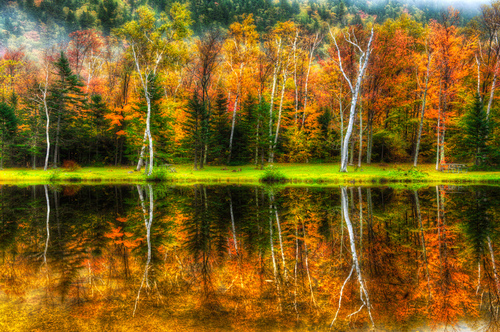
This photo mesmerized me. I still can’t stop looking at it. In the moments when something stops me completely in my tracks like this is when I feel the most alive!

Image is titled “Reflections On An Evening of Gratitude”.
Other beautiful photos like this one by Photomike07 http://mdsimages.com

Today I am grateful for the life balance felt inside and the beauty without to savor and appreciate. I have come to realize how rich my life is. It’s an amazing feeling.

Thank God I have seen
an orange sky with purple clouds.
How easy it is to forget that
we have the privilege of living in God’s art gallery.
Erica Goros

It’s Only In My Mind

A bad habit of mine is to wonder if I should be doing something else, have a different job or a different profession, be somewhere else other than where I am or mentally wander off into similar such thinking. In some circles it’s called “future tripping” when what is ahead has a greater focus that what is present. Intellectually I know living happens only in the present; that life is found only in the now; that living in the present well leads to one’s future. But I have human frailties and figurative ‘time travel’ into the future is something mentally I do far too much.

Well I want something to do, to create, to achieve, to whatever…. Something I can’t get enough of. You know something that I can’t wait to get up in the morning to do something I can’t get enough of, something that brings me joy and makes my heart sing. It could be anything, could be more than one thing but something that grabs me. Even a job, if it grabs me so that I could hardly wait to get there. Something that makes me feel good, allows me to be me, gives me freedom to grow and expand, something that grasps my heart, my joy, my excitement and leads me down the path to more joyful things, exciting challenges and challenging things. Klaus Joehle

Each man had only one genuine vocation – to find the way to himself….His task was to discover his own destiny – not an arbitrary one – and to live it out wholly and resolutely within himself. Everything else was only a would-be existence, an attempt at evasion, a flight back to the ideals of the masses, conformity and fear of one’s own inwardness. Hermann Hessee

You must love your work, and not be always looking over the edge of it, wanting your play to begin. And the other is, you must not be ashamed of your work, and think it would be more honorable to you to be doing something else. You must have a pride in your own work and in learning to do it well, and not be always saying, There’s this and there’s that—if I had this or that to do, I might make something of it. George Eliot

When you work you fulfill a part of earth’s furthest dream,
assigned to you when that dream was born,
And what is it to work with love?
It is to weave the cloth
with threads drawn from your heart,
even as if your beloved were to wear that cloth.
It is to build a house with affection,
even as if your beloved were to dwell in that house.
It is to sow seeds with tenderness
and reap the harvest with joy,
even as if your beloved were to eat the fruit.
It is to charge all things you fashion
with a breath of your own spirit.
Work is love made visible.
From “the Prophet” by Kahlil Gibran

All those borrowed words don’t put me any closer to putting an end to my “future tripping”. However, they do help me to know my quandaries are not unique; that wondering about where I am going, what I should be doing; and what livelihood I should be immersed in is simply a human condition. Today I will simply try my best at the work I apply myself to knowing a step at a time today is a certain path forward. I am grateful to realize my direction can be changed at any moment. Even if I feel stuck, I am not stuck. It’s only in my mind.

The highest form of human intelligence
is to observe yourself without judgment.
Jiddy Hrishnamurti