Power of Secrets

Every one of us has a portion of their self-knowledge known to no one else. Some things are believed to be not worth telling; others are just very personal or embarrassing. Then there are our most closely guarded secrets. These privately kept facts run the gamut from innocent ones left from childhood to the secrets kept as adults that have rarely, if ever, told. Within the latter are often the kind of untold secrets that psychologists say can be poison to a relationship if their toxicity is bad enough or allowed to grow long enough.

From my personal path I know well the damage secrets can bring. I hid secrets of childhood and the resulting dysfunction so well that others hardly noticed anything was not quite right within me. I became quite a good actor and allowed no one to see past the illusions I projected. While the ability at keeping my secrets hidden grew, the toxic nature of them only served to make worse what was wrong within me.

The creator of an eight year effort called The Post Secret Project is Frank Warren. This began as way of him dealing with his own issues and has grown to include a secret told to told no one but written and mailed anonymously on a postcard to him by over 500,000 people. Warren says the secrets run from sexual taboos and criminal activity to confessions of secret beliefs, hidden acts of kindness, shocking habits and fears. Since November 2004, PostSecret has been a safe and anonymous “place” where people can relieve the burden of their untold secrets

Frank Warren said, It was through crowd-sourcing…the kindness that strangers were showing me, that I could uncover parts of my past that were haunting me… Secrets can take many forms. They can be shocking or silly or soulful. They can connect us with our deepest humanity, or with people we’ll never meet.

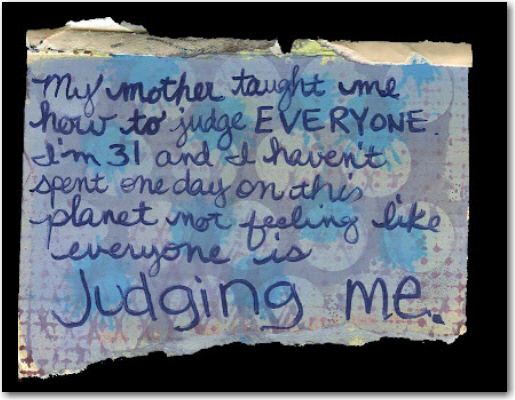
Here are a few “secrets” on postcards received.


Here’s a link to the Ted.com website (a favorite!) for Frank Warren’s moving video about the Post Secret Project: http://www.ted.com/talks/lang/en/frank_warren_half_a_million_secrets.html

Today I am not completely free of secrets, but the big ones kept longest and feared most are no longer untold.  By revealing my deepest secrets others have responded with everything from kindness and understanding to ridicule and contempt.  What matters is I no longer carry any of that darkness inside and am outwardly the person as the inward me.  What a relief.  I’m free!  And I’m very GRATEFUL!

What is love? Love is when one person knows all of your secrets…
your deepest, darkest, most dreadful secrets
of which no one else in the world knows…
and yet in the end, that one person does not think any less of you;
even if the rest of the world does.”
Anonymous

A Hair in a Biscuit

It’s Monday and time to head back to work. Time to put on business clothes, ready my work face and get ready for “meetin’ & greetin” people.

When meeting someone for the first time or often after not seeing a person for a while most in the western world shake hands. This used to be a gesture used largely by men, but in this age of improved gender equality shaking hands is just about as frequent for women. The ancient Greeks shook hands in similar fashion to how we do today as a gesture of friendliness, hospitality, and trust. In Europe during the Middle Ages, kings and knights would extend their hands to one another to show that they were not carrying a weapon and bore the other party no harm.

A “normal handshake” is described as: Firm; shake once or twice, but no more than three times; lasts for 5 seconds maximum. There are variations and anomalies.  Sales Psychology Expert, Dr. Gregory Stebbins has categorized what he calls the “Top 10 Handshake Types”:

1. Sweaty Palms – When a person is nervous their sympathetic nervous system often becomes overactive, sometimes resulting in sweaty palms.
2. Dead Fish – Indifferent handshakes that feel like the person has no bones in their hand often indicate a passive or reserved personality.
3. Brush Off – This handshake type is a quick grasp and then a release that feels like your hand being shoved aside.
4. Controller – You feel your hand being pulled toward the person or strongly guided in a different direction, perhaps towards a chair.
5. Politician – Your hand is firmly grasped as in a normal handshake. However, their other hand may cover yours or be placed on your forearm or shoulder.
6. Finger Vice – When someone grabs your fingers and not your entire hand it is meant to keep you at a distance.
7. Bone Crusher – The message of squeezing your hand until you cringe is clearly designed to intimidate you.
8. Lobster Claw – Like the claw of a lobster, the other person’s thumb and fingers touch the palm of your hand.
9. Hand Wrestler – Your hand is taken normally and then aggressively twisted under the other person’s.
10. Teacup – This handshake feels normal except that there is no palm-to-palm contact. The other person’s palm is cupped, like a teacup.

Then there is the more informal greeting expressed to those we often see or as a telephone salutation. I wonder how many times today I will hear “how are you” or some derivative such as “how ‘ya doing'” or “how you be”. Today I am going to attempt to keep count. As I do, I plan to hesitate a second before responding so I can notice how many actually wait for a response.

My usual response is “every day is a good day; some are just better than others”. Today I am going to try some new ones that I found on-line and see what response I get back from people. On my list to possibly use today are variations on the theme of my typical response, some just for fun and others on the wacko side.

Typical Responses
Getting better by the minute.
If I were any better there would be two of me.
Living and learning.
Excellent, but improving!
Doing great, in fact I can’t wait until tomorrow.
I am getting better every day.
Living the dream!
Feeling lucky and living large.

Fun Responses
If I was doing any better vitamins would be taking ME!
I am so excellent, if there was a law against it I would be arrested.
If I was any better I would have to run backwards to keep from flying.
My Mom tells me to quit smiling’ all the time or my face will freeze that way!
I’m still pleasantly pushing a pulse, thanks for asking.
If I were any better you’d have to tie me down ’cause I’d flying.
Happier than a cat in a room full of catnip.
I am functioning within established parameters.

‘Out there’ Responses
If I were any better, I’d need pom-poms!
Having more fun than a human should be allowed to have with their clothes on!
 If I were any better, Energizer would give me my own drum.
Hanging’ in there like a hair in a biscuit!
Much better .. according to my psychiatrist.
If I were any better, I’d have my own page on Wikipedia.
A bit gaseous…oh.. wait… never mind.
Totally Charged. Don’t get to close though, sometimes sparks shoot out my nipples.

After writing this piece I am in an incredibly good mood. Thinking about seeing people, shaking hands and trying some of these response lines to “how are you” have enhanced my day already. How cool! I am grateful.

We sometimes encounter people, even perfect strangers,
who begin to interest us at first sight,
somehow suddenly, all at once,
before a word has been spoken.”
Fydor Dostoevsky

No Apologies, No Regrets

Over time many people change. Some just get older while others find a comfy rut and live life out in it. Many just fake and and “put on” what they think people want to see. Others grow and evolve; some by choice and others out of necessity. I am one of the latter who transformed himself because there came a point life made no sense without a good deal of personal change. That’s when I got into counseling and entered recovery for depression and childhood junk. Today it is almost incomprehensible to think of living as I once did.

While many are happy for me, some are uncomfortable with the changes they notice. Others can’t or don’t want to see it at all. This is especially true of those who my connection is from long ago with little to no contemporary shared history.

Someone I knew long ago and have connected with briefly a few times over the years recently deleted me from her Facebook. The reason emailed to me was that after reading a post here about me being mostly an optimist today she simply said “I don’t believe you”. We have had little communication and had only recently established contact in limited fashion after none for over ten years.  All total we talked two or three times during relatively short phone calls and traded about that many emails. We have not seen each other in several decades.

The only real history this woman and I have dates back forty years around my high school graduation when we were both essentially kids. Yes, those were some of my dark, moody and confused days.  It was evident for anyone to see. No one would have called me anything but a pessimist then. That was then, and this is now.

My first momentary feeling about being “deleted” was to be a little hurt she could not see how far I have come and how much I have grown. Then I brought myself to the present and remembered her thoughts about me are largely stuck in a time long ago.

With repetition of experience, I have learned that if I present myself honestly and honorably yet someone can not see me as I am it the loss is theirs, not mine. In no way is it my fault that another person can not see truth when I present it. Nor is it healthy for me to try to convince them otherwise. Those whose presence in my life lends benefit to my existence are the only ones I have room for any more. No longer do I feel the need to attempt to get people to see me a particular way. Either they perceive me as I have become or they don’t.

Wayne Dyer stated my feelings well when he said, What you think of me is none of my business. Years and years and years it took for me to be able to practice the wisdom of those words. While being human does still cause me to care at least a little about what others think of me (still too much sometimes), for the most part I plainly just don’t care. Having spent decades trying to please others, be what they wanted me to be and doing things the way they wanted me to, life taught me the hard way such a way iof being is a fast road to continuous unhappiness and uninterrupted torment.

If someone thinks I am odd, that’s OK because I actually am. If another does not understand my unique views, that does not change them. If a person does not see truth when I express it, I lose nothing and the loss is theirs. And so on…

What you think of me is none of my business is one of the truths of living an overall contented life today. I trust the message of those ten words and do my best to live the wisdom in them. It is the ONLY way I can find some measure of peace in my life. I like who I am as a person, who I portray myself to be to others and truely accept myself.

Once again by stating it here, I let go of my concern over what others may think of me. To worry about what impression I may make on others is not healthy. It is impossible to control their thoughts anyway. Instead I focus on my own thinking and actions remaining true to myself. As long as I do this I come out of every situation, even messes made, with a good opinion of me and that is ALL that matters. To every teacher of all sorts that helped me find the path to live this insight I am humbly thankful.

Accept everything about yourself–I mean everything.
You are you and that is the beginning and the end–no apologies, no regrets.
Clark Moustakas

This Magnificent Cosmic Dance

This past weekend I read an article about our planet’s physical place in the universe that noted what I already knew: the Earth is one of the smallest planets in our solar system. What I had not been exposed to before was when the author went to note the Earth’s size makes for an estimated share of the total universe of 0.000000000000000000000000005%.  If our entire planet represents that small of a number, imagine how many zeros it would take to represent the share percentage for my physical form!  In the grand scheme of things I am indeed tiny beyond words.

Everything that exists, as we know it, originated from the same source of energy. We are connected to the entire universe.  We all came from a mother called the “Big Bang” and what followed creation. Nothing is better or worse. Everything just is. This unifying view helps me know that my smallness does not make me irrelevant.  Anything large is made up of many pieces that are small and within that structure I matter.

Although I adore traveling to see, touch and learn about foreign places my sphere of experience includes only a tiny portion of the planet.  My “world” that I live more than 90% of my life within is no more than twenty miles from where I sit typing these words on a keyboard.  It is here in “my world” that I am sizeable enough to influence in a noticeable what is around me.

The attitude that I show others, whether strangers or those I know well, sends a small ripple into my world.  A smile or a kind word has an effect on some and on others it rolls off like water on a duck’s back. At least for a few my kindness will be received openly and added to that person’s persona that in turn gets passed on to others.

Being a law-abiding citizen has an effect on those around me.  Because I choose to live responsibility, I make my community safer for all those who occupy it with me.  While a person being “good” is often overlooked and taken for granted, it is just such mundane decency of many that makes an area a pleasant place to live.

The greatest impact I have on anyone is that I have on my self.  The manner I treat “me”, the way I think of myself, the things I do to shape my being, the thoughts about the world that float in my head and the work I do or don’t do to grow and evolve all work together to shape the person that is me.  And who I am affects the world I live in and in the tiniest and smallest way imaginable, the universe is effected.

Sometimes it is my perceived imperfections that keeps me from realizing my place in the grand scheme. Yet, it was imperfection that allowed creation and life to materialize in the first place.  Since perfection can not be improved on, there would have been no need for a power greater than us bring the cosmos into existence.  It is through perfect imperfection that we came to be.

In only the last hundred years has mankind learned of the great energy stored within very tiny particles that when released for a split second changes everything nearby. Carol L. Bowman, MD wrote: Everything in our universe is made of energy. It has been said that we humans are able to perceive only approximately 1% of all the energies that exist. We are able to perceive, through our five physical senses, a limited range of smells, sounds, sights, sensations, and tastes. All of these are perceived via energetic vibrations interacting with our physical sense organs, and thus relaying messages to the brain that we can relate to and understand, based on our understanding of the world in which we live. Thus, our reality is strictly based on our ability to perceive. And we are only able to perceive 1% of what exists!

Whether I am only a small, nearly invisible, almost nonexistent, blip within the universe or a tiny particle releasing great energy that contributes greatly to all that is and ever will be does not matter.  I saw it once expressed beautifully this way:  We are part of an ever-expanding carnival of energy; we are fortunate to be able to experience and participate in this magnificent cosmic dance.

As my life ticks away one day at a time whether I accept what happens or not, it is still going to happen.  The only wise way of proceeding is for me to embrace what is happening and move forward.  As personal as I think my life is, it is only one of billions being lived at this moment like billions and billions that have come before. All things considered it is wisest for me to live in a way where I lighten up, try my best not take anything too seriously and take nothing that happens personally.  All I need to do is live as well as I can.

In her book “Dancing the Dream” Jamie Sams wrote about a vantage point toward life the Southern Seers maintain.  It begins with the question what does one get for living a good life?  The answer?  A good life!  I am grateful for mine!

When I read the Bhagavad-Gita and reflect about how
God created this universe everything else seems so superfluous.
Albert Einstein
The universe is like a safe to which there is a combination
But the combination is locked up in the safe.
Peter De Vries

At What Age Are We the Happiest?

By pure synchronicity I came in contact with two articles about levels of happiness this weekend. The first was a 2006 Harvard paper that took a look at how happy people in the USA were. Since 1972 several thousand people were asked each year “Taken all together, how would you say things are these days – would you say that you are very happy, pretty happy, or not too happy”. People were of all ages were combined and differences analyzed by comparing income levels, education, ethnicity, gender, etc.

A sobering overall conclusion was that since the 1970’s the general level of happiness has failed to grow in this country. At the same time income levels grew, discrimination by race and gender diminished markedly and the average level of education increased substantially. At first thought one would think that happiness surely would have charted better each year on those factors alone. But for the population at large, that is not what the facts say.

The second article was published a little over a year ago in the “Economist” and called “The U-Bend of Life”. Unlike the Harvard paper, global levels of happiness and well-being were looked at taking into account four main factors: gender, personality, external circumstances and age.

Generally women are slightly happier overall than men but are more susceptible to depression with about 20% of women saying they experience depression at some point in their lives compared to about 10% of men. Some suggest the percentages are probably about the same, but appear different due to men having more of a problem admitting depression and seeking help.

When personal traits were looked at, two showed themselves to be factors effecting happiness and well-being: neuroticism and extroversion. It comes as no surprise those prone to guilt, anger and anxiety tend to be unhappy. Studies over time have repeatedly shown being neurotic caused people to have negative feelings and low emotional intelligence which makes them bad at forming and managing relationships and that in turn makes them unhappy.

Being an extrovert does the opposite as being neurotic. Those who enjoy being around people, working with others and who relish social interaction tend to be happier than those who shut their office doors in the daytime or hole up at home in the evenings.

Then came the factor of age and the somewhat surprising statistic that in the great majority of countries people are at their unhappiest in their 40s and early 50s with a global average of 46. There were extremes when separated by individual country such as Ukrainians are at their most miserable at 62 and the Swiss at 35.

In 2006 in a Stanford study a group of 30 years olds and a group of 70 year olds were asked to rate their level of well-being and the 70 year olds were a lot happier. This difference is referred to as the “U-Bend” of aging where well-being consistently decreases until about fifty and then reverses to grow positively into old age. It was suggested that one explanation for this difference is that unhappy people die early. It is difficult to know for certain how much this factor needs to be taken into account. However, given that death in middle age is relatively rare it is likely to explain only a portion of the trend.

Another suggestion is differences could be an expression of external circumstances, Certain common factors affect people at particular stages of life. For example, people in their 40s, often have teenage children. Could the difficulty of the middle-aged have anything to do with sharing space with rebellious adolescents? Then older people tend to be more financially well off. Could their relative contentment be the result of their money?

The conclusion overall is people behave differently at different ages. Older people have fewer disagreements with others. They also come up with better solutions to conflict. They are better at controlling their emotions, better at accepting misfortune and less prone to anger. Maybe the experience for older people of contemporaries dying fairly frequently gives survivors determination to make the most of their remaining years.

Whatever the reason I am glad to have confirmed my growing feeling of well-being as I age is not an illusion. Further, I am grateful to know if I am blessed to live into old age, the odds are with me that my sense of well-being is likely to continue to grow!

The complete life, the perfect pattern, includes old age as well as youth and maturity. The beauty of the morning and the radiance of noon are good, but it would be a very silly person who drew the curtains and turned on the light in order to shut out the tranquility of the evening. Old age has its pleasures, which, though different, are not less than the pleasures of youth.
W. Somerset Maugham

Blessed Are They…

Codependency is a behavior pattern in which a person tends to form unhealthy relationships. People like me who have engaged in codependent behavior almost always appear to place the needs and desires of other people before their own. These other people often have unresolved emotional issues and sometimes addictions which the codependent person tries to repair, ignore or avoid. That is certainly true with me as I often picked people who needed “fixing”.

Ironically, the source of codependency isn’t about other people – it’s about the relationship with one’s self. Generally this manifests in things like insecurity, deficient self-confidence and even self-loathing. At the core of it all is a scarcity of self-love. Within that condition I spent many years feeling “less than” and that I didn’t measure up. I hid those feelings well and they were rarely noticed by anyone.

One of the tendencies of codependency is difficulty accepting gifts. When someone gives me something, that gift is far from unappreciated. Actually I am thankful beyond my ability to express gratitude. It’s a conflicted feeling of unworthiness in one sense, yet being hugely grateful at the same moment. Talk about bewildering!

Gifts received with difficulty are not just tangible items, but compliments and pats on the back as well. The latter two can be especially hard to accept with a tendency to deflect the good that has been expressed in my direction. At the least there is often some sort of discounting expressed. An example is someone saying to me “you did a great job on that project” with my reply being “no big deal” or “most anyone could have done it”. Receiving positive feedback is highly prized within me but even today I am uncomfortable receiving it. However I have learned to just say “thank you” even though I often blush a little when I do.

There is a tradition in most 12-Step groups to celebrate the annual anniversary of a when a person first got into recovery. Codependents Anonymous is no exception. A brass coin is given which is first “charged” with a few encouraging comments said by each group member one at a time while holding the coin.

The date marking the end of my fourth year was last October, but when it came up in the group to award my coin I always found some excuse to put off the award. I’d say I wanted to make sure “so and so” was at the meeting or something of the sort. Of course I always picked someone who rarely came to the meetings any more as my way of putting it off.

Why I kept dragging my feet on the simple little celebration of my anniversary was simple: Listening to good things said about me on other “recovery birthdays” embarrassed me. I LOVED HEARING THEM but reception of those “gifts of love in words” from the group members conflicted with the conditioning of codependence of not being “worthy”.

Last night almost six months after I should have been open to receiving my 4th year coin I opened up and allowed the group to present it to me. It helped that a relative newcomer to the group also received a coin earlier in the meeting. Somehow my not being the only one deflected enough of my dysfunction to allow me to open up and accept the “gifts” others spoke to me.

Such kindness and love expressed toward me last night brought fidgeting, teared up eyes and even a red face of positive embarrassment more than one. The latter coming from the simple fact that it is still hard to imagine that people like and respect me as much as they said. Yet, I know all spoke honest words from their heart. A day latter the joy still dances in me for the sincere people who said such loving things to me. The little boy who rarely if ever got such praise as a child is happily frolicking within today. I am grateful beyond words to my Wednesday Codependence Anonymous group!

Blessed are they who see beautiful things
in humble places where other people see nothing.
Camille Pissarro

Look Closer; See

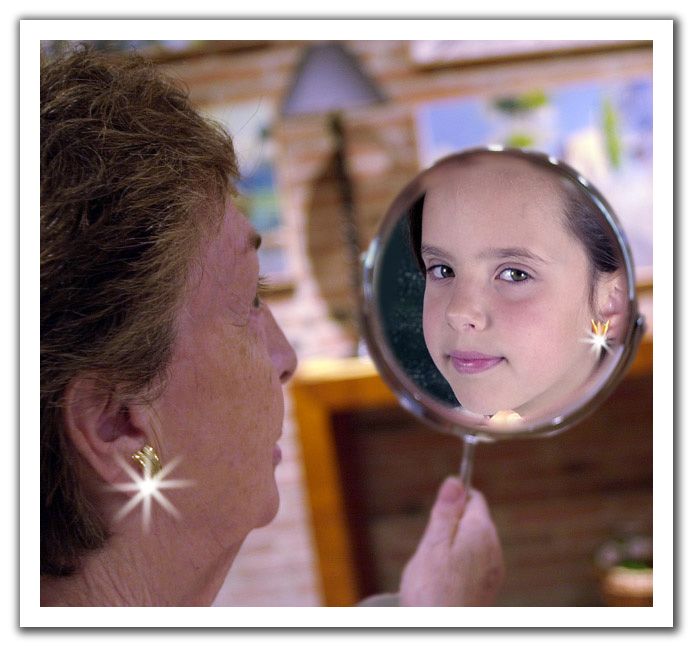
When an old lady died in the geriatric ward of a small hospital near Dundee Scotland , it was believed that she had nothing left of any value. Later, when the nurses were going through her meager possessions, they found this poem. Its quality and content so impressed the staff that copies were made and distributed to every nurse in the hospital. This little old Scottish lady, with nothing left to give to the world, is now the author of this ‘anonymous’ poem winging across the Internet:

Crabby Old Woman

What do you see, nurses. What do you see?
What are you thinking. When you’re looking at me?
A crabby old woman, not very wise,
Uncertain of habit, with faraway eyes?

Who dribbles her food and makes no reply.
When you say in a loud voice “I do wish you’d try!”
Who seems not to notice the things that you do,
And forever is losing a stocking or shoe?

Who, resisting or not, lets you do as you will,
With bathing and feeding, the long day to fill?
Is that what you’re thinking? Is that what you see?
Then open your eyes, nurse, you’re not looking at me.

I’ll tell you who I am as I sit here so still,
As I do at your bidding, as I eat at your will.
I’m a small child of ten with a father and mother,
Brothers and sisters who love one another.

A young girl of sixteen with wings on her feet
Dreaming that soon now; a lover she’ll meet.
A bride soon at twenty; my heart gives a leap,
Remembering the vows that I promised to keep.

At twenty-five now, I have young of my own,
Who need me to guide and a secure happy home.
A woman of thirty, my young now grown fast,
Bound to each other with ties that should last.

At forty, my young sons have grown and are gone,
But my man’s beside me to see I don’t mourn
At fifty once more, babies play round my knee,
Again we know children, my loved one and me.

Dark days are upon me, my husband is dead,
I look at the future; I shudder with dread.
For my young are all rearing young of their own,
And I think of the years and the love that I’ve known.

I’m now an old woman and nature is cruel;
Tis jest to make old age look like a fool.
The body, it crumbles, grace and vigor depart,
There is now a stone where I once had a heart.

But inside this old carcass a young girl still dwells,
And now and again, my battered heart swells.
I remember the joys, I remember the pain,
And I’m loving and living life over again.

I think of the years all too few, gone too fast,
And accept the stark fact that nothing can last.
So open your eyes, people, open and see,
Not a crabby old woman; Look closer…see…ME!!

Dang it!  Why does that poem bring me near tears each time I read it?  Who am I feeling for?  All of us I think, young and old, for the most part we have lost the ability to prize something highly valuable.  I am uncertain how, why or exactly when American culture began to value youth as the ultimate prize and to see elderly people as mostly worn out and useless. The more age pushes me toward my elder years the more I am aware of it, for in small ways turning somewhat invisible to those much younger has begun to happen to me.

With so much experience and so much to share, it is troublesome how old people get treated like they are either not there or just in the way. Since we all don’t want to die, why is it we fear getting old so much? That question illustrates the insanity we live within today; an unanswerable paradox.

I am grateful for coming across the elder lady’s poem again.  It is a reminder to practice more consistently what I began some years ago: to try imagine an old person as they were when “my age”. This is a very imperfect way of getting my mind straight for my view of them.  I wish I did not need such a crutch. However I am glad for a way of seeing that helps me to see an elderly person as a peer; another person just like me instead of some very old person who I have so little in common with.

Resolve to be tender with the young,
compassionate with the aged,
sympathetic with the striving,
and tolerant with the weak and the wrong.
Sometime in your life you will have been all of these.
Dr. Robert H. Goddard

Belief is Important; Trust is Essential

A small girl and her father were crossing a bridge.  The father asked his little daughter Sweetheart, please hold my hand so that you don’t fall into the river.  The little girl said No, Dad. You hold my hand.

What’s the difference? Asked the puzzled father. There’s a big difference, replied the little girl.  If I hold your hand and something happens to me, chances are that I may let your hand go. But if you hold my hand, I know for sure that no matter what happens, you will never let my hand go.

In any relationship, the essence of trust is not in its bind, but in its bond. So hold the hand of the person whom you love rather than expecting them to hold yours.

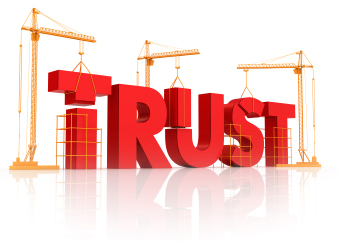
Definition of trust:  assured reliance on the character, ability, strength, integrity or truth of someone or something.

It is not uncommon for a person to emotionally love another, but not trust him or her.  Just as often one may trust another but not emotionally love him or her. To trust someone I have to believe they have my best interest at heart and would not hesitate to put consideration of me in front of them self.  Without doubt or hesitation I can rely on him or her.

While the beginning of trust may be given freely, it is earned over time by consistency.  To be trusted, I must show another person I will not use them or take advantage of them. I won’t abuse their love or generosity. I will think of him or her before acting.

Re-earning a person’s trust is done in the same way, but is far more difficult.  Once trust has been violated it may not be as fully possible as it once was.  It may not be achievable again at all!  If it is re-established, the rebuilding of trust takes a much longer period of time and may never achieve the strength that was once shared.

Each of us is different as to how early we can trust another.  Some have been seriously hurt previously and hesitate to trust again.  Other people can be very “trusting” even toward those who do not deserve their trust.  No matter the individual, you earn and re-earn people’s trusts through reliance on the consistency of character.  Each of us proves over time we are trustworthy or not by what we do.

The universal truth is if I have broken another’s trust, I have NO RIGHT to expect anything from the other person, especially trust.  I should not hold it against someone if they find they can not trust me again.  It is their right to protect them self from me or anything they perceive might hurt them again.  Even if a person I’ve hurt badly allows an opportunity to rebuild it will take huge amounts of perseverance and consistent proof to prove myself worthy.  In such as instance I must remember I am being given a chance I actually do not deserve.

Violating another’s trust not only hurts them, I damage me as well.  Learning to trust my self is difficult, but the only way to heal my own wounds caused by my own untrustworthiness.  Being true to my self is a large part of the ability to be trustworthy to others.

I am grateful for those who trust me and to deserve their trust.  There is much thankfulness for those whose trust I violated who have allowed me the chance to rebuild being trustworthy.  For those I proved myself unworthy of their trust, I respect the need to protect yourself and not trust me again.

Belief is Doubtful, Trust is Certain
Belief is from Mind, Trust is from Heart
Belief is Ordinary; Trust is Extra-ordinary
Belief is Limited; Trust is infinite
Belief is Partial; Trust is Complete
Belief is Important; Trust is Essential
Believe many; Trust only a Few
From “Belief vs. Trust” by Gan Chennai

Whatever the Outcome… Forgive Yourself

Likely the period of most profound growth for me was time spent immersed in learning who I was and coming face to face with ‘what was and is’ while at “The Meadows” in Wickenburg Arizona.  Those weeks in the high Sonora  Desert in 2007 were eye-opening and life changing beyond anything I can describe.

When I think of the experience, the first things that come to mind are:
1) Life is pretty much what you make it into.
2) Letting the past go is critical to having a future.
3) People I care about and those who care about me are what really matters.

On point number three I was exposed at The Meadows to a loosely structured way of making amends.  The process can those willing to listen and hear what I have to say, but is not sure thing.  However it almost always works in helping me make peace with myself.

To verbally attempt to make amends all that’s needed is someone willing to hear me out, even if they can barely stand to do so.  Attempting to make amends with another who does not want to be around me and holds great bitterness and hatred will only serve to make the chasm between us wider and deeper.

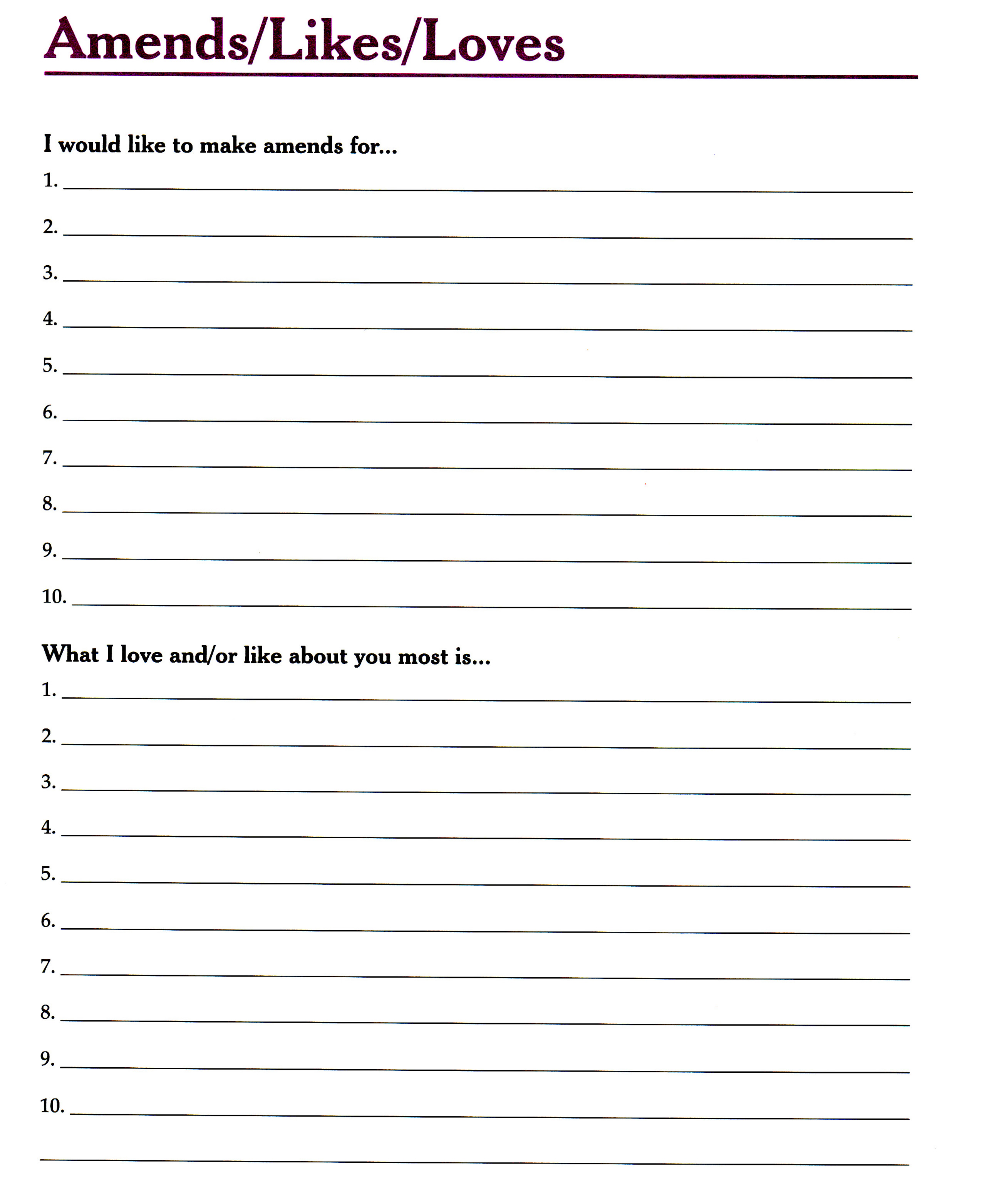
The amends process is mentioned often in recovery and self-help groups although the only “written form” I am aware of is the sheet just below.

The process is to over time thoughtfully fill out the ‘amends sheet’ and share the contents with the person you hurt, offended or wronged.  Sometimes sharing it with another is impossible and my healing comes from the focus to complete the form.  At other times it will make no difference and the abhorrence the person feels will be unaffected.

There are other occasions when a someone considers what was shared and accepts the amends somewhere in the future.  And there are the instances when an amends makes an instant difference.  It has amazed me how a person who could hardly stand to be in my presence softened and connected with me again when I spoke my amends. The “Likes/Loves” section can lend a lot toward helping reestablish some equilibrium between people.

It is important to remember an amend is not just an apology, but instead is about establishing justice as much as possible. If the indiscretion can’t be paid back or rebuilt, then symbolically restoration needs to be made.  Nothing says the latter stronger than a true change in the behavior and future actions of the offender.

Sometimes it makes no sense to make an ‘in-person” amends as more damage could be done by it.  At others amends are impossible because a person one hurt has passed on or is impossible to locate.  Then a “living” amends can help. This simply means living differently. Amends are about a genuine change in behavior instead of the patchwork of an apology.

The ten tips below about making amends can be found here in depth LINK
1. Face your own feelings first… it’s not always self-evident.
2. Understand what it takes to make amends. Go beyond desire to cover up shame.
3. Write down the reasons to make amends.  Get out of your head and on paper.
4. Look over your reasons… See patterns emerging?
5. Practice what you need to say in your head. Prepare your notes (form).
6. Express genuine regret and provide measurable promises to change.
7. Decide to meet … face-to-face (at) a good, neutral place (if it makes sense)
8. Don’t overdo it! Avoid making assumptions about their feelings or perspective.
9. Keep it simple and to the point.
10. Resolve to move on.  Whatever the outcome… forgive yourself.

Today’s blog came from looking for a file in my documents and stumbling across “The Meadow’s Amends Form”.  It has served me so well in making peace with others and myself.  The greatest benefit of each attempted amends, whether accepted well or badly by another, is the healing that has come to me.  For every one I have made and all those I yet will, I am very grateful for the process I was taught its many benefits.

The injured party does not want to be compensated because he has been wronged;
he wants to be healed because he has been hurt.
G.K. Chesterton

NOTE:  To save the form right click on it at the top of the blog and select ‘save picture as”.

Profoundly Tender Affection & Mood of Merriment

Happy St Patrick’s Day!

This morning surfing on-line for an Irish wish and prayer to send to a few friends on St. Patrick’s day I found this one I liked most:

May love and laughter light your days…
And warm your heart and home…
May good and faithful friends be yours…
Wherever you may roam…
May peace and plenty bless your world…
With joy that long endures…
May all life’s passing seasons…
Bring the best to you and yours…

Those words stuck me as being exactly the wish I wanted to send to a few people .  After reading the prayer several times I began to drill down and focus on what some of the words actually meant.  Through doing that I came away with a more personally meaningful insight of what is expressed in those eight lines.

LOVE:  a profoundly tender affection for another person

LAUGHTER:  A mood of merriment or amusement.

WARM: feeling of kindness or vitality

HEART:  the center of emotion and feeling

HOME: retreat of safety or shelter

GOOD:  virtuous; righteous

FAITHFUL: allegiant; loyal

FRIEND: people attached through feeling

ROAM:  go, walk or travel

PEACE:  freedom from strife or dissension

WORLD:  your part of Earth

PLENTY: abundant supply without impairment

BLESS:  sanctify, bestow good; holy

JOY:  great happiness; delight

ENDURE: sustain without impairment

LIFE: human existence; animate existence

SEASON:  periods when conditions are best

BEST:  highest quality; most advantageous,

YOU:  total of who you are

YOURS:  what belongs to you.

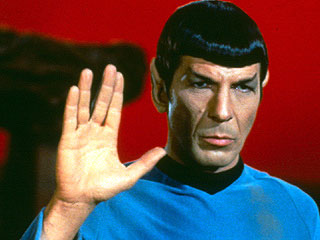
Then taking those definitions I reworked the eight lines to say essentially the same thing in a different (albeit a little longer) manner.  I am grateful for the added relevance that flowed to me as I reshaped the words to how “Mr. Spock” might have expressed them.

A new interpretation of an old Traditional Irish Wish and Prayer
by James Browning
May a profoundly tender affection & mood of merriment light your days…
And bring a kindly feeling in your center of emotion & retreat of safety…
May virtuous & allegiant people attached through feeling be yours…
Wherever you may go, walk or travel…
May freedom from strife & an abundant supply sanctify your part of Earth
With great happiness that long sustains without impairment…
May all human experience in periods when conditions are best…
Bring the highest quality to the total of who you are & what belongs to you…