Letting Go

For much of my life I was one of those men women need to be a bit wary of. I don’t believe I was ever a truly bad guy, well not too bad anyway. Rather I was driven by unresolved childhood insecurity, abandonment and abuse that created a compulsion and need to get women to come closer and be interested in me. Underneath, at least on my part, there was frequently a sexual tinge to my interactions with many women. Nothing is offered here as an excuse, but rather as an explanation. I hold myself responsible for all my actions. Bad behavior is bad behavior no matter how explainable the motivation.

I truly am different now. Maybe different is not the correct word since I know such things used to go on and the memory of it all is still in me. A better way of stating my more recent attitude and behavior is I have grown up and matured.  No longer do I carry within a mind that operates like that of a hormonal male teenager on the make most all the time. FINALLY, it is possible for me to just be a friend to a woman. Hallelujah!

This way of being has allowed me to make a few real friendships with women. Through these relationships I am gaining a new understanding of myself and specifically the female gender. I am learning! Previously I allowed sexual involvement to stunt or destroy what could have been caring friendships. I regret those losses. “No more” is my strong and sincere intention and promise to my self. When neither is on the “prowl” and a man and woman can openly be themselves it is not just educational, but endearing and downright fun!

Within the last six months P. and me met and over time have become friends like what is possible between a brother and sister. This sort of a friendship is new for me and something I am very grateful for. Of a sort she has become a good teacher even though I don’t believe that is her intention or that she is even aware of it. Last evening P. and I grabbed dinner together. We ran out of time long before we ran out of words and we laughed our asses off (no wonder they stopped seating people close around us).

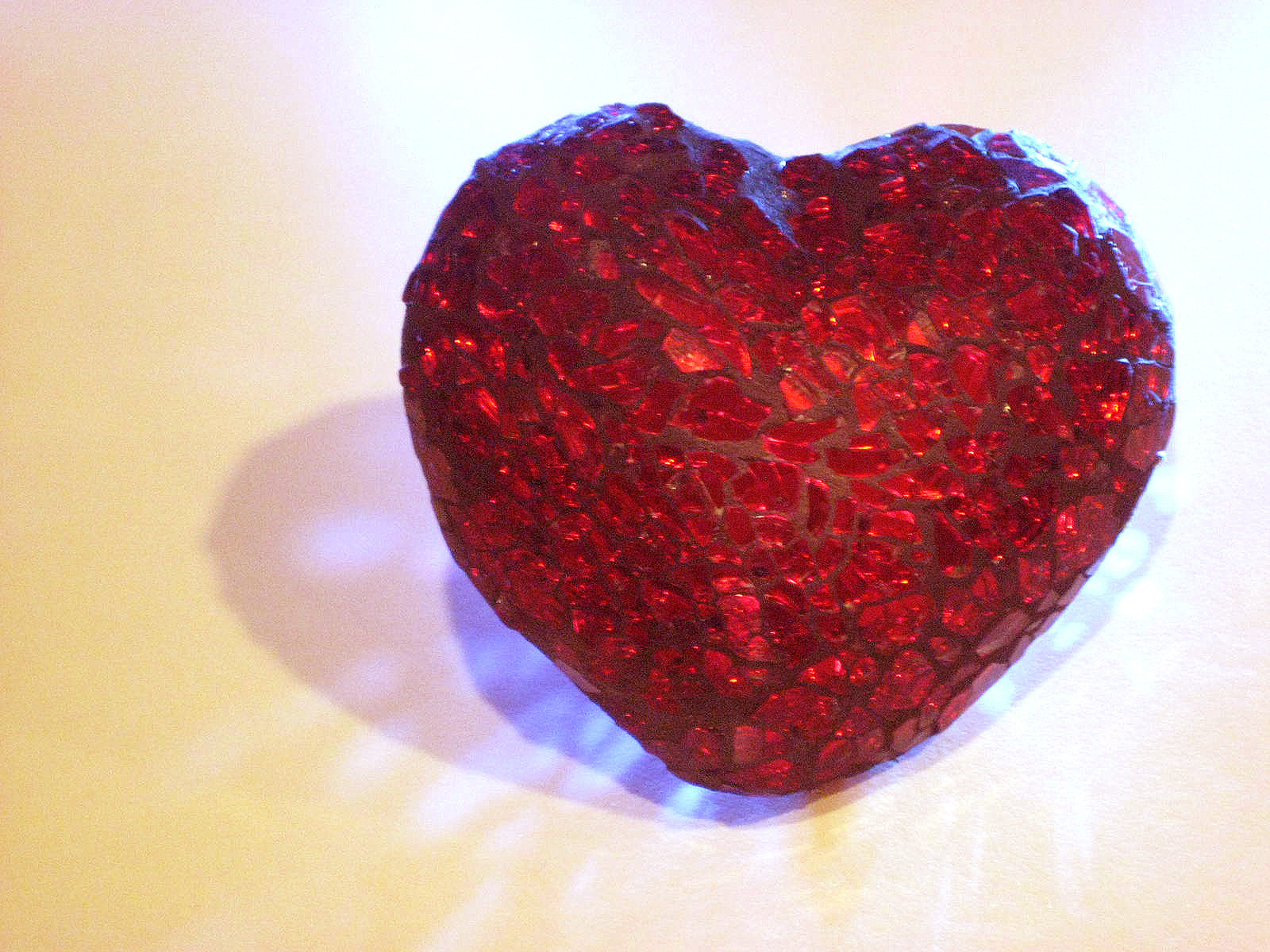
Several times when I have seen P. I have given her a book and last night she came bearing a gift for me: the heart you see pictured at the top. She knows the hell I have put myself through in my past and how shattered my heart became. P. also knows a special woman has come into my life that has rekindled the brightness of my heart and ignited a spark within. How wonderful it is to have a “sis” who is encouraging and understands my heart is like the one in the photo: shattered but reassembled, whole again, but fragile. Her gift told me without words she was saying everything from “be careful” to “I am glad for you” and from “I see the spark in you when you talk about K.” to “I will kick her ass if she hurts you”.

How wonderfully blessed I am to be able to let the past go so I can embrace the present. I am grateful for the wisdom and ability that age and experience has brought me to where I can have a friend and “sister” like P. Further, I am humbly thankful for the condition today of my heart that allows someone special like K. to come close. For both women and other female friends I am grateful for their presence in my life without the ability to put that gratitude into exact words except to say “thank you;  thank you very much”.

Letting Go
To let go doesn’t mean to stop caring;
It means I can’t do it for someone else.
To let go is not to cut myself off…
It’s the realization that I can’t control another…
To let go is not to enable,
but to allow learning from natural consequences.
To let go is to admit powerlessness,
which means the outcome is not in my hands.
To let go is not to try and change or blame another,
I can only change myself.
To let go is not to care for, but to care about.
To let go is not to fix, but to be supportive.
To let go is not to judge,
but to allow another to be a human being.
To let go is not to be in the middle arranging all the outcomes,
but to allow others to affect their own outcomes.
To let go is not to be protective,
it is to permit another to face reality.
To let go is not to deny, but to accept.
To let go is not to nag, scold, or argue,
but to search out my own shortcomings and correct them.
To let go is not to adjust everything to my desires,
but to take each day as it comes and cherish the moment.
To let go is not to criticize and regulate anyone,
but to try to become what I dream I can be.
To let go is not to regret the past,
but to grow and live for the future.
To let go is to fear less and love more.
Author Unknown


“Three Good Things”

Once upon a time I believed achieving happiness was the purpose of my life.  Experience has since taught the pursuit of happiness actually leads to a good deal of unhappiness.  My vantage point of today tells me happiness is actually a consequence of a very different pursuit in life – the pursuit of the evolution of my ability to love myself and others.

In days past my pursuit of happiness has included many different, but unsuccessful approaches including:

1. The pursuit of momentary pleasure drove me for a long while during the time when I believed happiness was the same as pleasure.  It took empty experience over decades to teach me that sex is not happiness nor is sex love.

2. The pursuit of money, the control it gives and the things money can buy was a catalyst for achievement for much of my adult life.  I thought having then what I did not have as a child would fill in some missing parts within.  Once I had an over abundance I found I felt more hallow than even before.

3.  I realize now my pursuit of happiness included a burning need to be valued as a human being by others.  My childhood environment provided almost none of that reinforcement and instead I felt a need to impress others, to be admired and thought well of.  In that thinking my happiness was attached to what others thought as I attempted to get love, attention and admiration in an impossible way.

Today the fact rings true within that true happiness is not the result of DOING, but of a way of BEING. Rather than being a result of the momentary pleasures or money or even other people, it is the result of my intention to evolve daily as a loving human being.

As a further aid in my positive evolution I am cultivating a new habit.  Each morning I focus on what I am grateful for and ask myself “what three good things happened yesterday”.  This practice comes directly from the book “Flourish” by Martin Seligman whose work I admire and has found a great help to me personally.

Anytime I focus on what I am thankful for and get away from what I wish were different, my life experience improves.  And the more I do that, the greater and more lasting the improvement is. “What three good things” is a simple method of redirecting attention towards positive thoughts and away from negative thinking. It works wonders for me.

We human beings evolved spending much more time thinking about negative experiences and possibilities than positive ones. That’s what kept us safe in the wild and from becoming some animal’s lunch.  Starting when we lived in caves the instinct was strong to spend a lot of time thinking about what could go wrong and how to avoid it.  Once upon a time there was an evolutionary advantage to this dominant way of thinking, but for modern humans this negative bias is a source of a lot of anxiety, depression, and general lack of wellbeing.  Luckily, by re-directing my thoughts intentionally towards positive events, I have found I can do a lot to correct this negative bias.

Dr. Deborah Barnett, Ph.D. writes the “3 Good Things” exercise, also known as the “3 Blessings” exercise, is a great Positive Psychology technique that has been well tested. It has been shown to increase well-being and decrease depression and anxiety. Martin Seligman, Ph.D., conducted a study using this exercise. The results were that 94% of very depressed people became less depressed and 92% became happier in 15 days. Furthermore, the results lasted for at least 6 months.

“The good things” is simple to do.  Each morning soon after I first get up I pick out 3 things that went well the previous day (many prefer to do this in the evening at the end of the day).  In just a few words I write down three events or experiences that went well and why they went well or what felt good about the experiences. I’ve learned what I choose does not have to be spectacular or dramatic.  Something as simple as being grateful for the sweet strawberries at dinner, appreciating a cool, misty morning or a call from a good friend the night before are good examples of simple, but meaningful reasons for me to be grateful.

Growing my awareness of gratitude has been a profound life-changer.  Always I felt I was thankful, but looking back now I realize before I spent 90% or more of my time focused on what needed to be improved, what needed to change, what I needed to be wary of, what had gone wrong or what might go wrong.  While I can’t say the percentage has reversed to be vastly all gratitude, there is balance now.  My life today contains at least as much thankfulness and well-being as it does worry and anxiety.  I am grateful for my gratitude!

If you don’t get everything you want,
think of the things you don’t get that you don’t want
Oscar Wilde

Free download of “3 good things” log page show in image at top.  No strings attached.
http://papernstitchblog.com/wp-content/uploads/2011/06/3goodthingslist1.pdf

When We Have Practiced Good Actions…

One reason that has made change in my life so challenging is explained in part by what psychologists say is the primary response to thinking of change: FEAR. In a book called “This year I will…”, Andy Ryan, an expert in collaborative thinking, spelled out why change is difficult: Whenever we initiate change, even a positive one, we activate fear in our emotional brain…If the fear is big enough, the fight-or-flight response will go off and we’ll run from what we’re trying to do.

Described by psychologist A. J. Schuler, some fears that get in the way of change are :
The risk of change seems greater than the risk of standing still.
We feel connected to other people who identify with the old way.
We lack role models for the new activity
We fear failure
We feel overwhelmed
Our self-image is threatened
We are reluctant to learn something new

In Andy Ryan’s book she (yes, “Andy” is a she) says the first step toward successful change is NOT to try to kill off old habits because once those ruts of procedure are worn into our psyche, they’re there buried deep. She says the first step is instead to deliberately ingrain new habits to create parallel roadways that we can use to bypass those old paths. Instead of thinking “I can’t change” the trick is to instill a new habit that in time can be used to overcome the old habit. That makes sense to me.

Those who study such things say the more we instill new habits, the more creative we become in stepping outside our comfort zone in all ways. I have personal proof of that through my new habit of getting up much earlier than I ever have (on average about 5:30am now). That tweak on my lifestyle has caused a wave of subtle changes I did not expect. For example, I find now I am more social, especially on weekends. Where I used to sleep late and often just be lazy and hang out at home alone, I now spend a lot more weekend time with people I care about.  Some weekend extra snooze time still exists, but I am up now around 7am on Saturday and Sunday replacing my 10am or later previous rising time.

Another point psychologists make is that lots of small changes are more likely to be successful than trying to make one large change. There is a Japanese concept called “Kaizen” or “change for the better” that has been used in business for over 50 years. The word originated from the Japanese words “kai” which means “change” or “to correct” and “zen” which means “good”. The premise of Kaizen is small changes consistently over time create major change for the better. Do the little things well and the big ones will show up in time.

An example of Kaizen being used successfully is how my earlier waking time became established. Had one evening I set my alarm for the next morning to get up ninety minutes earlier I doubt I would have gotten up at the new time even one morning. When I began trying to establish the new time to rise and shine, I did so in 10 to 15 minute increments which I stuck to for a week or two. I went to bed a little earlier and woke a little sooner. When I felt mostly comfortable with  a new time, I did the same thing again to change my habit a little more. It took over two months for my 5:30am rising time to become a comfortable new habit. Had I not approached instilling this new habit in steps, I would have quickly given up and you’d not likely be reading this blog today.

Today I am grateful for the small change of finding time to write this blog that has resulted in me now doing it every day for over half a year. In that time I have established new rising and bed times, become more social and through the associated sense of accomplishment I am more content than before. WOW! I want more of this change stuff.

When we have practiced good actions awhile they become easy;
When they are easy we take pleasure in them;
When they please us we do them frequently;
And then, by frequency of act they grow into habit.
Tilloyson

First we form habits, then they form us. Conquer your habits or they will conquer you. Rob Gilbert

The Jewel is in the Lotus

One of the lessons of wisdom my years have taught me is “you find what you go looking for”. Looking back from a perspective of today it is relatively easy to see the times I proved true something Buddha said: “The mind is everything. What you think you become”. It’s impossible for me to get on that trail of thought without some regret, but there is also delight for the knowing of the wisdom within. How I look at things is by far the biggest element in the quality of my existence that I have control of.

Here’s an illustration that helps to show how people see things has great control over conclusions. Imagine you have a corkboard attached to a wall, a box of tacks and a candle. You have been challenged with arranging the materials (all three and only those three materials) in a way that allows the candle to burn without dripping wax on the floor. Think about that for a moment and see what you come up with.

Some inventive people may come up with a number of solutions, but I missed a very simple one due to my previous use of these items being mentally etched in my mind. The uncomplicated answer is to dump the tacks out of the box, use a few of them to affix the box to the bulletin board and then put the candle on the box. The box will support the candle and catch wax that drips. From experience I saw the tack box as only a container. Only with the presented solution was I able to see it differently as an item to support the candle.

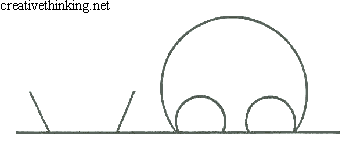
With the best of intentions frequently my expectation of how things are supposed to be colors the outcome. When you look at the rough sketch at the top of today’s entry, what do you see? Please take a look and see what jumps into your head.

Now if I tell you it’s a simple line drawing of a large cleaning woman on her knees washing a floor can you see that?

Now completely forget what I suggested the drawing represents and focus only on other solutions. Is what I suggested gone? For me and most other people the answer is “no”. The planted thought won’t completely go away and is a hindrance to coming up with other answers. We mostly see what we have been conditioned to see.

When my son was a little boy he loved “The Wizard of Oz” and watched it over and over and over, which meant I too saw all or parts of it many times. Only after much repetition did I “see” some of the message of the movie. Dorothy found a Scarecrow who thought he had no brains, a Lion who believed he had no courage and a tin man who was convinced he had no heart. At one point watching the movie for the 100th time with my son it hit me. The one who always figured out how to get them out of trouble was the Scarecrow. It was the Lion who always tried first to protect them. It was the tin man that kept rusting up from tears coming from his heart. What each sought was within them. They just could not see it.

A Buddhist phrase often used as a mantra is “Om Mani Padme Om” which does not have a direct English translation, but the core meaning is “the jewel is in the lotus”. The “jewel” (what you seek) “is in the lotus (you). The way I see the world is a result of my attitude, beliefs and conditioning. While not easy, changing my life for the better is simple. When a specific attitude, belief or my conditioning stands in my way I can find a different attitude, adapt my beliefs and condition myself in new ways. Life changing stuff! I am deeply grateful for this knowledge and wisdom!

As we think, so we become
The thought manifests as the word,
The word manifests as the deed,
The deed develops into habit,
And habit hardens in character,
So watch the thought and its ways with care,
And let it spring from love,
Born out of concern for all beings…
As the shadow follows the body,
As we think, so we become
Buddha (from the Dhammapada)

You Want The Truth?

Just below are borrowed words I found on-line by an unknown author.  Line by line it rings real and true for me.  I am in a period of renewal:  a time of joy, understanding and change.  I can feel myself maturing and growing as the seasons change from Fall to Winter.  I am well.  I am content.  I am happy.  I am grateful!

You want the truth?
Well, here it is.
Eventually, you forget it all.
First, you forget everything you learned;
the dates of wars and Pythagorean theorem.
You especially forget everything you didn’t really learn,
but just memorized the night before.
You forget the names of all but one or two of your favorite teachers;
and eventually you forget those, too.
You forget your junior year class schedule and where you used to sit,
and your best friend’s home phone number
and the lyrics to that song you must have played a million times.
And eventually, but slowly, you forget your humiliations –
even the ones that seemed indelible just fade away.
You forget who was cool and who was not,
who was pretty, smart, athletic, and not.
Who went to a good college,
who threw the best parties,
who had the most friends –
you forget all of them.
Even the ones you said you loved,
and the ones you actually did.
They’re the last to go.
And once you’ve forgotten enough,
you love someone else.
You replace the old friends with new ones.
You replace the old knowledge with new knowledge.
You replace what was with what is.
And one day you’ll look back at this time in your life
and wonder why you were so miserable.
You’ll ask yourself why you let certain things get to you,
why you let people get to you.
You won’t even be able to name the people whose opinions currently mean everything.
The truth is that everyone forgets,
and everyone is forgotten,
everyone replaces and
everyone is replaced.
It’s unavoidable.

 I chose intentionally to write today’s installment of “Good Morning Gratitude” at the end of the day instead of the beginning.  I am in a period of awakenings and finding my inner compass again that has been misplaced for such a long time.  The old is being shed.  The new is being embraced. My weekend has been wonderfully rich and today especially so.  Time with people I care about filled Saturday and Sunday, both beautifully sunny and cool days.  My awareness of affection for my friends and everything around me has been heightened the last two days.  Why?  There is a spark of love in my heart and that is the filter I am seeing the world through.  I am very grateful….  

I have a simple philosophy: 
Fill what’s empty. 
Empty what’s full. 
Scratch where it itches. 
Alice Roosevelt Longworth

Whimsical to Imagine

Last night I spent several hours listening to records. That’s right I said “records” meaning “LP’s”, “vinyl”, “albums”, etc. Remember those? I am not stuck in the past and exhibit that by my large CD collection and several thousand digital downloads. On my iPhone lives around a thousand songs that travel around with me all the time. However, there’s just something special, warm and personally reminiscent about the sound that comes from my LP collection of around 3,500 LP’s.

Music matters to me far more than television or movies and even a little more than books. That is saying a lot since reading is a highly favorite way to spend my time. Some of the music I love best is poetry set to music. Last night while listening to James Taylor, Gordon Lightfoot, Prince, The Beatles and Concrete Blonde I looked through a couple of my poetry books. The notion struck me of wondering how some of the old poems might sound set to music that matched their meter and rhyme. I can almost hear the melody of poems like:

“The Years” by Sara Teasdale 1884 – 1933
Tonight I close my eyes and see
A strange procession passing me–
The years before I saw your face
Go by me with wishful grace
They pass, the sensitive shy years,
As one who strives to dance, half blind with tears
The years went by and never knew
That each one brought me nearer to you;
Their path was narrow and apart
And yet it led me to your heart–
Oh sensitive shy years, oh lonely years,
That strove to sing with voices drowned in tears.

Kisses Kept Are Waster by Edmund Vance Cooke (1866-1932)
Kisses kept are wasted;
Love is to be tasted.
There are some you love, I know;
Be not loathe to tell them so.
Lips go dry and eyes grow wet
Waiting to be warmly met.
Keep them not in waiting yet;
Kisses kept are wasted.”

“To My Dear and Loving Husband” by Anne Bradstreet 1612-1672
If ever two were one then surely we.
If ever man were loved by wife, then thee.
If ever wife were happy in a man,
Compare with me, ye women, if you can.
I prize thy love more than whole mines of gold
Of all the riches that the East doth hold.
My love is such that rivers cannot quench,
Nor aught but love from thee give recompense.
Thy love is such I can no way repay.
The heavens reward thee manifold, I pray.
Then while we live, in love let’s so persevere
That when we live not more, we may live ever.

It’s whimsical to imagine such old poetic work having a modern musical score. Yet when I read some of it, there is a melody about the poems that is just out of reach of my ears. That phenomenon is one of the things I love most about well written rhyming poetry. While I appreciate works that don’t rhyme, like Whitman, I just can’t hold any of it to the high level of esteem I feel for even metered, rhyming work.

This morning I am thankful for all the music I love that has been a soundtrack for my life. In like kind, there is deep gratitude within for the words of the poets that stir my soul and heart so much I imagine music set behind them.

Music washes away from the soul the dust of everyday life. 
Berthold Auerbach

Every Day, In Every Way…

A long time ago I read that if a person repeated aloud the same statement each day for thirty days he or she would begin to believe what was said to be true even if the statement was a bold-faced lie. Imagine how much more engrained something can become if it actually is possible or true to start with!

The term ‘affirmation” is thrown around so much today the meaning can be cloudy. A short, but clear definition of affirmation is: to declare or assert.

Emile Coue was a French psychologist who lived from mid 1800’s through the first quarter of the 20 century. He is regarded as the person who introduced the basis of how positve affirmations can have effect through his work in self-improvement and optimistic auto-suggestion. His most famous affirmation is “Every day, in every way, I’m getting better and better”. His method centered on repeating such a statement(s) at the beginning and at the end of each day or more frequently.

Science now knows that every thought we think and every word we say is a stream of affirmations. We are continually affirming subconsciously with our words and thoughts.  This flow of affirmations helps to create our life experience. Beliefs are learned thought patterns we have developed since childhood. Many of these thoughts work well for us, but others may now be working against us. Thinking may at times be dysfunctional and may even be sabotaging us. Every affirmation we think or say is a reflection of our inner truth or beliefs.

By choosing to think and say positive affirmations as true, the subconscious is forced into one of two reactions – avoidance or reappraisal. The bigger the issue the bigger the gap between the positive affirmation and the perceived inner truth and the more likely that one is going to experience resistance. This is where the subconscious finds it easier to stay with its perceived inner truth and avoid the challenge using any means at its disposal to keep from examining the issue. One can recognize this reaction by a strong negative feeling inside as positive affirmations are stated. Equally if one experiences a sense of joy and well-being, the mind is instinctively responding to something it believes to be true.

I began using positive affirmations regularly while I spent five weeks at The Meadows in the fall of 2006. I was there learning how to deal with reoccurring moderate depression and related issues. At first my opinion of saying positive things aloud to improve my life was that it had to be BS. Yet, I was determined to change my life for the better and was willing to try most anything to achieve that. So I began the practice of getting up before sunrise and while standing on my dorm balcony I’d watch the sun rise each day over the high Sonora Desert as I read aloud a list of affirmations. Results did not come the first day or even the first week, but within two weeks the affirmations begin to have a positive effect. As time went on I began to look forward to my sunrise time and my belief in affirmations has grown stronger and stronger since.

Here are a few examples of affirmations I like:
Loving my self heals my life.
My body heals quickly and easily.
The more grateful I am, the more reasons I find to be grateful.
I know I deserve Love and accept it now.
I give out Love and it is returned to me multiplied.
When I believe in myself, so do others.
I am my own unique self – special, creative and wonderful.
I am at peace.
I trust in the process of life.
I am proud of myself.
I am whole, complete and perfect just as I am.
I clearly see lots to be grateful for in life.
Through gratitude my world expands.
Happiness exists where I choose to look for it.
I release all negativity and hold joy in my heart.
I accept the good that is flowing into my life.
The warmth of love surrounds me.
I release myself from my anger and let the past go.
I live in the now each moment of each day.

Affirmations are not a magic spell or potion. They are simple exercises for the psyche to improve mental health similar in fashion to how working out at a gym can create better physical health. Affirmations gain their power from repetition in the same manner as repeated physical exercise yields results. The more often I say them, the more they will impact my reality. This morning I am grateful for the power of affirmations. Beyond a shadow of doubt, I know for me they work!

No matter where you go or what you do, you live your entire life within the confines of your head.
Terry Josephson

Time is Limited

I had an awareness of Steve Jobs while he lived and knew he was an amazing guy. My respect for him was solidified when viewing a video of a speech he gave at the 2005 graduation at Stanford not long after one of the times he beat cancer. Now with his passing and more material coming to light about his life, my opinion is evolving. In greater depth I have come to know he wasn’t perfect, but he was damn good!

From an article in USA Today, Wednesday October 10, 2011: “There’s a phrase in Buddhism – ‘beginner’s mind’ – it’s wonderful to have a beginner’s mind,” Jobs would tell people. This means approaching things without any preconceived notions, judgments or expectations, just like a child. It was the core of his innovations and what fundamentally made him such an original thinker. He was not remotely afraid to experiment, and more important, not afraid to lose either. He once said, “I am the only person I know that’s lost a quarter of a billion dollars in one year… its very character building”. He never equated failing with being a failure.

In death, some people get eulogized beyond what resembles the life that was lived. That does not seem to be necessary with Steve Jobs.  He was the “real deal”. Not everyone loved him, but few did not respect him.

Steve Jobs was fully human and had flaws. As early as 1981, Macintosh project founder Jef Raskin wrote a note to Apple president Mike Scott complaining:
Jobs regularly misses appointments
He acts without thinking and with bad judgment
He does not give credit where due
Jobs often reacts ad hominem (with feelings rather than intellect)
He makes absurd and wasteful decisions by trying to be paternal
He interrupts and doesn’t listen
He does not keep promises or meet commitments
He makes decisions ex cathedra (by virtue of one’s position)
Optimistic estimates
Jobs is often irresponsible and inconsiderate

There are stories that include Steve getting mad and firing employees on the spot. One particular account that has made the rounds has him firing someone on an elevator and another tells about how he let someone go for bringing him the wrong type of mineral water. There are lots of tales about Steve Jobs. Often they are likely to be exaggerations, but many of them are probably based in some truth as well.

When my time comes for a few stories to be told after I am gone I wonder what they will be. Will the stories be about moments when I was emotional or irrational and made bad choices? Or will they be about the times when I was creative and originated some semblance of original thought? Will what is said be about me as a person or my professional persona? Will those who respect me be the story tellers or will it be the naysayers who never “got me” who spin the tales? The answer? Both I imagine. You know, it really won’t matter much to me then.  I’ll be DEAD!

Steve Jobs was quoted as saying “Death is very likely the single best invention of life. Almost everything, all external expectations, all pride, all fear of embarrassment or failure: These things just fall away in the face of death.”

In the Stanford Speech Jobs said “Your time is limited, so don’t waste it living someone else’s life… Have the courage to follow your heart and intuition. They somehow already know what you truly want to become.”

At 5.8 decades of life, more than ever I am aware that “time is limited”. However, I am more grateful for my remaining days than I have ever been before. A discovery of recent months is one of the best uses of some of my limited time is to come here each day and express my thanks for another day of life. Thank you for sharing the journey with me and witnessing the growth of my gratitude. 

If you can’t get rid of the skeleton in your closet, you’d best teach it to dance.  George Bernard Shaw

Those Who Have Less Are Many

This morning as I begin a new day writing here, I am curious if I can come up with 50 things to be grateful for in 10 minutes. Here goes:

1. Bed I woke up in.
2. Clean sheets I slept on.
3. Home I slept safely in last night.
4. Alarm clock that woke me up.
5. Electricity to power everything.
6. Lights so I could see before dawn.
7. Coffee pot and ground coffee.
8. Milk and sugar.
9. Glasses so I can see this screen.
10. Ability to see so the glasses matter.
11. Comfy clothes to wear.
12. Coffee cup for my coffee.
13. Morning banana.
14. My computer.
15. High speed internet.
16. Inspiration to write this blog.
17. Being alive.
18. Hands and arms that work.
19. Good health.
20. Email I get from a friend each morning.
21. A good brain that allows me to write.
22. Carpet under my feet.
23. Legs that work.
24. Wisdom to be grateful.
25. Desk and a chair to sit in.
26. Radio to listen to.
27. Pen and notepad.
28. My Bathroom.
29. Indoor plumbing to wash my hands.
30. Comforter and blanket on my bed.
31. Pillow for my head.
32. Those that support my writing.
33. Living in a peaceful country.
34. My phone to get a text on.
35. A window to see the sunrise.
36. The calendar in my office.
37. Art on my walls.
38. Optimistic and hopeful outlook.
39. Nat Geo to read during morning business.
40. A job to go to later.
41. Ample money to support myself.
42. People I look forward to seeing today.
43. A short commute to/from work.
44. The cool fall morning outside
45. Heat to keep me warm this morning.
46. A wide choice of clothes in my closet.
47. Refrigerator
48. Food in the pantry and fridge.
49. Ability to remember.
50. Love of friends and family.
51. Toothbrush and toothpaste
52. All my fingers and toes.
53. The Internet
54. A good night’s sleep.

The last four are bonus entries to make up for any duplication or similarity of entries created by writing quickly on the fly. My progress began to slow down a little after the first 30 but the list above was completed in about eight minutes;   one thing to be grateful for every eight seconds!

Once I began to focus on comparing my life to how it could be, gratitude filled me more and more. I imagined how decadently luxurious almost all waking today up in a third world country would find my list. People who have more than me are few and those who have less are many. Such a way of looking at things is a noble way to put my life in perspective. On what many would call a “bad day” I have a better and easier life than almost all on the planet! The majority of the world’s population spends most of every day on one task: attempting to find enough to eat.

How lucky am I! For my rich blessings I am highly grateful. A great frame of mind to begin a new day with!

It’s Never Too Late; There’s Always Time

Years ago I read Mitch Albom’s book “Tuesdays with Morrie”.  The novel touched me deeply and I eagerly bought Albom’s “The Five People You Meet in Heaven” when first I came across it in a book store.  Last week I bought a copy of the movie made of the latter from a bargain bin.  I previously did not recall the book was ever even made into a movie!

There are those little moments when just what I need comes to me at the moment I need it. Whether such times are the work of God and the Universe or pure chance and coincidence does not change the effect (although I like to think it is some combination of both). Watching “The Five People You Meet in Heaven” last night was one of those times.

I left work during the mid-afternoon yesterday because a bout of moderate depression was about halfway through its usual 2-3 day run.  Little was getting accomplished; I could not concentrate. Depression has a unique way of accentuating all I feel has not been right about my life and lowering hope for the future to a dim and distant light.  From experience I know intellectually what is going on, yet that does little to hinder the torrent of clouds and dark feeling that come over me.

OK… all you macho types are not going to like this, but to borrow a bit of a phrase from Rhett Butler “Frankly I don’t give a damn”.  Watching the “Five People You Meet in Heaven” movie last night caused a tear at several points as I allowed myself to be absorbed into some of the emotions being expressed.  In the main character’s sadness and grief for what he perceived as his wasted life I found an evening’s solace for what ailed me.  Better than any pill or distracting activity I was righted from being depressed by a good dose of my own emotions.  How very grateful I am this morning to feel “It’s never too late; there’s always time”.

It’s never too late
There’s always time.

It’s never too late to change.
There’s always time to begin.

It’s never to late to say I’m sorry
There’s always time to start again.

It’s never to late to let the past go
There’s always time to start a future.

It’s never too late to be happy
There’s always time to stop being sad.

It’s never too late to fall deeply in love,
There’s always time to reopen one’s heart.

It’s never too late to write your thoughts
There’s always time to speak your piece.

It’s never to late to find what you’ve dreamed of
There’s always time to learn to do something new.

It’s never too late to connect with one you left behind
There’s always time to be lost and to get found.

It’s never too late to try again when you failed before
There’s always time to grow and learn from mistakes.

It’s never too late to hope no matter how old you are
There’s always time to have foolish fun like a child.

It’s never too late to have much more than you need
There’s always time to make your life more simple.

It’s never too late to live the way you want to live
There’s always time to find yourself if you look.

It’s never to late to stop feeling old regret
There’s always time for hope for the future.

It’s never too late to find happiness
There’s always time to laugh more.

It’s never too late to forgive
There’s always time to be forgiven.

It’s never too late to change.
There’s always time to begin.

It’s never too late
There’s always time.
James Browning October 10, 2011

All endings are also beginnings. We just don’t know it at the time.
Mitch Albom 

“Five People You Meet in Heaven” trailer:  http://www.youtube.com/watch?v=IrLMtmvHYy0