Old Dogs CAN Learn New Tricks

There is a primitive part of the brain that science identified years ago as containing a human’s innate instinct for survival.  This behavior comes without conscious thought and is a reflex to be on guard and scan our environment for threats or “what’s wrong”.  When mankind lived in the bushes and was under constant threat the instinct served us very well.  In today’s environment the “what’s wrong” reflex can easily get misapplied and overused to cause fault finding where there are none.

All people have flaws and my life experience has shown me I have more than most.  Yet, in awareness and through consistent hard work to get past my defects of character I believe I am healthy, moral and mentally strong today.  However, no matter what, some people will always see me as I once was and not as the me I am today.  There is nothing I can do about that, but it still bothers me sometimes.

This week an ex-wife contacted me through email and with a three note exchange it because obvious she was viewing me as I once was.  Yes, I lied to her.  Yes, I cheated on her. In the end what happened literally broke my heart and showed me the lowest lows of my life.  There was great pain for both of us, but good did come of it for me.  The end of the relationship was the wakeup call where I was finally able to see my behavior for what it was and begin work in earnest to get better. Today I am well balanced and whole inside.  The feeling of being “not good enough” is quite dim most of the time and no where near what it used to be.  Simply I am the best I have ever been inwardly and outwardly.  My ‘ex’ does not see that though.

In contemplating the happening of yesterday I ended up taking issue with such sayings as “a leopard cannot change its spots”, a tiger can’t change its stripes” or “you can’t teach an old dog new tricks”.  Maybe you can’t teach a critter new tricks or get them to change their very color, but humans can change through intention and determination.  Heck, dogs, tigers and leopards live at best around 15-17 years and a human lives five or more times that.  Maybe if the animals lived as long as people their stripes, spots and tricks could change.

In pondering this whole subject and poking around on the internet I found that people often accept as truth sayings that are absolutely contradictory.  For example:

“You can’t teach an old dog new tricks.” VS.  “You’re never too old to learn.”
“Actions speak louder than words.” VS.  “The pen is mightier than the sword.”
“Silence is golden.” VS.  “The squeaky wheel gets the grease.”
“Never judge a book by its cover.” VS.  “Clothes make the man.”
“Opposites attract.” VS. “Birds of a feather flock together.”

Did you know that “an apple a day keeps the doctor away” was a marketing slogan dreamed up in the early 1900’s by American apple growers concerned that the temperance movement would cut into sales of apple cider?  While apples are good for you, believing that because of an advertising catchphrase shows how gullible we are.

Further, we often bastardize sayings beyond their original meaning.  It is not unusual to hear someone say “He got off scot free” and I’ll bet you 99% of people believe they are making some reference to Scottish people.  In reality “scot” is an old Norse word that means “payment” so the phrase has an original meaning of “not having to pay”.

Another is “If you think that, you have another thing coming” which is supposed to end with “another THINK coming”.  That error is so wide spread if you Google “another thing coming” you’ll get something like 150,000 results, while “another think coming” returns about one fourth of that.

I take great exception with the saying “people don’t change”.  Yes, we all have ingrained personality traits, but we are not held captive by them.  To believe I can not change is only encouraging myself to accept my weaknesses.  A comparison of my self of today with person I was a few years ago shows me I am the same, yet so much more than I was. Unchanged is how I think and process information but experience, recovery and hard work has changed the way I interpret everything and how I act. Every day adds a new layer of character. That’s why I find myself today approaching getting older with optimism rather than dread. I am grateful to know and believe what Emerson wrote “As we grow old the beauty steals inward.”

Growth is the only evidence of life.
John Henry Newman

Passage of Time

If I had a dollar for every time I have exchanged a thought recently with someone about how fast times passes there’d be at least an extra hundred bucks in my pocket!  The shared lamenting is often about how close Christmas already is or how fast it seems to have crept up on us.  Or there is consternation about the speed 2011 has evaporated with.  This morning the passage of time popped in my head as a good subject to do a free-form journey in words to aid me getting to a point just out of reach at this moment.

Clocks are a fascination of mine which led me to take apart my parents windup alarm clock with a screwdriver when I was four years old.  I literally wanted to see “what made it tick”.  While there was no visual explanation for me to find inside the clock about its “ticking”, I did get to marvel at all those little parts which would not go back together.  Even my parents had no luck reassembling it and little ole me got into big trouble for my curiosity.

Old clocks have been an interest for years and at one point I possessed twenty-one antique seven-day mechanical wall and mantle clocks.  Once upon a time on each Saturday approximately one hour was spent winding them all each week and setting the correct time.  In my home there was quite a symphony of bells at the top of every hour.  As the days went by each week the onslaught of chiming began about five minutes before the hour until about five past as the slow runners were late to ring and the clocks running fast rang early.  It was quite a chore when the daylight savings time change came each fall and all the clocks had to be set back an hour.  Mechanical clock hands can not be moved backwards so I had to move the hands forward and let the clock chime on every hour and half hour before getting back around to the correct time. 

Our awareness of time is so acute today, but it was not always so.  In a favorite book “The Discoverers”, Daniel J. Boorstin points out mechanical clocks did not even exist until late in the 14th century and fairly accurate ones did not come along until a hundred years later.  The first people known to consistently measure time were the Egyptians who divided the day into two 12-hour time periods using a sort of sun-dial.  This method of dividing each day was picked up by other civilizations and became standardized in Latin:  “ante meridiem” (A.M.”before midday”) and “post meridiem” (P.M., “after midday”).  The Egyptians along with the Greeks and Chinese also developed water clocks which were followed by hourglasses.  Candle clocks were used in Japan, England and Iraq and something called a timestick was used in India, Tibet and parts of Europe.

For century’s most people were concerned with the passage of a day and but not about the passing of an hour and certainly not of something as small as a minute.  Beginning about five hundred years ago the first widely dispersed time pieces were town or church clocks which chimed one time on the hour.  Some of the earliest were in France and we get the word “clock” from the French word “cloche” which means bell.  For several hundred years a single chime noted the passing of an hour because almost every one was illiterate and could not count.  So our awareness of time (or is it obsession?) is a more modern affliction.

Being one of those with great curiosity who asks “why” a lot I began in childhood to drive adults crazy with inquisitiveness.  Clearly in memory is asking a 5th grade teacher why our number system was based on 10 and yet we use a system of 60 to tell time (60 seconds to a minute, etc).  She got frustrated I think because she did not know the answer and shooed me away, so I looked it up.  What I found was the practice is carried over from the ancient Sumerians who used a number system based around the number 60.  Even today some scientists and mathematicians will tell you a number system based on 60 is a more “logical” way to count and measure. 

So now that I have bored you with a synopsized history lesson about time, it would be easy to ask “why”.  Essentially writing this piece was a sort of meditation on the passage of time.  The most important ‘ah-ha” has been conscious awareness of time actually seems to make it pass more quickly.  When I can lose myself in something, as I did in writing this, time becomes largely irrelevant.  At such moments I am only aware of what I doing.  So that is the take-away I will gratefully head into my day with.  The more engaged in life I am, the less awareness I have about the passing of time.  Less awareness equals a feeling of having more time.  And with that thought it is time to jump head first into my day.

Clocks slay time… time is dead as long as it is being clicked off by little wheels; only when the clock stops does time come to life.  William Faulkner

Seeing Beyond What is Visible

Left on our own without stimulus or reminders, living can fall into a rut easily. Without reference points our days can appear bland and lacking the bright color engaged experience can provide.  One lesson taught to me frequently which took a long to absorb is my life is mostly what I make it out to be.  It is my choice whether I see being alive as a miracle or a burden.  It is a choice whether I choose to embellish life to its most positive aspect or diminish life to lowest possible meaning.  Where on that scale I choose to spend my days is in majority within my control.

On a lark this morning my love and I choose to watch a movie from a decade and a half ago that has been taking up space on my DVR.  Having seen a portion of it before when I decided to record it, I already knew I would probably enjoy it.  How could I not; Johnny Depp and Marlon Brando together! 

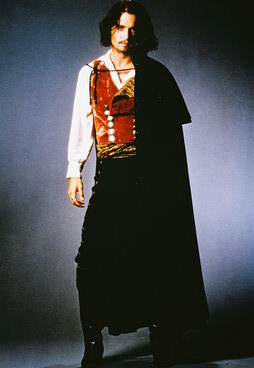
“Don Juan DeMarco” is a 1995 romantic comedy/drama set in modern times starring Depp as a man who believes himself to be Don Juan, the greatest lover in the world. In his cape, mask and typical 17th century garb DeMarco ends up being treated by Dr. Mickler, a psychiatrist (Brando’s character).  In the work to cure Depp’s character of his apparent delusion an unexpected effect on the psychiatric staff appears.  Many are inspired by DeMarco’s delusion.  The most profoundly affected is Dr. Mickler, who rekindles the romance in his complacent marriage and rediscovers life in general.  Now that the general story line has been revealed, I want to share a few wonderful pieces of dialogue from the movie spoken by Johnny Depp’s character, Don Juan DeMarco:

There are only four questions of value in life… What is sacred? Of what is the spirit made? What is worth living for, and what is worth dying for? The answer to each is the same: only love. 

Have you never met a woman who inspires you to love? Until your every sense is filled with her? You inhale her. You taste her. You… know that your heart has at last found a home. Your life begins with her, and without her it must surely end. 

Every true lover knows that the moment of greatest satisfaction comes when ecstasy is long over and he beholds before him the flower which has blossomed beneath his touch.

There are those that do not believe that a single soul born in heaven can split into twin spirits and shoot like falling stars to earth where over oceans and continents their magnetic forces will finally unite them back into one. But, how else to explain love at first sight?

By seeing beyond what is visible to the eye. Now there are those, of course, who do not share my perceptions, it is true. When I say that all…  women are dazzling beauties, they object. The nose of this one is too large; the hips of another, they are too wide; perhaps the breasts of a third, they are too small. But I see these women for how they truly are… glorious, radiant, spectacular, and perfect… because I am not limited by my eyesight. Women react to me in the way they do… because they sense that I search out the beauty that lies within until it overwhelms everything else.

If none of those lines touches or moves you I encourage you to immediately head to the nearest emergency room as most likely your heart has stopped beating.  Or else, you and your soul have fallen so out of love with each other and have become complete strangers for which I can only suggest therapy.  It’s quite alright if you don’t want to admit it to anyone that the movie dialogue touched you.  As long as you know is what matters! 

The movie, “Don Juan DeMarco”, is not “reality” based and that’s just fine with me.  Frankly sometimes I have way too much reality in my life.  Constantly there is a barrage of news about bad economic conditions, crime, pollution, political corruption, global warming and things of the sort that sow enough negativity to choke a masochist.  While I attempt to avoid what I can, and focus only on what I can help change, the whole mess drags me down sometimes.  To balance the all too real segments of life since childhood I have held on tight to what inspiration I can find from others. 

Mark Twain, Jack London, Hemingway, Kipling and Tolkien long before he was well known are writers who took me to grand new places and inspired me as a child.  In my adult life Thoreau, Huxley, Orwell, Vonnegut, Clarke, Fitzgerald, Joyce, and Forster are among those who pushed me to see a world broader and deeper than I could have otherwise known.

Movies have had a parallel affect on me and many have served to help me see beyond my range of life experience and become enthused, contemplative and even inspired about living.  From “The Wind and the Lion” to “Gone with the Wind”, from “Groundhog Day” to “The Day the Earth Stood Still”, from “Love Me Tender” to “Love Story”, they all left a  mark within me.  And now on my list is “Don Juan DeMarco”, a movie about inspired love that comes at a time when wondrous and unexpected love has come into my life.  I am grateful to know beyond a shadow of a doubt I would rather live delusionally inspired than realistically dull and bland.  For that small grain of wisdom my gratitude is too tremendous to even try to state.  

Imagination is more important than knowledge.  Albert Einstein
 

Warts and All

When the phrase “I love me” was spoken aloud the statement used to feel awkward, uncomfortable and untrue.  No, more than that; it felt stupid.  Now I know why it seemed so foreign; I did not love myself!  At best I loved myself a little with lots of reservations built in.   At worst, I held myself in great contempt and could come up with nothing specific to love myself for.  I have learned that love of self is inexplicably tied to my ability to love others.  Whenever love is conditional upon external conditions it is not really love at all and likely some sort of compulsion or obsession instead.  Coming to know love “warts and all” has been a real eye opener for me.  Or better yet, a real “soul opener”. 

The phrase “warts and all” has often been credited to Oliver Cromwell’s instructions to the painter Sir Peter Lely.  Lely’s painting style was, as was usual in the 1600’s, intended to flatter the sitter.  Cromwell had a preference for being portrayed as a military man and disdained any form of personal vanity. Cromwell was so adamant that Lely modified his usual overly complementary style and did what the leader wanted.

It is recorded that Cromwell’s words were “Mr. Lely, I desire you would use all your skill to paint my picture truly like me, and not flatter me at all; but remark all these roughness’s, pimples, warts and everything as you see me, otherwise I will never pay a farthing for it.”  We have Oliver Cromwell’s death mask as a reference. The mask shows a face with warts and imperfections making it evident that Lely’s portrait is an accurate record of Cromwell’s actual appearance.

How I began to love myself was to find some acceptance for my “roughness’s, pimples, warts”.  I made peace with my non-perfect features and habits.  It took time to come to see that each of those imperfect things worked together to create a unique person that has not been before nor will ever be again.  Given time and practice I did come to know the meaning of “perfectly imperfect”.  I became glad to be me.

My acceptance of self had to happen on many levels before I could love myself.  There had to be peace made with my age (in my 50’s) and wishes of being younger had to be taken down to few and far between.  I needed a clear realization of what my talents were which could only come with acceptance of my lack of talent in other things.  It was the contrast between the two that created a more clear way of my seeing me.  There needed to be pride and satisfaction from my past good behaviors and forgiveness for the ones I regretted.  Finding fulfillment in my fiscal health as it was had to happen so I could put away “wishing my life away” for money and things I did not have.  It even took accepting that no woman would ever love me again romantically in order for romantic love to find me.  

The pinnacle of the lesson could not be achieved until I found contentment with who I was and what I had done.  Only then could I love myself.  If I allowed misgivings about my past or disliked my present lot in life, my ability to love was unconditionally was stunted.  

Once upon a time I thought “self-care” was about spoiling one’s self.  Luxury, comfort and pleasure were always the first things that came to mind when I thought of it.  As enjoyable as such experiences may be they are not necessarily good self-care and can easily be the reverse in the form of a compulsion or addiction.

Today I love my self.   Saying “no” to something I don’t want to do is good self-care just as well as eating healthfully is.  Making sure I get ample sleep and rest is good self-care and so is setting good boundaries with others.  Even putting people not good for me outside my life is good self-care just as well as getting past bad habits. 

Until personal truth was made of the statement “you can not truly love others until you love yourself” I honestly did not know what love really was.  Opening my heart, mind and soul to acceptance of the “real me”is what brought me to its true meaning.  Once I began to find “me” I discovered love had been around me the whole time.  However, my state of being previously caused me to be unable to feel it.   Today I am grateful for the ability to feel honest human emotion and to love myself “warts and all”.  Joy leaps in my heart as I write those words.

Self love is food for your mind-body-soul, the nourishment that you need even before you can make any meaningful attempt to do anything great or anything at all. You access the beauty, strength, grace and eternal nature that is you.  Evelyn Lim

Uniquely Emoted by Each Reader

Please pardon that my usual type of content is being replaced today with something of an editorial rant.  I apologize in advance and appreciate your indulgence.  

Writing this blog every day now for eight months has been a highly rewarding experience. The commitment has brought discipline that was not present before.  Releasing to the world some of my deepest thoughts and feelings has quieted my mind and stilled my soul.  There have been great personal rewards, but not all I have received has been positive. 

Words typed on a screen are uniquely emoted by each reader; some vary only slightly from what is intended while others can find meaning that was never written.  The latter has been the only negative from my writing so openly.  I try to remember when a person interpolates content I did not write the occurrence is all about them and has nothing to do with me.  However, I am an emotion based human being and being chided for something I never said is not fun.  

The wisdom I lean on is the knowing that what matters is what I intended and not the interpretation of another person.  If someone chooses to find a way to be offended, hurt or bothered by something I have written that is not of my doing.  Nothing I have ever written on this blog was a slight or slam on anyone but myself, my parents, my stepfather and a few others who greatly mistreated or hurt me.  If someone else misunderstands, misinterprets, misreads, mistakes, misjudges, misconstrues, misapprehends, gets the wrong idea, misses the point or finds a snub or affront in this blog it is a creation of their own mind and has absolutely nothing to do with me.  And if that happens, I humbly request that you keep your personal fabrications to yourself!

Today I am grateful for your indulgence that allows me to “clear the air” and “get something off my chest”.  Thank you for your understanding.

I’m older. I’m more confident in who I am, what I want and what makes me happy. I’m still not immune to snarky comments or cutting remarks but it’s much easier to not let them bother me too much. Because worrying about those things and putting energy into them is a waste of my valuable time. 
From the blog The Minimalist Mom

I have been misunderstood perhaps more than anyone else ever, but it has not affected me, for the simple reason that there is no desire to be understood. It is their problem if they don’t understand, it is not my problem. If they misunderstand, it is their problem and their misery. Bhagwan Shree Rajneesh   

Why should we worry about what others think of us, do we have more confidence in their opinions than we do our own?  
Brigham Young

What You Think of Me is None of My Business

When considered all together, getting older is a good balance of what I am glad about and what I sometimes wish were no so.  Of course, having more of the hair I used to have or a back that does not ache after working in the yard or to not need reading glasses are good examples of what’s on the “I wish were not so list”.  Moving to the “I’m glad about list” immediately I find gratitude for knowledge not possible in younger years that has come from a broad range of life experience.  I cherish the wisdom earned the hard way mostly from my mistakes. 

One of the gems of wisdom I am grateful for is summed up in the words of Wayne Dyer:  What you think of me is none of my business.  No magic immunity from such thinking have I learned, but what others think of me plainly matters much less here in the fifth decade of my life than ever before.  Bosses I work for don’t make me nervous any more (does it have anything to do with the fact that most are younger and less experienced than me?)  Dressing nicely still matters, but comfort in what I have on is at the top of my list and matters ten times more than what others think of my wardrobe.       

A good deal of personal growth is evident to anyone who has long known me.  However, inwardly there remains speculation from time to time if I measure up in other people eyes.  An often successful method I use to combat such “stinking thinking” is to self-question with this thought:  How would I feel if I was literally unable to worry about another person’s opinion of me?  Getting some sort of silent mental answer in response to that quandary seems to banish the need to care what others think more often than not.  

Deep down I know I don’t need the approval of others. It is my ego, the fragile little pretend person within, that craves approval and fears disapproval. Even with the wisdom of years my mind will take things personally sometimes if I let it.  The need to attempt to gain power through approval and disapproval games will always be there. Here in middle age I am grateful to be able to separate myself from my ego more successfully and know approval and disapproval have no real value whatsoever.  In reality, another person’s thought or opinion about me is never personal, because it is never really about me in the first place. It’s about them. A person’s thoughts about anything and everything are only about them self. 

Writer Byron Katie has written several self-help books that have been insightful to me.  She says my business is what I think and what I feel.  If I get worried about how someone feels about me, I’m in their business. And if I’m busy living in their business, how am I present for my own business?  A helpful process Katie recommends to throw off untrue thoughts she calls “Inquiry”.  This process I have found helpful includes four questions to ask one’s self:
1. Is it true?
2. Can you absolutely know that it’s true?
3. How do you react when you think that thought?
4. Who would you be without the thought?

The most intimate relationship I have is the one with my own mind.  When that chatterbox in my head is stressing and screaming, I find that it will keep on doing it until I give it some attention.  That sort of thinking is like a toddler in a grocery store pitching a fit until it gets attention.  One way I give that attention is  putting my thoughts through Byron Katie’s four questions.  When I truly question their validity it’s common to find beliefs I have had for 5, 10, 30 years, even the worst, most stressful ones, disappear with regularity.  Then the “monkey mind chatterbox” (my brain) slows down and living becomes easier and life tastes better.  

When I can consider things objectively I see the most others can have of me is an opinion.  When thinking clearly I know to elevate another’s opinion of me to the status of a judgment is simply ridiculous. No one can judge me unless I grant him or her the power of being my judge.

When I let go of worry over other people’s opinions, I become free to reflect on my own opinion of myself. Living according to my own truth is an act of self-love and self-care. When I live according to my own beliefs and stay in my own  business (and out of other’s business), I find others usually will honor the truths I live by, whether they agree with me or not.  To know that tidbit of wisdom is a gift I’m grateful for.

I don’t know the key to success, but the key to failure is trying to please everybody. Bill Cosby

But for the Grace of God

My memory of that afternoon awakens thoughts of a sunny fall day.  Back in time a dozen years it was one of those in-between days of not cold yet, but not warm either.  Balanced between extremes that Saturday was one of those cool fall days I love most. 
 
Gone are the details of where my then-wife and I were driving to, but clear is the mental image of the ramp she was exiting on.  It was one of those long, circular highway exits that causes you go twenty-five miles an hour around three-quarters of a circle to get to the other side of the road.  Once there I looked down on that side of the in-town freeway to see an old car with a much older man outside taking to someone sitting on the passenger side. 
 
After getting my wife to pull over over safely on the side of the ramp, I got out and yelled down to the stranded man “are you OK?”  A slow Oklahoma country drawl came from the old man’s mouth “No sir, we ain’t”.   He looked harmless enough and had some difficulty walking, so I felt safe headed down the bank of the ramp to get close enough to talk to him.  On my way down I saw he was at least seventy-five or so and his passenger was a woman near his age who I assumed was his wife, which he later confirmed. 
 
As I stopped about six feet away from him, the old man said “once upon a time I was rich, but not no more.  That’s been gone for a long time.  It’s OK, but it’s hard when I come up short sometimes like now”.  I asked what was going on and he answered “we’re trying to get to some family down in Tahlequah.  The gas gauge don’t work and I thought we had enough to get there.  I was wrong and we ain’t got no money.”
 
About that time I saw the head of a baby close to a year old pop up from the lap of the woman in the car.  The old man said “that’s my great grand baby!  My wife and I been takin’ care of her ‘cause her momma and daddy ain’t no good.  It’s hard on us, but church helps us some and we get by.  I try not to complain ‘cause it’s what the good Lord sent us.  When I hold that little baby I just know God’ll provide for us somehow”.   
 
I asked about credit cards and found they didn’t have any.  I knew what had to be done. Remembering a farm supply store a few miles away across from a mini-mart I told him we’d be back be back in fifteen or twenty minutes with some gas.  At that moment the first smile I’d seen on the old guy’s face lit up.  The smile was missing half the teeth it once had but was warm and genuine.  His relief was obvious.  As I walked back to our car above I heard his “thank you mister” followed by the old woman chiming in right after with “God bless you sir”.
 
A half hour later we were back with a near full red plastic five gallon gas can.  My wife stayed in the car after we pulled up behind them on the shoulder of the road.  Not much spilled as I poured the gas into the tank of the old car without a funnel.  When done the old guy began trying to start his car.  It took a while and several false starts with the engine spitting and sputtering until it roared to life.  The motor was not running well, but seemed like it could get them to where they needed to go.
 
After buying the gas can and gas, I still had twenty-five dollars and some change left.  I kept a five and tried to give the remaining twenty to the old man sitting behind wheel of his old car.  He said “No sir, I ain’t gonna take your money.  You already been real too kind to us.  I’m much obliged God sent you.”  I insisted saying he didn’t have enough gas to finish his trip.  He continued to resist and shake his head side to side to say “no”.
 
Walking around to the passenger side of the car I made eye contact with the old lady and asked her if it would be ok if I gave her the money for the baby.  She looked at her husband and then at me… and repeated looking back and forth between us several times.  She never said a word, but ever so slightly he nodded his head “yes” to her.  I handed the money through the window and as she took it she held back tears and repeated the only four words I had heard her say earlier; “God bless you sir”.  Soon the car steered onto the highway and faded into the distance.
 
To this day I don’t know why I believed the old man.  He could have been a con artist, but if so he was damn good at it.  Even now I feel certain he was legit.  Real pain and fear are hard to make up.  The exact look in his face when he first looked into my eyes and began to speak saying “I used to be rich….” clearly showed the old man’s anguish. 

Even thought my now ex-wife was nervous enough to not get out of her truck, she was proud of what I did that day.  There will always be gladness within that we got to help someone in need, but to an even greater degree I am grateful for the gift I got that day.   Many times I have remembered the old man’s words “I used to be rich…” and how they touched me.  Thinking about those words and the situation I found him is a reminder that nothing on this Earth is permanent.  Tough times harder than we can even imagine are never far away from happening. The possessions I own, the money I have, the good health I enjoy: everything could all be gone in a blink!  I am grateful my memory of the encounter with the old couple is so vibrant yet today.  Each time I recall it my mind whispers softly to my soul, “There but for the grace of God, go I”.

Courage is as often the outcome of despair as of hope; in the one case we have nothing to lose, in the other, everything to gain.   Diane de Pointiers

When the Student is Ready…

Several times in the last ten years I have received a forwarded email titled “Bill Gates 11 Rules for Life” and while the list contains some relatively good advice, it has nothing to do with Bill Gates.  He never made a speech at a high school that contained the material being attributed to him.  The list most often sent around is actually incomplete in its length and who it is credited to.  The complete list includes 14 rules and comes from “Some Rules Kids Won’t Learn In School” by Charles J. Sykes.  It was originally printed in the San Diego Union Tribune on September 19, 1996.  Here’s the original text in complete and unedited form:

Unfortunately, there are some things that children should be learning in school, but don’t. Not all of them have to do with academics. As a modest back-to-school offering, here are some basic rules that may not have found their way into the standard curriculum.

Rule No. 1: Life is not fair. Get used to it. The average teen-ager uses the phrase, “It’s not fair” 8.6 times a day. You got it from your parents, who said it so often you decided they must be the most idealistic generation ever. When they started hearing it from their own kids, they realized Rule No. 1.

Rule No. 2: The real world won’t care as much about your self-esteem as much as your school does. It’ll expect you to accomplish something before you feel good about yourself. This may come as a shock. Usually, when inflated self-esteem meets reality, kids complain it’s not fair. (See Rule No. 1)

Rule No. 3: Sorry, you won’t make $40,000 a year right out of high school. And you won’t be a vice president or have a car phone either. You may even have to wear a uniform that doesn’t have a Gap label.

Rule No. 4: If you think your teacher is tough, wait ’til you get a boss. He doesn’t have tenure, so he tends to be a bit edgier. When you screw up, he’s not going to ask you how you feel about it.

Rule No. 5: Flipping burgers is not beneath your dignity. Your grand-parents had a different word of burger flipping. They called it opportunity. They weren’t embarrassed making minimum wage either. They would have been embarrassed to sit around talking about Kurt Cobain all weekend.

Rule No. 6: It’s not your parents’ fault. If you screw up, you are responsible. This is the flip side of “It’s my life,” and “You’re not the boss of me” and other eloquent proclamations of your generation. When you turn 18, it’s on your dime. Don’t whine about it, or you’ll sound like a baby boomer.

Rule No. 7: Before you were born your parents weren’t as boring as they are now. They got that way paying your bills, cleaning up your room and listening to you tell them how idealistic you are. And by the way, before you save the rain forest from the blood-sucking parasites of your parents’ generation, try delousing the closet in your bedroom.

Rule No. 8: Your school may have done away with winners and losers. Life hasn’t. In some schools, they’ll give you as many times as you want to get the right answer. Failing grades have been abolished and class valedictorians scrapped, lest anyone’s feelings be hurt. Effort is as important as results. This, of course, bears not the slightest resemblance to anything in real life. (See Rule No. 1, Rule No. 2 and Rule No. 4)

Rule No. 9: Life is not divided into semesters, and you don’t get summers off. Not even Easter break. They expect you to show up every day. For eight hours. And you don’t get a new life every 10 weeks. It just goes on and on. While we’re at it, very few jobs are interesting in fostering your self-expression or helping you find yourself. Fewer still lead to self-realization. (See Rule No. 1 and Rule No. 2.)

Rule No. 10: Television is not real life. Your life is not a sitcom. Your problems will not all be solved in 30 minutes, minus time for commercials. In real life, people actually have to leave the coffee shop to go to jobs. Your friends will not be as perky or pliable as Jennifer Aniston.

Rule No. 11: Be nice to nerds. You may end up working for them. We all could.

Rule No. 12: Smoking does not make you look cool. It makes you look moronic. Next time you’re out cruising, watch an 11-year-old with a butt in his mouth. That’s what you look like to anyone over 20. Ditto for “expressing yourself” with purple hair and/or pierced body parts.

Rule No. 13: You are not immortal. (See Rule No. 12.) If you are under the impression that living fast, dying young and leaving a beautiful corpse is romantic, you obviously haven’t seen one of your peers at room temperature lately.

Rule No. 14: Enjoy this while you can. Sure parents are a pain, school’s a bother, and life is depressing. But someday you’ll realize how wonderful it was to be a kid. Maybe you should start now.

You’re welcome.

Whether you’re six or sixty there is good practical advice for living contained within Mr. Sykes list.  Even for my peers who are “middle ager’s” all we have to do is substitute a few words here and there and apply a different context on a few rules to make the advice fully applicable.  I am grateful for the reminder this list brings to me and for it coming back into my life again today completely unexpected via email.

When the student is ready, the teacher will appear. Buddhist Proverb 

The Road Less Traveled

There is someone who lives about 200 miles away who has become a good friend over the last five years.  The common ground for us has been our struggles with life including depression, broken marriages, shame and regret.  When I hit my crisis point in 2007 she encouraged me, often emailed and sometimes called to see how I was and generally gave me support.  Now it is my turn.  Through the lessons of difficulty she is potentially at a new starting point.  Great discomfort can encourage a person to change and open the gateway to growth.  My pain was the catalyst for my growth and I hope hers can be turned into a positive force in a similar manner.   
   
In this current period of difficulty she has come face to face with herself and her past and truly wants to grow beyond it all.  She reached out for advice in an email last evening and what I sent her were some borrowed words below from the book “The Road less Traveled” written by psychiatrist, M. Scott Peck, M.D.

Life is difficult.  This is a great truth, one of the greatest truths.  It is a great truth because once we truly see this truth, we transcend it.  Once we truly know that life is difficult – once we truly understand and accept it – then life is not longer difficult.  Because once it is accepted, the fact that life is difficult no longer matters.
 
Most do not fully see this truth that life is difficult.  Instead they moan more or less incessantly, notably or subtly, about the enormity of their problems, their burdens, and their difficulties as if life were generally easy, as if life should be easy.  They voice their belief noisily or subtly that their difficulties represent a unique kind of affliction that should not be and that has somehow been especially visited upon them…
 
Yet it is in this whole process of meeting… problems that life has its meaning.  Problems call forth our courage and our wisdom; indeed, they create our courage and wisdom.  It is because of problems that we grow mentally and spiritually.  When we desire to encourage the growth of the human spirit, we challenge and encourage the human capacity to solve problems, just as in school we deliberately set problems for our children to solve.  It is through the pain of confronting and resolving problems that we learn.  As Benjamin Franklin said, “Those things that hurt, instruct”. 
 
…when we avoid the legitimate suffering that results from dealing with problems, we also avoid the growth that problems demand from us.  It is for this reason that in chronic mental illness we stop growing, we become stuck.  And without healing, the human spirit begins to shrivel.
 
 Problems do not go away.  They must be worked thorough or else they remain, forever a barrier to the growth and development of the spirit.  We must accept responsibility for a problem before we can solve it. 
 
Self-discipline is a self-enlarging process. 
 
What are these tools… these means of experiencing the pain of problems constructively that I call discipline?  There are four: delaying of gratification, acceptance of responsibly, dedication to truth and balancing.  

Delaying of gratification is a process of scheduling the pain and pleasure of life in such a way as to enhance the pleasure by meeting and experiencing the pain first and getting it over with.  It is the only decent way to live.  

We cannot solve life’s problems except by solving them.  …we must accept responsibility for a problem before we can solve it.  We cannot solve a problem by saying “It’s not my problem.”  We cannot solve a problem by hoping that someone else will solve it for us.  I can solve a problem only when I say “This is my problem and it’s up to me to solve it.” (You can only solve YOUR problems.  You can not solve a problem that belongs to someone else). 

Truth is reality.  Our view of reality is like a map with which to negotiate the terrain of life.  If the map is true and accurate, we will generally know where we are and if we have decided where we want to go, we will generally know how to get there.  If the way is false and inaccurate, we generally will be lost. 

Balancing is the discipline that gives us flexibility.  The essence of this discipline of balance is “giving up”.  …as we negotiate the curves and corners of our lives, we must continually give up parts of ourselves. …personality traits, well-established patterns of behavior, ideologies and even whole life styles. 

Dr. Peck’s book was good reading when I first got through it a decade ago.  Now down the road in my growth his words speak to me much more strongly now.  I am grateful for the help I received from Dr. Peck through his book and thankful now I can offer a little of its wisdom to someone I care about.

You can’t run away from trouble.  There ain’t no place that far.  Uncle Remus

The Problem is not the Problem….

Professionally my job is to manage a small business.  On Wednesday’s I have a “first thing in the morning” meeting with seven department heads and I try to leave them with something positive and thought-provoking.  This week it was a two-minute video from the “In Search of Excellence” guy, Tom Peters: http://www.youtube.com/watch?v=UFZA2rWUjxI

In the video Mr. Peters says:
1) The problem is never the problem.  The response to the problem is almost always the problem. 
2) The way you deal with a problem is frankly so much more important on many dimensions than the problem itself.  
2) Perception is all there is.  There is no reality.  There is only perception.
 
Out of the blue while I was eating lunch yesterday the line “The problem is never the problem…” came up in my mind.  In that moment I realized the statement was just as true for personal life as it was in Mr. Peter’s frame of reference regarding commerce, trade and industry.  Clearly I was able to see the majority of my troubled life experiences did not come from the “codependence” I learned as a child.  My problems came from my response to “codependence”.

That moment of crystal clear thought resonated to be a universal truth I will carry forward.  I’ll remember “the problem for me is not my dysfunction.  The problem is my response to that dysfunction: codependence’.

“Codependence” was originally used to describe one in a relationship with a substance abuser, and is co-dependent with the addict. In that context, the codependent is the person who counts drinks, makes excuses, and is hyper vigilant of the addict’s moods in an attempt to gain some control over something they have no control over….the substance abuser’s behavior.

“Codependence” today has come to mean any person who focuses on another person in order to gain some kind of control. For example, a codependent who lives with a violent man watches him to assess his moods, walks on eggshells to keep from upsetting him, is cautious about what she says so he won’t get mad, etc.  A codependent boyfriend might keep his needs to himself. He doesn’t voice an opinion until he sees what his girlfriend believes, so he won’t come into conflict with her.

The basis of codependence is about having a dysfunctional relationship with my self.  Because I had a dysfunctional relationship internally with myself, I choose dysfunctional relationships externally. The impetus was to take care of others with all I had and to love them without boundaries so they would do the same in return to me.  It was crazy thinking to believe by saving someone I would get saved.  Such action is how a person trying save someone drowning ends up getting pulled under by the drowning person.

In reference to Mr. Peters train of thought “the problem is not the problem, the response is the problem” it is clear to see now my response to codependence was to follow without questioning the conditioning of childhood.  It never occurred to me a big part of the problem was me by choosing those who were not able to have a healthy relationship. Things began to improve when I became aware of my codependence which over time drastically altered my behavior and greatly improved my life.

Examples of “OLD Reactions”
Examples of “NEW Reactions”

Find needy people to take care of
Find healthy people good at self-care
Try to please others instead of myself
Try to please me first instead of others
Feel victimized by the “selfishness” of others
Don’t associate with “victim” players
Try to be all things to all people all the time
Realize I am just me & that is enough
Have difficulty saying “no”/setting boundaries
Set good boundaries and say “no”
Try to prove I am good enough to be loved
I’m good enough to be loved just as I am
Try to be perfect and expect others to be perfect
I am ‘perfectly imperfect’
Have self-blame and put myself down
Rarely put myself down & spot it when I do

My natural and previous reaction to codependence was a tangle of dysfunctional relationships that did not meet my needs.  Romantic relationships, family relationships, work relationships: all my relationships were affected.  But life is different now.  The old behavior is not gone completely.  Decades of habitual response is not eradicated by a few years of awareness.  Every day that I side step my codependent tendencies, the less volume the noise of codependence booms within my life.  I am HUGELY grateful for my improved perception and awareness that guide me to react to my problems in ways that ARE NOT the problem.

Most of the problems in life are because of two reasons:
we act without thinking
we keep on thinking without acting.
Anonymous