Lots and Lots of Practice

Where would the world be without second chances?  Few things are ever accomplished as well as they could be done on the first attempt.  Painting beautiful art, sculpting a striking statue, creating a melodic song, proficiency at a profession, learning how to build a loving relationship, recovering from difficulty, living a good life….all these things take lots and lots of practice to do them well!

It is the imperfection of the world that creates the myriad of beauty within it.  The unique differences work together to create a beautiful quilt of varied color, texture, behavior and expression.  We live in a far from perfect world and without second chances you and I would not exist.  The power beyond me or Nature if you prefer to call it did not get everything just right on the first try.  It is out of failure and imperfection that fruitful creation is made.

With trial and error I have concluded the main difference between an obstacle and an opportunity is my attitude.  If I think I can’t or don’t want to, I create an obstacle.  If I think I can and want to, I create an opportunity.  As the saying goes “whether you think you can or can’t, you’re right”.

Here are a few thoughts about second, third, fourth and additional chances:

1 – Put what is behind me, behind me.  The past never goes away completely, but how much space it takes in my present is my choice. A good start to a second chance is getting past the past.  I tell myself things like “no, I am not going to think about that” or “stop it, you can’t change any of that” or “it will never make sense, so stop trying to figure it out”.  Does it work every time?  No!  But it does work better and better the more I practice it.

2 – Learn the life lesson and move on.  Repeating the same behavior and expecting different results is said to be a form of insanity.  One way I stopped some of the craziness in my life was to stop and learn what life was trying to teach me.  What good are second, third and more chances if I screw them up the same way as I did before?  If nothing else pain in great enough amounts can become a good teacher if the student is paying attention to life.  One only fails when they stop trying.

3 – Be responsible for myself.  I had to stop blaming others. When I realized that no one made me do anything, it was an eye opener.  Long I had said things like “she made me mad” or “he made me feel bad”.  In reality I choose what goes on inside me or at the very least how long a particular feeling or thought lasts is my choice.  No matter how much someone hurt me in the past, if I am still being hurt by something that happened long ago I am the culprit hurting me now.  The haze of applying responsibility to others for what I am responsible for wastes every additional chance as if it never existed.

4 – Attitude is everything.  If I go expecting bad things to happen, life will rain crap on me every day of my life.  It’s the law of attraction.  Absolutely life is difficult, but it always has been so that should be no surprise to anyone.  To the best of my ability I try to amplify the good and diminish the bad.  The more “good” I expect the more of it comes my way.

5 Know what I can change and what I can’t.  The serenity prayer says it all “Grant me the serenity to accept the things I can not change, the courage to change the things I can and the wisdom to know the difference”.   Applying a second chance to something I can’t change is akin to beating my head against the wall:  it gets me nowhere except to a headache.

6I have to know what I want.  Without knowing what I want and need in my life, my existence is like that of a ball in a pinball machine bouncing endless from bumper to bumper with no direction.  Deep down we all know what we need and want.  If I let fear of change stop me from accepting my needs, I will be destined to repeat unsatisfying behavior over and over and over.  I make lots of lists of what I think I need and want and the top stuff always emerges  given enough time.  What good are second chances if I don’t know what to do with them?

7 – Self control is critical.  If I can not get myself to do what I need to do, life can become hopeless.  I am a normal person (well, mostly) and no matter how much control I achieve, my life will always be lived in a somewhat of an out of control manner.  That is a big part of the human experience.  Yet, with trial and error, over and over, the self-control I need to make a good life has become possible.  Without the ability to direct myself a second chance withers without use.

8 – Pay little attention to what others think.  Yes, it’s hard to ignore that others have to say, especially those I care about.  However, until I learned to be true to myself and stop listening to others so much I usually wasted my additional chances in life.  There is only one way I know to change the world and that is to change me and by example inspire others to grow and change. Any new chance at something is my gift and belongs to no one but me.  I don’t give them away any more!

For all of the second, third, fourth, fifth, sixth, seventh, eighth…..one hundredth, one thousandth chances life has given me I am very grateful.

Nobody can go back and start a new beginning,
but anyone can start today and make a new ending.
Maria Robinson

Old Dogs CAN Learn New Tricks

There is a primitive part of the brain that science identified years ago as containing a human’s innate instinct for survival.  This behavior comes without conscious thought and is a reflex to be on guard and scan our environment for threats or “what’s wrong”.  When mankind lived in the bushes and was under constant threat the instinct served us very well.  In today’s environment the “what’s wrong” reflex can easily get misapplied and overused to cause fault finding where there are none.

All people have flaws and my life experience has shown me I have more than most.  Yet, in awareness and through consistent hard work to get past my defects of character I believe I am healthy, moral and mentally strong today.  However, no matter what, some people will always see me as I once was and not as the me I am today.  There is nothing I can do about that, but it still bothers me sometimes.

This week an ex-wife contacted me through email and with a three note exchange it because obvious she was viewing me as I once was.  Yes, I lied to her.  Yes, I cheated on her. In the end what happened literally broke my heart and showed me the lowest lows of my life.  There was great pain for both of us, but good did come of it for me.  The end of the relationship was the wakeup call where I was finally able to see my behavior for what it was and begin work in earnest to get better. Today I am well balanced and whole inside.  The feeling of being “not good enough” is quite dim most of the time and no where near what it used to be.  Simply I am the best I have ever been inwardly and outwardly.  My ‘ex’ does not see that though.

In contemplating the happening of yesterday I ended up taking issue with such sayings as “a leopard cannot change its spots”, a tiger can’t change its stripes” or “you can’t teach an old dog new tricks”.  Maybe you can’t teach a critter new tricks or get them to change their very color, but humans can change through intention and determination.  Heck, dogs, tigers and leopards live at best around 15-17 years and a human lives five or more times that.  Maybe if the animals lived as long as people their stripes, spots and tricks could change.

In pondering this whole subject and poking around on the internet I found that people often accept as truth sayings that are absolutely contradictory.  For example:

“You can’t teach an old dog new tricks.” VS.  “You’re never too old to learn.”
“Actions speak louder than words.” VS.  “The pen is mightier than the sword.”
“Silence is golden.” VS.  “The squeaky wheel gets the grease.”
“Never judge a book by its cover.” VS.  “Clothes make the man.”
“Opposites attract.” VS. “Birds of a feather flock together.”

Did you know that “an apple a day keeps the doctor away” was a marketing slogan dreamed up in the early 1900’s by American apple growers concerned that the temperance movement would cut into sales of apple cider?  While apples are good for you, believing that because of an advertising catchphrase shows how gullible we are.

Further, we often bastardize sayings beyond their original meaning.  It is not unusual to hear someone say “He got off scot free” and I’ll bet you 99% of people believe they are making some reference to Scottish people.  In reality “scot” is an old Norse word that means “payment” so the phrase has an original meaning of “not having to pay”.

Another is “If you think that, you have another thing coming” which is supposed to end with “another THINK coming”.  That error is so wide spread if you Google “another thing coming” you’ll get something like 150,000 results, while “another think coming” returns about one fourth of that.

I take great exception with the saying “people don’t change”.  Yes, we all have ingrained personality traits, but we are not held captive by them.  To believe I can not change is only encouraging myself to accept my weaknesses.  A comparison of my self of today with person I was a few years ago shows me I am the same, yet so much more than I was. Unchanged is how I think and process information but experience, recovery and hard work has changed the way I interpret everything and how I act. Every day adds a new layer of character. That’s why I find myself today approaching getting older with optimism rather than dread. I am grateful to know and believe what Emerson wrote “As we grow old the beauty steals inward.”

Growth is the only evidence of life.
John Henry Newman

Man’s Greatest Wisdom

About ten or twelve years ago I read a fictional book with a message titled “The Celestine Prophecy” by James Redfield.  The tale became a best seller and revolves round the discovery of a mysterious, ancient manuscript that is being withheld from the public by government and church.  The basic premise of the book is there is much more to the cosmos than we are aware, there are no coincidences and everything happens for a reason.

A reader of  “The Celestine Prophecy” finds something called “The Nine Insights” outlined that are hints that tie back well to many other teachings about how to have a good life.  Just one example is how I tie the Insights back to 12 Step Programs (see parenthesis below).   

Insight #1 is a feeling of restlessness and a search for more meaning in life. Responding to this urge, awareness begins of “coincidences”, synchronicity and some underlying process operating in life. (We are powerless…)

Insight #2 is an awareness of a historical and present preoccupation with the material world which instigates a search for a deeper meaning and the purpose for life. (Came believe in a power greater than our self…)

Insight #3 is seeing our connectedness to everyone and all things.  A knowing comes of the subtle energy of everything and how each person helps create the world we live in. (Turn our will over to a power greater than our self)

Insight #4 is learning how people all compete for this energy and this competition underlies all conflicts that come from humans need to control and dominate one another. (Made a fearless inventory of our self and admitted the nature of our wrongs)

Insight #5 is discovering the key to overcoming conflict is to tap into the source thorough spirituality where people find connectedness and oneness with everything. (Ready to have our defects removed and asked for help)

Insight #6 is awareness of the Childhood traumas and false messages that block the ability to know one’s true spirit.  Overcoming the issues allows healing and transcending the past. (Becoming aware of shortcomings and seeking to make amends)  

Insight #7 is moving beyond past trauma and building spirituality.  This allows for connection to something greater than one’s self and receiving guidance from it. (Continuing to search for and make amends)

Insight #8 is humans are here to support, teach and care for one another.  Only through uplifting others can we release counterproductive behaviors and become a whole person. (Sought to improve our conscious contact with a power beyond our self)

Insight #9 is the purpose of human life is to grow.  The more a person evolves positively the greater the connection to a Higher Source becomes and “heaven on Earth” is manifested. (Trying to carry the message to others)

Anyone who has or is working a 12 step program as I have with Codependence Anonymous should be able to readily notice some correlation between the Nine Insights and the 12 Steps as I noted above.  My interpretation is loose, but no less meaningful.  

When boiled down, there is much wisdom to be found within the teachings from many sources.  There is commonality between the Nine Insights, the 12 Steps, the Ten Commandments, the Buddhist Eight Fold Noble Path, the Wiccan Three Fold Law and many ancient and modern spiritual teachings. 

Professor Huston Smith is a well-known spiritual leader, author and Methodist minister who practiced Hinduism, Zen Buddhism and Sufism for over ten years each.  His belief based on ninety-two years of life and study is the teaching of all great religions distilled down together is Man’s greatest wisdom.

I am grateful to have learned there is a difference between religion and spirituality. While they certainly may come together, they are not the same.  Religion is much about a connection to concepts and people while spirituality is about connection to something far outside human experience.   I am thankful for that clarity and knowledge and the peace that my seeking has brought to me.

Wherever people live, whenever they live, they find themselves faced with three inescapable problems:  1) Winning food and shelter from the natural environment (the problem nature poses), 2) Getting  along with one another (the social problem), and 3) Relating our self to the total scheme of things (the spiritual/religious problem).  
Huston Smith

No Longer in the Shadows

For over four years attending meetings of Codependence Anonymous ( http://www.coda.org/ or  http://coda-tulsa.org/ ) has been a consistent personal commitment. Going to these two weekly 12 step gatherings has been a big help in coming to understand Codependecy issues that created havoc in my life and working past them.  Here on this blog previously were listed all the afflictions I got into recovery for, but for the subject of today’s blog only one is being brought up: sexual compulsion.  While there are arguments going on today about whether people actually can use sex in the same manner an addict uses a substance, I can assure you from personal experience a person can.  I did.  I hated myself every step of the way, but that hatred did not stop me from “medicating with my habit of choice”.   

I wish there was a local chapter of Sexual Compulsives Anonymous, but am grateful local meetings for groups related to SCA are in town.  I have attended meetings of Sexual Addicts Anonymous (SAA) and Sex and Love Addicts Anonymous (SLAA).  The former was down right scary to me and seemed to be populated by people whose dysfunction had growth way beyond anything I could imagine (my heart goes out to them).  The meetings of the latter group were helpful but not targeted to my needs.

Contemplating trying to start a local chapter of Sexual Compulsives Anonymous, I have been reading material from the organization on their website http://www.sca-recovery.org/compulsive.htm .  There I found:  Members of SCA have learned through sharing their experience, strength, and hope with each other that sexual compulsivity is a disease.  This disease has three dimensions: physical, emotional, and spiritual.  Physically, we engage in sexual behaviors that we know are not healthy for us or that place us in legal, physical, or spiritual jeopardy.  Emotionally, we experience a “high” in contemplating and engaging in the “acting out” behavior, followed by an emotional let-down after acting out has concluded.  Spiritually, we feel disconnected from others, especially from relationships we want to be “healthy” ones. 

Clearly I can relate to all three dimensions described and have been greatly disappointed in the past when people thought my behavior was a choice.  I assure one and all it is not something a person makes a conscious choice to do.  The compulsions were so strong resisting them seemed impossible until I got into recovery, understood the dysfunction, where it comes from and overtime developed healthy behaviors  Just like beating drugs or alcohol, it was difficult, especially at first.  Taking it one day at a time, one step at a time as the recovery programs suggest brought me in time to be a healthy being, sexually and otherwise.  Looking back my past behavior looks so insanely crazy, but that viewpoint today is from a point of healthfulness.  A person lost in craziness has a very difficult time focusing and seeing the amount of crazy they are practicing.  When I was lost in the storm I could not see outside of what swirled around me.

A substantial part of my recovery was to find a long period of sexual sobriety.  As an alcoholic gets the shakes without his drink, I got the mental shakes from my not giving in to my unhealthy desires.  However, once the moment arrived when I knew I HAD TO HAVE a different life, a normal life, I gained the strength to bear the “mental shakes” without giving in to them.  Those who doubt the presence of a Higher Power have never been to the low depths I was down to.  It took being broken down to the point of helpless for me to find a willingness to accept help beyond myself.  But I did, and with assistance from my Higher Power I began to move forward to where I am today.  If I try to define “God” I get lost in the attempt.  The simple knowing there is a power beyond me is enough.  

Where am I?  Love has come into my life and for the first time I don’t find myself feeling strongly about a woman and lusting after others in my mind at the same time.  She is all I need.  Being in recovery herself, she “gets me”.  There is no reason to hide anything.  The realization still amazes me of how wonderful love and sexual expression can be when focused on one person.  I have never known such peace before.  With 100% of me in the relationship while deeply in love, everything about my life has gained a sparkle never experienced previously.   

The paragraphs above were written to get to a single point of immense gratitude.  Last evening there was a Codependents Anonymous meeting attended by seven attractive women and me.  While there are other examples in recent times, none was as striking as last evening when the realization hit me of how far my recovery has come.  I was able to be at the meeting and completely comfortable with a room full of women while just being myself.  There were no inappropriate thoughts running through my head distracting me and focus on the meeting itself was easy.  To many my realization may seem like no big deal.  Well aware I am that one does not get awards for becoming a functional human being who can be called to some extent “normal”.  But I am giving myself a big pat on the back anyway, for to think of myself as somewhere near the realm of “normal” used to feel impossible.

Today I am grateful the storm within no longer rages.  I am very glad my life has ceased to be lived in part as a secret and my sexuality is no longer lost in the shadows.  There is much thankfulness for the peers who I have shared recovery with.  My gratefulness for the love in my life humbles me.  Yes, without a doubt… gratitude truly is one of the great secrets to a good life.   

That which does not kill us, makes us stronger.
Friedrich W. Nietzsche

What You Think of Me is None of My Business

When considered all together, getting older is a good balance of what I am glad about and what I sometimes wish were no so.  Of course, having more of the hair I used to have or a back that does not ache after working in the yard or to not need reading glasses are good examples of what’s on the “I wish were not so list”.  Moving to the “I’m glad about list” immediately I find gratitude for knowledge not possible in younger years that has come from a broad range of life experience.  I cherish the wisdom earned the hard way mostly from my mistakes. 

One of the gems of wisdom I am grateful for is summed up in the words of Wayne Dyer:  What you think of me is none of my business.  No magic immunity from such thinking have I learned, but what others think of me plainly matters much less here in the fifth decade of my life than ever before.  Bosses I work for don’t make me nervous any more (does it have anything to do with the fact that most are younger and less experienced than me?)  Dressing nicely still matters, but comfort in what I have on is at the top of my list and matters ten times more than what others think of my wardrobe.       

A good deal of personal growth is evident to anyone who has long known me.  However, inwardly there remains speculation from time to time if I measure up in other people eyes.  An often successful method I use to combat such “stinking thinking” is to self-question with this thought:  How would I feel if I was literally unable to worry about another person’s opinion of me?  Getting some sort of silent mental answer in response to that quandary seems to banish the need to care what others think more often than not.  

Deep down I know I don’t need the approval of others. It is my ego, the fragile little pretend person within, that craves approval and fears disapproval. Even with the wisdom of years my mind will take things personally sometimes if I let it.  The need to attempt to gain power through approval and disapproval games will always be there. Here in middle age I am grateful to be able to separate myself from my ego more successfully and know approval and disapproval have no real value whatsoever.  In reality, another person’s thought or opinion about me is never personal, because it is never really about me in the first place. It’s about them. A person’s thoughts about anything and everything are only about them self. 

Writer Byron Katie has written several self-help books that have been insightful to me.  She says my business is what I think and what I feel.  If I get worried about how someone feels about me, I’m in their business. And if I’m busy living in their business, how am I present for my own business?  A helpful process Katie recommends to throw off untrue thoughts she calls “Inquiry”.  This process I have found helpful includes four questions to ask one’s self:
1. Is it true?
2. Can you absolutely know that it’s true?
3. How do you react when you think that thought?
4. Who would you be without the thought?

The most intimate relationship I have is the one with my own mind.  When that chatterbox in my head is stressing and screaming, I find that it will keep on doing it until I give it some attention.  That sort of thinking is like a toddler in a grocery store pitching a fit until it gets attention.  One way I give that attention is  putting my thoughts through Byron Katie’s four questions.  When I truly question their validity it’s common to find beliefs I have had for 5, 10, 30 years, even the worst, most stressful ones, disappear with regularity.  Then the “monkey mind chatterbox” (my brain) slows down and living becomes easier and life tastes better.  

When I can consider things objectively I see the most others can have of me is an opinion.  When thinking clearly I know to elevate another’s opinion of me to the status of a judgment is simply ridiculous. No one can judge me unless I grant him or her the power of being my judge.

When I let go of worry over other people’s opinions, I become free to reflect on my own opinion of myself. Living according to my own truth is an act of self-love and self-care. When I live according to my own beliefs and stay in my own  business (and out of other’s business), I find others usually will honor the truths I live by, whether they agree with me or not.  To know that tidbit of wisdom is a gift I’m grateful for.

I don’t know the key to success, but the key to failure is trying to please everybody. Bill Cosby

When the Student is Ready…

Several times in the last ten years I have received a forwarded email titled “Bill Gates 11 Rules for Life” and while the list contains some relatively good advice, it has nothing to do with Bill Gates.  He never made a speech at a high school that contained the material being attributed to him.  The list most often sent around is actually incomplete in its length and who it is credited to.  The complete list includes 14 rules and comes from “Some Rules Kids Won’t Learn In School” by Charles J. Sykes.  It was originally printed in the San Diego Union Tribune on September 19, 1996.  Here’s the original text in complete and unedited form:

Unfortunately, there are some things that children should be learning in school, but don’t. Not all of them have to do with academics. As a modest back-to-school offering, here are some basic rules that may not have found their way into the standard curriculum.

Rule No. 1: Life is not fair. Get used to it. The average teen-ager uses the phrase, “It’s not fair” 8.6 times a day. You got it from your parents, who said it so often you decided they must be the most idealistic generation ever. When they started hearing it from their own kids, they realized Rule No. 1.

Rule No. 2: The real world won’t care as much about your self-esteem as much as your school does. It’ll expect you to accomplish something before you feel good about yourself. This may come as a shock. Usually, when inflated self-esteem meets reality, kids complain it’s not fair. (See Rule No. 1)

Rule No. 3: Sorry, you won’t make $40,000 a year right out of high school. And you won’t be a vice president or have a car phone either. You may even have to wear a uniform that doesn’t have a Gap label.

Rule No. 4: If you think your teacher is tough, wait ’til you get a boss. He doesn’t have tenure, so he tends to be a bit edgier. When you screw up, he’s not going to ask you how you feel about it.

Rule No. 5: Flipping burgers is not beneath your dignity. Your grand-parents had a different word of burger flipping. They called it opportunity. They weren’t embarrassed making minimum wage either. They would have been embarrassed to sit around talking about Kurt Cobain all weekend.

Rule No. 6: It’s not your parents’ fault. If you screw up, you are responsible. This is the flip side of “It’s my life,” and “You’re not the boss of me” and other eloquent proclamations of your generation. When you turn 18, it’s on your dime. Don’t whine about it, or you’ll sound like a baby boomer.

Rule No. 7: Before you were born your parents weren’t as boring as they are now. They got that way paying your bills, cleaning up your room and listening to you tell them how idealistic you are. And by the way, before you save the rain forest from the blood-sucking parasites of your parents’ generation, try delousing the closet in your bedroom.

Rule No. 8: Your school may have done away with winners and losers. Life hasn’t. In some schools, they’ll give you as many times as you want to get the right answer. Failing grades have been abolished and class valedictorians scrapped, lest anyone’s feelings be hurt. Effort is as important as results. This, of course, bears not the slightest resemblance to anything in real life. (See Rule No. 1, Rule No. 2 and Rule No. 4)

Rule No. 9: Life is not divided into semesters, and you don’t get summers off. Not even Easter break. They expect you to show up every day. For eight hours. And you don’t get a new life every 10 weeks. It just goes on and on. While we’re at it, very few jobs are interesting in fostering your self-expression or helping you find yourself. Fewer still lead to self-realization. (See Rule No. 1 and Rule No. 2.)

Rule No. 10: Television is not real life. Your life is not a sitcom. Your problems will not all be solved in 30 minutes, minus time for commercials. In real life, people actually have to leave the coffee shop to go to jobs. Your friends will not be as perky or pliable as Jennifer Aniston.

Rule No. 11: Be nice to nerds. You may end up working for them. We all could.

Rule No. 12: Smoking does not make you look cool. It makes you look moronic. Next time you’re out cruising, watch an 11-year-old with a butt in his mouth. That’s what you look like to anyone over 20. Ditto for “expressing yourself” with purple hair and/or pierced body parts.

Rule No. 13: You are not immortal. (See Rule No. 12.) If you are under the impression that living fast, dying young and leaving a beautiful corpse is romantic, you obviously haven’t seen one of your peers at room temperature lately.

Rule No. 14: Enjoy this while you can. Sure parents are a pain, school’s a bother, and life is depressing. But someday you’ll realize how wonderful it was to be a kid. Maybe you should start now.

You’re welcome.

Whether you’re six or sixty there is good practical advice for living contained within Mr. Sykes list.  Even for my peers who are “middle ager’s” all we have to do is substitute a few words here and there and apply a different context on a few rules to make the advice fully applicable.  I am grateful for the reminder this list brings to me and for it coming back into my life again today completely unexpected via email.

When the student is ready, the teacher will appear. Buddhist Proverb 

The Problem is not the Problem….

Professionally my job is to manage a small business.  On Wednesday’s I have a “first thing in the morning” meeting with seven department heads and I try to leave them with something positive and thought-provoking.  This week it was a two-minute video from the “In Search of Excellence” guy, Tom Peters: http://www.youtube.com/watch?v=UFZA2rWUjxI

In the video Mr. Peters says:
1) The problem is never the problem.  The response to the problem is almost always the problem. 
2) The way you deal with a problem is frankly so much more important on many dimensions than the problem itself.  
2) Perception is all there is.  There is no reality.  There is only perception.
 
Out of the blue while I was eating lunch yesterday the line “The problem is never the problem…” came up in my mind.  In that moment I realized the statement was just as true for personal life as it was in Mr. Peter’s frame of reference regarding commerce, trade and industry.  Clearly I was able to see the majority of my troubled life experiences did not come from the “codependence” I learned as a child.  My problems came from my response to “codependence”.

That moment of crystal clear thought resonated to be a universal truth I will carry forward.  I’ll remember “the problem for me is not my dysfunction.  The problem is my response to that dysfunction: codependence’.

“Codependence” was originally used to describe one in a relationship with a substance abuser, and is co-dependent with the addict. In that context, the codependent is the person who counts drinks, makes excuses, and is hyper vigilant of the addict’s moods in an attempt to gain some control over something they have no control over….the substance abuser’s behavior.

“Codependence” today has come to mean any person who focuses on another person in order to gain some kind of control. For example, a codependent who lives with a violent man watches him to assess his moods, walks on eggshells to keep from upsetting him, is cautious about what she says so he won’t get mad, etc.  A codependent boyfriend might keep his needs to himself. He doesn’t voice an opinion until he sees what his girlfriend believes, so he won’t come into conflict with her.

The basis of codependence is about having a dysfunctional relationship with my self.  Because I had a dysfunctional relationship internally with myself, I choose dysfunctional relationships externally. The impetus was to take care of others with all I had and to love them without boundaries so they would do the same in return to me.  It was crazy thinking to believe by saving someone I would get saved.  Such action is how a person trying save someone drowning ends up getting pulled under by the drowning person.

In reference to Mr. Peters train of thought “the problem is not the problem, the response is the problem” it is clear to see now my response to codependence was to follow without questioning the conditioning of childhood.  It never occurred to me a big part of the problem was me by choosing those who were not able to have a healthy relationship. Things began to improve when I became aware of my codependence which over time drastically altered my behavior and greatly improved my life.

Examples of “OLD Reactions”
Examples of “NEW Reactions”

Find needy people to take care of
Find healthy people good at self-care
Try to please others instead of myself
Try to please me first instead of others
Feel victimized by the “selfishness” of others
Don’t associate with “victim” players
Try to be all things to all people all the time
Realize I am just me & that is enough
Have difficulty saying “no”/setting boundaries
Set good boundaries and say “no”
Try to prove I am good enough to be loved
I’m good enough to be loved just as I am
Try to be perfect and expect others to be perfect
I am ‘perfectly imperfect’
Have self-blame and put myself down
Rarely put myself down & spot it when I do

My natural and previous reaction to codependence was a tangle of dysfunctional relationships that did not meet my needs.  Romantic relationships, family relationships, work relationships: all my relationships were affected.  But life is different now.  The old behavior is not gone completely.  Decades of habitual response is not eradicated by a few years of awareness.  Every day that I side step my codependent tendencies, the less volume the noise of codependence booms within my life.  I am HUGELY grateful for my improved perception and awareness that guide me to react to my problems in ways that ARE NOT the problem.

Most of the problems in life are because of two reasons:
we act without thinking
we keep on thinking without acting.
Anonymous

To Laugh Often and Much..

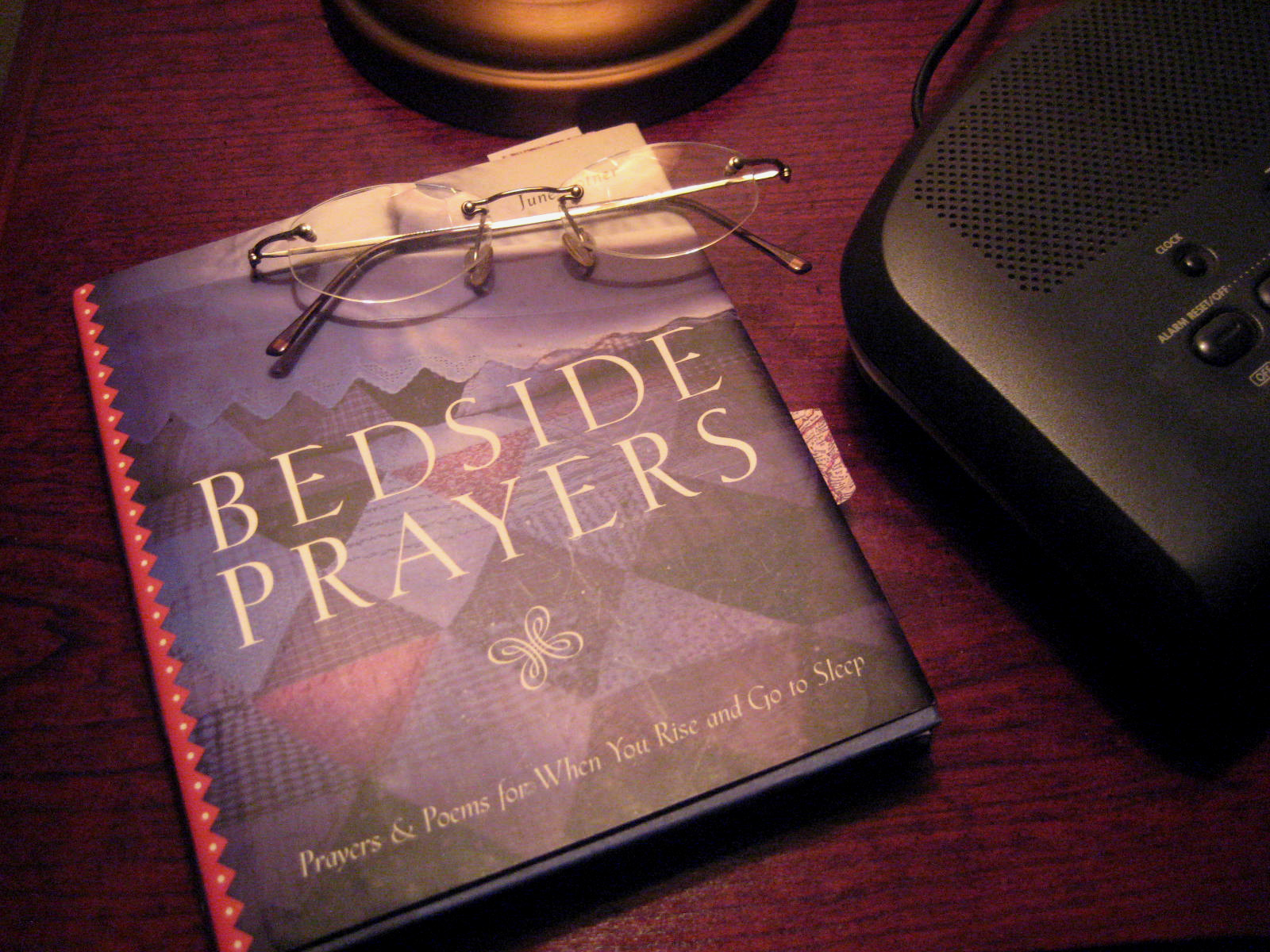
I found a used copy of the book pictured above a few weeks ago:  “Bedside Prayers, Prayers and Poems for When You Rise and Go to Sleep” collected by June Cotner.  It has found a convenient home on my night stand.  With decent regularity it finds its way into my hands just before lights out at night to put some meaningful thoughts to put into my head before sleep. 
 
“Bedside Prayers” has these words of description on its dust cover:  a marvelous collection of prayers, meditations, sentiments, and quiet celebrations.  Drawing from a rich spectrum of traditions and writers – from Rainer Maria Rilke to Robert Louis Stevenson, and from Buddha to contemporary writers with fresh insights… for spiritual seekers of any tradition… a charming companion that encourages us to recognize the divine gifts all around us each day.  I find something meaningful every time I pick the book up and read a random page.  
 
Among my favorites found in “Bedside Prayers” is thirteen lines by George Eliot that encourage me to be grateful for each day and to live with courage and intent to leave the world a little better than I find it.

May every soul that touches mine—
Be it the slightest contact—
Get from there some good;
Some little grace; one kindly thought;
One aspiration yet unfelt;
One bit of courage
For the darkening sky;
One gleam of faith
To brave the thickening ills of life;
One glimpse of brighter skies
Beyond the gathering mists—
To make this life worthwhile,
And heaven a surer heritage. 

In a poem written almost a hundred years ago Ranier Maria Rilke described the power of being in the moment long before it was a popular notion.  Being aware of one’s “aliveness” is the message he left to be printed in “Bedside Prayers”.

You see, I want a lot.
Maybe I want it all:
The darkness of each endless fall,
The shimmering light of each ascent.
So many are alive who don’t seem to care.
Casual, easy, they move in the world
As though untouched.
But you take pleasure in the faces
Of those who know they thirst.
You cherish those
Who grip you for survival.
You are not dead yet, it’s not too late
To open your depths by plunging into them
And drink in the life
That reveals itself quietly there.

First time through the following eight lines by Joseph Byron seemed to be only be a play on words.  Then as I read them a second and third time it became apparent that simply changing the order of words added great meaning. I get the most from Byron when I read his forty-five word poem slowly and savor each line before moving to the next.  

Feeling strong and strongly feeling.
Being glad and glad of being.
Care for need and needing caring.
Sharing self and selfless sharing.
Full of spirit spirit filling.
Will is warm and warmly willing.
Give joy enjoy the giving
Life is love and love is living. 

Those eight lines really touch me! 

There is nothing new or original in what I offer gratitude for today.  What is stated, I have written about before.  Here again is my thankfulness expressed for the work of others that touch my heart and spirit and make me think.  The canvas of an artist can have that effect on me and so can the notes of a musician.  A script well acted can move me deeply as can the words of a writer, but few things touch me as quickly or as profoundly as a well written poem.

Maybe I am old-fashioned. Maybe my soul has remnants within of the Victorian Era.  Or maybe I feel deeply which allows my sensitive self to receive in great dimension the feelings, thoughts and sentiments in poetry.  Whatever the reason may be, my gratitude is deep for the writers who put pieces of themself into measured word for me to discover, for my ability to feel what the poets left behind and for books like June Cotner’s “Bedside Prayers” that bring poetry into my life.

To laugh often and much;
To win the respect of intelligent people
And the affection of children;
Earn the appreciation of honest critics
And endure the betrayal of false friends;
To appreciate beauty,
To find the best in others;
To leave the world a bit better,
Whether by a healthy child,
A garden patch,
Or a redeemed social condition;
To know even one life has breathed easier
Because you have lived.
This is to have succeeded.
This old favorite by Ralph Waldo Emerson is included in “Bedside Prayers”

Anger is a Curved Blade

Holding anger is a poison…It eats you from inside…We think that by hating someone we hurt them…But hatred is a curved blade…and the harm we do to others…we also do to ourselves.  Mitch Albom “The Five People You Meet In Heaven”

A lot of my life I spent being angry at people and holding grudges, especially for the ones I felt I could hang the conditions of my life on.  I became expert at blaming others.  To a large degree I was an animosity collector and used my compilation of grudge and anger as justification for my behavior.  I reasoned why I behaved in an incorrect manner was because I had been hurt and wronged.  With those words typed out on my screen now, it is so simple to see such thinking goes compoletely against reason and logic.  Yet, in my thoughts I had no problem creating and accepting fake facts created out of nonsense and living in a self-created sort of survivable insanity.

If a person hurt me, given some time the anger simmered into a thin, but strong thread of feeling within.  When someone else wronged me, the fiber of that hurt was spun into another thread.  A “fabric” of negative emotion was created when these threads were combined and over time woven tighter and tighter together.  That emotional ‘clothe’ became a blinder that shrouded a good deal of my view of life.  What colored the fabric I created?  Fear!

Wikipedia says Fear is a distressing negative sensation by a perceived threat; a survival mechanism occurring in response to a specific stimulus, such as pain or the threat of danger. In short, fear is the ability to recognize danger leading to an urge to confront it or flee from it.  This description fits well how I was able to keep old wrongs done to me so fresh and alive within.  I would not let them go.  Fear became the sustenance that fed my anger and grudges which I was constantly either fighting or fleeing.  No wonder I lived in a constant inner emotional storm.

Psychologists say “fear is anger turned inward”.   Today that resonates true with me.  From experience I can readily see who it was that suffered most for bitterness I held within for others.  It was me!  I hurt myself by keeping other’s wrongs so alive within me.

Looking back I can see the steps I had to take to bring healing to old wounds I had kept infected, sometimes for decades.

1 – Acknowledge:  The beginning of healing was bringing the grudge and anger to the surface and expressing it.  I had to move past just thinking about it.  The beginning of healing was to relieve the pent-up pressure by writing about the wrong done to me or speaking about it to an understanding person.  Usually I did both.

2 – Acceptance:  Just writing or speaking about my anger did not cure it; those actions served only to bring the pain to the surface.  To move on I had to accept my feelings, and see more tangibly the depth of my emotions.  Letting myself accept that is was OK to have felt what I did was a beginning.

3 – Letting go of expectations:  Coming to realize that expecting remorse from others was a waste of time was a big step.  I had to come to know an expectation like that was one of the ways I kept old pain alive in the present.  Some things never make sense no matter how long they are pondered.  To stop expecting logic to make sense of things was another giant step in the healing process.

4 – Forgiveness:  Forgiving someone didn’t exempt them from their actions. It didn’t change the facts. I came to know that even though I had been legitimately wronged, forgiving did not mean I had to forget.  It did mean that I had to acknowledge the humanness of life, that all people make mistakes and do wrong things.  In the process came the discovery I needed to forgive myself just as much as others.

5 – Stop feeding the fire:  Once a fear/wrong/grudge was acknowledged and accepted, expectations had been let go of and forgiveness found, a personal commitment had to be made to not “feed the fire”.  I had to move on and stop thinking or talking about what happened.  When an old wound surfaces I mentally change the subject. If someone brings it up, I explain that’s in the past and I didn’t want to dwell on it any longer. While I will never be perfect at that type of self-control, it has improved greatly the more I have practiced it.

The storm that once raged within is mostly a gentle breeze these days, and only rarely more than that.  To get better emotionally it took living one day one day at a time and trying to take baby steps forward during each one.  Sometimes I moved forward and at others I took steps backward, but by consistently applying myself I moved onward and gained momentum that brought me to today where I am happy and content.  It took years, but all the effort was worth it!  To all I have learned and to all I have learned from, I am deeply grateful.

 Your problem is how you are going to spend this one and precious life you have been issued. Whether you’re going to spend it trying to look good and creating the illusion that you have power over circumstances, or whether you are going to taste it, enjoy it and find out the truth about who you are.  Anne Lamott

The Illusion of Self-Awareness

In the last decade I have worked with zeal to become more self-aware.  During the last four years my efforts moved into crescendo and that diligence has resulted in a generous amount of healing and understanding.  In the life I lead now the words “I’m happy” can come from my lips knowing I am telling the pure truth.  There are still wake up calls along the way and today I have been humbled!

Bouncing around the net I came across a statement whose timeliness could not have been better aimed: 

The Illusion of Self-Awareness: We are more Unaware than Aware.

The punctuality of this statement arriving in my presence is a near cosmic occurrence as a biting reminder of my lack of awareness.  Less than a half hour ago the realization hit me; early last week I missed the birthday of my dearest male friend (other than my Brother)! I completely spaced it!  To add to the embarrassment I visited my friend for a few hours over this past weekend.  His birthday did not dawn on me then and he is too much of a gentleman to hint at it.  I feel like a schmuck! (Yes, I know what the word means and it fits how I feel about myself at this moment). 

While I still need to buy a card, the birthday present for my friend’s birthday was purchased over two months ago; so long ago I darn near forgot about it.  There is wisdom to be gained in realizing my self-awareness is not nearly as complete as I have myself believing sometimes.  There is weighty truth for me to be reminded of in the words “we are more unaware than aware”.  Sure ‘nuff!

Yes, I had an important out-of-town company meeting last week and a lot of prep was necessary before the trip.  I am head over heels in love with a wonderful woman in a growing relationship that takes not only my breath away, but also at times my focus (it’s a wonderful thing!). Further, work is challenging in the present economy (I don’t know anyone who has not felt some effect).  None of those reasons are acceptable ones for letting my friend’s birthday slip my mind.  I have no doubt he will be kind and understanding about my absent-mindedness.  I am grateful for that. 

Neuroscientist Dr. David Rock, PhD reported almost 50% of the time we are operating on automatic or not consciously aware of what we are doing. Apparently that is when we’re going at average speed.  When we get busy and really wrapped up in specific things our auto-pilot goes into acute over-use.

Here are a few eye-openers from psychologist Relly Nadler of why our awareness can be so skewed from what is going on around us: 

  1. Intention and execution gap: We have 100% intentions and only 50% effectiveness in carrying out our intentions (at best!).
  2. Our thoughts are facts fallacy: Believing because you think something therefore it is true and don’t check your assumptions with others and worse act only on limited or skewed data.
  3. Superiority illusion: We overestimate our strengths. We think we are more successful, interesting, attractive, and friendly than the average person.
  4. Our memory distorts reality: We create false attributions and stories about the facts of a situation.

OK.  I admit my at-least-sometimes guilt to all four!  Of such things I am sorely aware at this moment after having been humbled with a new lesson about awareness.  A ‘lack’ recognized is again my teacher.  At least for now my awareness is far keener than yesterday.  My fallacies have been shown to me as a reminder that no matter how much I grow, there is always more to go.  And further, there is no arrival or ‘getting there’.  I will always be a work in progress as long as I live.

This morning there is renewed self-awareness that allows me to see where my thoughts and emotions can take me, even when it is to places I did not intend to visit.  When all wrapped up in certain things, I can go mostly blind and my awareness of everything else diminishes. 

Life has so much to teach to a willing student.  I am.  All I have to do is remember to pay attention.  Gratefully I have been reminded of that. 

By becoming more aware, one BECOMES more aware
There is no other method to it. It is a simple process.
Osho