What Do I Feel?

Having been in recovery from codependence for over four years, it is easy to notice how much better off I am now.  The “constant noise and emotional confusion” inside has dimmed to just a whisper the vast majority of the time.  While not true 100%, mostly the “not good enough feelings” are greatly diminished or gone entirely.  That is a near miracle!

What is codependence?  An answer from:  http://www.allaboutcounseling.com/codependency.htm

Codependency is a set of *maladaptive, *compulsive behaviors learned by family members in order to survive in a family which is experiencing *great emotional abuse; pain and stress.

*maladaptive – inability for a person to develop behaviors which get needs met.
*compulsive – psychological state where a person acts against their own will or conscious desires.
*sources of great emotional pain and stress – chemical dependency; chronic mental illness; chronic physical illness; physical abuse; sexual abuse; emotional abuse; divorce; hypercritical or non-loving environment.

As adults, codependent people have a greater tendency to get involved in “toxic relationships”, in other words with people who are perhaps unreliable, emotionally unavailable, or needy. And the codependent person tries to provide and control everything within the relationship without addressing their own needs or desires; setting themselves up for continued un-fulfillment.

Even when a codependent person encounters someone with healthy boundaries, the codependent person still operates in their own system; they’re not likely to get too involved with people who have healthy boundaries. This of course creates problems that continue to recycle; if codependent people can’t get involved with people who have healthy behaviors and coping skills, then the problems continue into each new relationship.

I borrowed the definition of codependency, to set up the following story from the book “Tuesdays With Morrie” by Mitch Albom.

On this day, Morrie says that he has an exercise for us to try. We are to stand, facing away from our classmates, and fall backward, relying on another student to catch us. Most of us are uncomfortable with this, and we cannot let go for more than a few inches before stopping ourselves. We laugh in embarrassment.
 
Finally, one student, a thin, quiet, dark-haired girl whom I notice almost always wears bulky, white fisherman sweaters, crosses her arms over her chest, closes her eyes, leans back, and does not flinch, like one of those Lipton tea commercials where the model splashes into the pool.
 
For a moment, I am sure she is going to thump on the floor. At the last instant, her assigned partner grabs her head and shoulders and yanks her up harshly.
 
“Whoa!” several students yell. Some clap. Morrie finally smiles. “You see”, he says to the girl, “you closed your eyes.  That was the difference. Sometimes you cannot believe what you see; you have to believe what you feel. And if you are ever going to have other people trust you, you must feel that you can trust them too – even when you’re in the dark, even when you’re falling”.

As I have been able to let go of being what I thought people wanted me to be and instead keep healthy boundaries and be true to myself, life has greatly improved.  However, there are still times when I get bewildered.  Coming to “believe what I feel” is a challenge then when I am emotionally like a seven year-old boy trying to sort it out.  When one has “put on” feelings and ways of being for as long as I have, it can hard here and there to know what is pretend and fake from what is real and true.  But every day this gets a little easier.   

I am very grateful for what I have learned and put into practice through my involvement with Codependents Anonymous.   Application of such things is responsible for a great improvement in the quality of my life.  I am glad to say I am happy most of time.  When I ask myself “what do I feel?”  An answer does not always come, but usually one does.  I am very thankful to be the most emotionally healthy today I have ever been. 

The walls we build around us to keep sadness out also keeps out the joy.  Jim Rohn

Find out more about codependence here:

http://www.webmd.com/sex-relationships/features/signs-of-a-codependent-relationship

http://www.allaboutlifechallenges.org/codependency.htm

http://www.addictionz.com/20_questions_for_codependents.htm (20 question quiz to find out if you might suffer with codependence

Good Oblivion

There are times I wonder if the weekend editions of “Good Morning Gratitude” should be renamed “Good Afternoon Gratitude”.  Often the less structured hours of a Saturday or Sunday allow getting things done at an enjoyable and more leisurely pace.  So far today about all I have done is sleep late, do laundry and catch up on emails from last week I did not get to as they came in.  

This morning I slept later than I can remember having done in a long time:  eleven hours!  Last time I strung that many hours of sleep together I was suffering badly from jet lag after returning from a European trip.  Dragging butt from sleep shortfalls during a business trip last week plus comforting a friend Friday evening into the wee hours of Saturday morning gave me a dose of sleep deprivation.  

With curiosity if I could actually “catch up” on sleep I missed out on and wondering how much sleep a person needs, I did some research.  What I found began with the words of Michael H. Bonnet, PhD who is a professor of neurology at Wright State University School of Medicine.  He wrote we are all different.  You need enough sleep so you can awaken feeling refreshed without an alarm clock.  With a close friend who has slept only 1-4 hours per night since he was a little boy and my guesstimated need of 8 hours, I know there are wide swings in how much individuals need to spend time sleeping. 

According to “Web MD” whether you need seven, eight, or even nine hours of sleep a nightmay be up for debate, but the importance of getting adequate sleep is not debatable. Sleep loss increases the risk of high blood pressure, inflammation, weight gain, and diseases associated with these risk factors, such as diabetes and heart disease.  Sleep loss also impairs performance and mood, according to the report. 

Duh!  I know all about “impaired performance and mood” from my experiences back when my alarm went off at 3am each workday and am not surprised living that way has  health implications.  It was suggested by Web MD to test to see how much sleep you need: If you need an alarm clock to wake, try going to sleep 15 minutes earlier. Do you still need an alarm clock? If you do, push your bedtime up another 15 minutes.  Do this until you no longer need an alarm to wake up. This exercise should give you a pretty good idea about the amount of sleep you need per night.  Sounds logical and I hope to be my own lab rat and try that experiment sometime.  

Back in April when I began blogging here, to have the time to write each morning I intentionally changed my sleep habits and referenced it in an early blog titled “A Recovering Night Owl” https://goodmorninggratitude.com/2011/05/26/a-recovering-night-owl/  From that experience it is known to me that one can adapt their sleep habits. 

Digging deeper I found:  Studies show that people who sleep between 6.5 hr. and 7.5 hr. a night, as they report, live the longest. And people who sleep 8 hr. or more, or less than 6.5 hr.; they don’t live quite as long. There is just as much risk associated with sleeping too long as with sleeping too short. The big surprise is that long sleep seems to start at 8 hr. Sleeping 8.5 hr. might really be a little worse than sleeping 5 hr. That was a bit of a wakeup call since I am writing this after sleeping eleven hours last night! 

Moving on to an answer of how much sleep I need, the following was found on Helpguide.org:  Aim for at least 7.5 hours of sleep every night. Consistency is the key.  Settle short-term sleep debt with an extra hour or two per night. (If you lost 10 hours of sleep, pay the debt back in nightly one or two-hour installments).  

Helpguide.org offers similar advice to Web MD (above) about sorting out how much sleep I need.  Take a sleep vacation to pay off a long-term sleep debt. Pick a two-week period when you have a flexible schedule. Go to bed at the same time every night and allow yourself to sleep until you wake up naturally. No alarm clocks! If you continue to keep the same bedtime and wake up naturally, you’ll eventually dig your way out of debt and arrive at the sleep schedule that’s ideal for you.  Sounds like a good idea but will take some astute planning in order to have a chance to try it. 

Now it is late afternoon and if I don’t hurry this entry will be posted near bedtime and have a name amendment to “Good Evening Gratitude”.  With the knowledge of the friend who sleeps just a little and at least two others who suffer from insomnia, spending a couple of hours reading about sleep brought to the surface several pieces of gratitude.  

1)  With a few exceptions I have no problem going to sleep.
2)  Most nights I sleep quite well.  Only occasionally do I wake up and have a problem going back to sleep.
3) For the most part my lifestyle allows me to get near what I perceive as the proper amount of sleep each night.  I do cheat myself out of sleep at times so I can do other things though.

I find one additional thing to be grateful and that is the knowledge of the experiments on how to find the proper amount of sleep that fits me personally.  While I have no idea when I will find the time to try, it is on my ‘to do” list and will happen in the months to come.  I will write about the experience then.   

And if tonight my soul may find her peace in sleep,
and sink in good oblivion,
and in the morning wake like a new-opened flower
then I have been dipped again in God, and new-created.
D.H. Lawrence

The How of Happiness

Being happy has not been a natural occurrence in my life.  It is something I have had to work at. It surprised up on me when about two years ago in a group of people the words “I’m happy’ came from my lips. Frankly, it startled me at the time. Without a doubt the statement rang true when the words were first formed in my mouth and continue (at least the vast majority of the time). My adopted motto “every day is a good day, some are just better than others” is a truthful statement whenever I speak it (which is often!) although it confounds some people.

Every moment of my life is not spent in some sort of frolic in bliss. Outside of fantasy, delusion or a drug induced state I don’t believe that is possible for anyone.  What changed about my level of happiness from what used to be is inside me. My external circumstances actually became more challenging with much pain and heartache to wade through. Through hard work, intention, help of others, study and understanding I allowed happiness to arrive in my life in spite of what was going on around me.

“The How of Happiness:  A Scientific Approach to Getting the Life You Want” is the title of a book by Sonja Lyubomirsky PhD, a professor at the University of  California-Riverside. In it her research indicates that around 50% of my happiness comes from a generically determined “set point”.  She explains:   The set point for happiness is similar to the set point for weight.  Some people are blessed with skinny dispositions: Even when they’re not trying, they easily maintain their weight.  By contrast, others have to work extraordinarily hard to keep their weight at a desirable level, and the moment they slack off even a bit, the pounds creep back on.

Where I got lost previously was the belief that changing my external situation and location could change my level of happiness.  In her book, Lyubomirsky indicates only about 10% of my level of happiness can be explained by differences in life circumstance or situation.  Of small consequence are conditions such as rich or poor, healthy or unhealthy, beautiful or plain, married or divorced and so on.  It is humbling to realize decades spent attempting to be happier through changes in my external life at best barely had any affect.  I moved all over the country and even to a foreign land, changed wives, lovers, jobs, homes, cars, etc. and none of it had more than a temporary effect.

Sonja Lyubomirsky explains:  One of the great ironies of our quest to become happier is that so many of us focus on changing the circumstances of our lives in the misguided hope that those changes will deliver happiness…  An impressive body of research now shows that trying to be happy by changing our life situations ultimately will not work.  Why do life changes account for so little?  Because of a very powerful force that psychologists call hedonic adaptation… Human beings adapt to favorable changes in wealth, housing, and possessions, to being beautiful or being surrounded by beauty, to good health, and even to marriage…

If we observe genuinely happy people, we shall find that they do not just sit around being contented.  They make things happen.  They pursue new understandings, seek new achievements, and control their thoughts and feelings.  In sum, our intentional effortful activities have a powerful effect on how happy we are, over and above the effect of our set points and the circumstances in which we find ourselves.  If an unhappy person wants to experience interest, enthusiasm, contentment, peace and joy, he or she can make it happen by learning the habits of a happy person. 

In other words, I learned to finally be happy by getting off my butt and seriously working at it instead of searching to find it like a prospector looks for gold.

In the book “The How of Happiness” is listed 12 elements described as “evidence-based happiness-increasing strategies whose practice is supported by scientific research.”
1. Expressing Gratitude
2. Cultivating Optimism
3. Avoiding Over-thinking and Social Comparison
4. Practicing Acts of Kindness
5. Nurturing Social Relationships
6. Developing Strategies for Coping
7. Learning to Forgive
8. Increasing Flow Experiences
9. Savoring Life’s Joys
10. Committing to Your Goals
11. Practicing Religion and Spirituality
12. Taking Care of Your Body:
Meditation
Physical Activity
Acting like a Happy Person

In retrospect, I can see ALL those strategies were put into practice to achieve the level of happiness I have today.  While not being aware of Sonja Lyubomirsky’s book until more recently, I am grateful to know her take on things.  Her vantage point confirms and recommits to me the importance of staying on my path.  Gratitude beyond explanation sings in my heart and mind to be where I am today.  To everyone and everything that helped me get here… THANK YOU!

The Constitution only guarantees the American people the right to pursue happiness. You have to catch it yourself.
Benjamin Franklin

Perfectly Imperfect: You Are Enough

This morning while searching in “My Documents” I came across something I wrote almost four years ago.  The “Recovery Letter” was originally hand-written while I was at The Meadows working past my childhood junk.  The assignment was to create a letter to one’s self that could be pulled out and read as an intervention tool in the event old practice and habit appeared to be trying to return.  My letter did come in handy once or twice in the months just after I returned to “real life”.  Since then times have been steadily better.  I have not read what I wrote in about three years.  It was unanticipated fortune to stumble upon the letter this morning.  The serendipitous re-reading and sharing it here renews and reaffirms the letter’s contents within me. 

October, 2007 

Dear James, 

Chances are if you are reading this you are going through a difficult time.  You may be hurt, stressed, lonely or suffering from old wounds.  But DON’T do what you have thought about.  Read this entire letter and think about what is being said here:

  • Your compulsion is a dead-end.
  • There is not anything good about it but momentary pleasure.
  • You will feel horrible and guilty like always, but especially now that you have worked so hard to recover.
  • Think of all those you will disappoint.
  • Think of how much you will be disappointing yourself!
  • Somewhere within it all you will begin to lie again and keep secrets.
  • Professionally your career could be hurt badly when others find out … and in time they will.
  • Think of what your son will think of you.
  • Your Mother and Father’s abuse will be alive within you once again.  THEY WILL WIN!!!!  YOU ARE NOT THEM!!!
  • You will worry about what you have done, shame will fill you and sleep will be difficult.

 So think about what you are considering.  Think long and hard.  Remember what you learned at the Meadows:

You are enough.   
You are NOT your past.
You are a good man.
You are perfectly imperfect
Think of the child within that needs you.
You are strong and can accomplish anything.
 
You deserve better.  You are worthy of having your needs met in a way that respects the ideals you stand for.  You are loved.   You are respected.  Keep your new spirituality intact.  Enjoy the peace you have searched for… for so very long.  Don’t mess up the grace you have found.
 
Somehow, someway PLEASE find a way to fill your need besides what you are thinking of doing.  Don’t do that one thing that messes up EVERYTHING.  You have worked so hard to be free.  I beg you, PLEASE DON’T do what you are thinking of.
 
Remember all you feel is the torture of your past.  It is not real anymore.  Don’t lie to yourself.  Remember your truth.  You love yourself.  Let it fill you.  Now call a friend, a peer, take a photograph, do affirmations, read a book, go for a ride or a walk… do whatever you need to do… BUT DON”T ACT OUT AGAIN.  I BEG YOU NOT TO DO IT.
 
I LOVE YOU, 
me

It takes courage to grow up and become who you really are. 
E. E. Cummings

Count Your Blessings Instead of Sheep

There’s an old song most often credited to Bing Crosby and other crooner’s a bit before my time titled “Count Your Blessings Instead of Sheep”.  I prefer to hear Diana Krall sing it and my favorite of her versions is just her playing piano and singing:  http://www.youtube.com/watch?v=JeftvZPsXeY 

The lyrics of the song are: 

When I’m worried and I can’t sleep
I count my blessings instead of sheep
And I fall asleep, counting my blessings

When my bankroll is gettin’ small
I think of when I had none at all
And I fall asleep, counting my blessings

I think about a nursery
And I picture curly heads
And one by one I count them
As they slumber in their beds

If you’re worried and you can’t sleep
Just count your blessings instead of sheep
And you’ll fall asleep counting your blessings.

I had a living reminder over the weekend of the blessings I have to count.  It can be sobering observing another person’s difficulty but also a solid reminder of one’s own good fortune. 

A friend and I were visiting an antique shop in a small town outside the city where we live.  There was a print from the 1920’s I took a fancy to and decided to buy if I could improve the asking amount a little.  I asked the man behind the register what the best price was and he said I would need to talk to the proprietor who he went to get.  

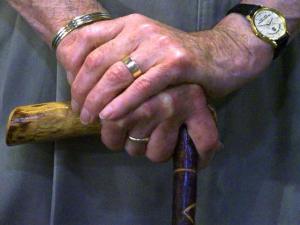
The owner was summoned out of the back of the store and very, very slowly he made his way to the front leaning heavily on a cane.  The sluggish pace of his movement gave me time to study him.  What I saw was an old man probably near 70 years-old who looked older than his years.  He did not look healthy.  It was distressing for me to watch him grimace with pain with each step.  There is a gray-ish color that comes upon the face of someone seriously ill and he was painted with it.  

The owner made me a fair deal on the print and in conversation I learned knee replacement surgery had not gone well and he was in a great deal of pain along with some other unnamed health issues.  He sensed my taste might be similar to his based on the print I purchased.  We were invited to the back of the store to see some “really good stuff that was not for sale”.  

I expected we’d end up in a storeroom and instead found myself walking through a door and into the man’s bedroom.  Through the bedroom we continued and entered into a combination living room and kitchen, all dimly lit.  The place was well lived in but was not a mess.  The bed was unmade and there were things lying about.  Yet there seemed to be some general organization to the clutter.  

Once in his “living room” with some difficulty he plopped down on a Queen Anne type love seat.  Our host started to point out several art deco pieces I had noticed as soon as we entered the room.  He was correct about me loving that type art from the 1920’s and 30’s.  

It is my strong suspicion the shop owner has few personal visitors.  I think he is lonely.  While he was in obvious pain, he seemed to enjoy greatly the half hour he spent with us.  His face would light up when he pointed to another deco piece as he began to tell us about its story and pedigree.  His collection contained several quite valuable pieces of types I have never seen up close before.  I enjoyed hearing about each one.  I think he would have preferred to visit with us longer but it was clear the moving around had brought increased pain which he acknowledged to us.  He said he needed to rest.  

As I emerged back into the main store, I was struck with a sadness that matched the murky light in owners two room home in the back of the store.  Thoughts rushed in asking:  Why did he live alone?  How did he come to be here? Why was there not someone to take care of him?  Was there no better place else where he could recuperate?  Was he as depressed as he appeared?  And so on….

As we began the drive home I thought of the shop owner hobbling along.  Over his gray pallor I clearly saw an expressionless sadness that seemed to keep him from making much eye contact.  I sensed he was fearful that someone who looked directly into his eyes could see the source of the pain he preferred to keep hidden.  Even this morning I feel sad for him. 

I have no idea what the shop owner’s story is, but meeting him reminded me how blessed I am with good health, a caring son, friends to take care of me, more than two rooms to live in and so much more.  I am very grateful.  From the weekend experience I gained a renewed perspective of gratefulness and a soft spot for the “old man” who owns the store.  I know I will visit again soon.  

The capacity to give one’s attention to a sufferer is a very rare and difficult thing; it is almost a miracle; it is a miracle.  Simone Weil

Codependence and Interdependence: What is Normal?

Choice is the exploration of desire and then the selection of action.  In every moment, you are choosing either to align yourself with your own true path or to veer away from it.  There are no neutral actions.  Even the smallest gesture has a direction to it, leading you closer to your path or farther away from it, whether you realize it or not.*   

While that paragraph feels true it has not been factual in all of what appear on the surface to have been my choices made in free will.  In relationships I have been compulsive and driven, often by a force I did not understand if I was even able to notice it. The force has been with me for so long I do not remember life without it.  Learning and acknowledging that my compulsions even existed was the biggest step yet in understanding my self.   

There is a certain flavor to a codependent relationship that might be described as ‘driven’ or ‘intense.’ There is a compulsive nature to it. The members are tied to each other almost as with an invisible rope. The slightest move in one causes a reaction in the other. The positions are rigid. Every word or thought is guarded, weighed against the other’s imagined response.** 

And there it is; that word codependent.  I have come to know it well as my primary dysfunction has come into focus in recent years.  In a broad sense, a codependent can be defined as one having an addiction to people, behaviors, or things. My codependency has been an unconscious fallacy that caused me to attempt to manage my interior feelings by maintaining power over people, things, and events on the outside, sometimes through control and at others through compliance.  By its very definition, being a codependent means I have a tendency to make relationships more important to me than I am to myself.  

In codependency, control or lack of it is central to every aspect of life. There is emptiness within that originates in childhood from parental neglect, abandonment and abuse. Emotionally a child does not mature and exhibits child-like and immature emotional behavior when grown up, but can not see it themselves.  As an adult each codependent struggles relentlessly to fill a great emotional vacuum within themselves.

While a full list of codependent tendencies is quite long, here is a short list:  
1.  Lacking appropriate levels of self-esteem.
2.  Inability to set realistic, functioning, boundaries.
3.  Difficulty knowing who you are.
4.  Having trouble defining needs and wants and meeting them.
5.  Difficulty in expressing ourselves moderately and knowing what “normal” is.

What about healthy relationships?   How different is the closeness of an interdependent relationship! The desire is there but not the intense need. Love, whether for a spouse, a child, a parent, or a friend, is a matter of choice. **

People in healthy, interdependent relationships do whatever is best for both partners.  They make sincere, reliable agreements with each other, based on their separate wants and needs, and they generally stick to them.  There is no happily-ever-after on this plane of existence.  I may find a princess but she will have issues to deal with.  We all do.  Relationships are something that needs to be worked on – not some magic wand that makes everybody happy.

Codependence and interdependence are two very different dynamics.   Codependence is about giving away power over my self-esteem.  Interdependence is about making allies, forming partnerships.  It is about forming connections with other beings.  Interdependence means that I give someone else some power over our welfare and our feelings.

It is impossible to love without giving away some power.  When I choose to love someone (or thing – a pet, a car, anything) I am giving them the power to make me happy.  However, I cannot do that without also giving them the power to hurt me or cause me to feel angry or scared.  That is “normal”.

Much progress has been made, but there is much yet to make. Writing here today is a sort of ‘homework’ assignment that helps me maintain clarity and growth and one I hope may help others.  I am grateful to have knowledge now about my part in past relationship problems and to have new hope future relations will be far improved by what I have learned and am learning.  Class dismissed…..

Oh, the comfort – the inexpressible comfort of feeling safe with a person – having neither to weigh thoughts nor measure words, but pouring them all right out, just as they are, chaff and grain together; certain that a faithful hand will take and sift them, keep what is worth keeping, and then with the breath of kindness blow the rest away.  Dinah Craik 1859

 * From “If Life is a Game, These Are the Rules” by Cherie Carter-Scott, Ph.D.
**Love is a Choice” byHemfelt, Minirth, and Meier

Memories of a Dear Friend

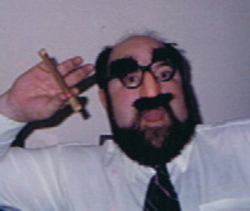
This morning I woke up thinking of a dear friend of 30 years who passed away last year about this time.  Ultimately not taking care of himself combined with bad habits and the unmanaged stress of a challenging life did him in.   If he cared about someone he would do just about anything for them.  Like the photo above suggests, he was great fun to be around. 

 His nickname,  “Banger”, began in reference to his first car which was a “beater”  and did not fire on all cyliders consistently.  Hearing the car nearby back firing, his friends would say “here comes the banger” which over time became adapted to be his nick name.

I met Bill at a radio station where he came to work as an Account Executive.  He was good at selling, even selling himself.  A funny story about getting the job was the listing on his resume of spending a year and a half on the road as a wholesale ceramics sales person.  That is a true statement, but lacks the detail to show that job was for a ceramic company that made bongs he peddled wholesale to head shops in the Midwest.  What makes this even more ironic is Bill never used a bong or anything of the sort in his whole life!   

Within less than a year of meeting “Banger” I was at his bachelor party.  He and his future wife had been living together and now that she was expecting he deemed it time to get married.  That was the night he introduced me to something called “purple Jesus”.  I remember clearly him showing me a good-sized new plastic trashcan about a third filled with red liquid with sliced fruit floating in it.  I asked why the name “purple Jesus” and Bill said, “drink enough of this and you’ll go see Jesus”.  After a half a glass of the stuff put me into orbit, I stopped short of going forward to test his prediction.  What was it?  A concoction of red Hawaiian punch and grain alcohol with sliced oranges and limes floating in it.      

Bill would never say exactly, but I have always wondered in what measure was love his motivation to marry as compared to a sense of doing what he thought was right.  I do know he had a high sense of honor and he loved both his children.  By the time he had two sons a few years into elementary school he was divorced.  He never remarried. 

The heart wrenching part of Bill’s life was when his youngest son was diagnosed with Muscular Dystrophy.  The boy was six or seven years old when the doctors made the determination.  Clearly I recall over time watching the disease progress.  One scene vivid in memory was when Bill came to visit one afternoon and both his boys were playing with my son.  All three had gone up stairs which the son with MD negotiated with some difficulty going up, but to get down my friend had to carry him.  Soon the boy was in a wheel chair. 

 Within a year or so Bill was the parent the boys lived with full-time.  He took good care of them as best he knew how and was especially devoted to the younger one bound to a wheel chair whose disease progressed slowly but steadily.  The young man was smart and always quick to smile.  He had a bunch of friends, of which one or two were there just about always when I dropped by.  He shook hands with two presidents and was a “poster child” for MD twice.  What he told his Father consistently was when things got to where he could not breathe unless hooked to a machine; he wanted Bill to let him go.  That time came when the younger son was around 20 and in the hospital only able to breathe with mechanical aid.  He told his Dad it was time and within two days the young man was gone.  

Bill had always been a drinker and as his boy’s illness grew worse, Bill’s intake grew.  He was not someone who got sloshed in public and got into trouble.  Instead he did it quietly mostly in the evening, often after the boys were asleep.  “Banger” smoked and did not watch his weight and became heavier and heavier as the years passed.  By the time he accepted his health was in trouble it was too late except to buy a little time.  Quitting smoking and drinking did extend his life a while, but living with 10% liver function did not present a lot of hope.  Bill was on a transplant list, but was never healthy enough for the surgery. 

For over a decade my friend and I lived hundreds of miles apart, but stayed in close touch mostly with frequent phone calls and I visited him about once a year.  He drove out to see me twice.  The last year of his life hospital visits were frequent, but he always came through .  Some of us close to him swear it was on pure stubbornness!  

Bill passed away on a Tuesday and late the week before my mobile phone rang and answering I heard a soft and weary voice say “how you doing boy?”  I told him I was doing well and he replied “I just needed to hear your voice Brother”.  I asked how he was doing.  His said he was struggling and that even getting up to get to the bathroom was a major chore.  Bill did not give me a chance to say much more.  He said he was very tired and had to go.  Then again he told me he called to just hear my voice.  Some of his very last words to me were “I love you Brother” to which I replied “I love you too “Banger”.  Then with a couple of “talk to you later’s” the less than 60 second call was over.  I know now what Bill did, but probably didn’t consciously know himself; he called to tell me goodbye.  My gratitude that he did exceeds my ability to express it.  

He that is thy friend indeed,
He will help thee in thy need:
If thou sorrow, he will weep;
If you wake, he cannot sleep;
Thus of every grief in heart
He with thee doth bear a part.
Richard Barnfield

Discovering My “Undiscovered Self”

In the “Undiscovered Self” Carl Jung wrote that man often remains…”an enigma to himself.  Most people confuse “self-knowledge” with knowledge of their self-conscious ego personalities.  But the ego knows only its own contents… What is commonly called “self knowledge” is therefore a very limited knowledge…”   Jung went on to say self-knowledge is possible “only when the individual is willing to fulfill the demands of rigorous self-examination”. 

I have several years now of serious introspection and rigorous self-examination. The resolute searching within began earnestly with the epiphany I could be the “me” I wished to be only by knowing better the “I” which already existed.  Having dedicated myself to shining a little light into my own darkness to discover self truth, I have learned first hand how difficult and daunting a task of self-discovery is.  My ego has fought me every step of the way and has done its best to blind me whenever it could.  This journey has been irregularily enlightening, difficult most of the time, unnerving during every step and worth every effort! 

In embracing the past my emotions and feelings released have shaken me to my core.  What I have done and what was done to me, what I have said and what was spoken to me and the pain I dealt to others and the pain received all colluded at times to “knock the breath out of me mentally and emotionally”.  But this process of allowing myself to be “broken open” has benefited me greatly.  I am grateful for the outcome, enough so, to continue to face the “demons” and “desert walks” the process requires.  Yet, the fear that is a prelude to each step to understanding is still daunting.  It is the knowledge of the reward only that is the impetus that keeps me on this path. 

I am thankful for those whose teachings I have benefited from in my growth and development.  One specific example is Elisabeth Kubler-Ross M.D., a psychiatrist who wrote the landmark book “On Death and Dying” in 1969.  While her book was originally written about terminal illness, it has accurately been applied to many forms of catastrophic personal loss such as job, freedom, divorce, death of a loved one, addiction, disease, tragedy and disaster.  My 2nd divorce was a deep personal catastrophe.  The fact I did not want it was made worse by knowing I was the majority cause of the demise of the marriage.  For me the ending was a “death” I mourned more so than any physical death I recall.

Kübler-Ross‘s work says recovering from catastrophic personal loss requires at least two of these five steps below and most will go through all five but not necessarily in order.  This process is popularly known by the acronym DABDA.

1Denial — “I feel fine.”; “This can’t be happening, not to me.”  Denial is usually only a temporary defense.  

2.  Anger — “Why me? It’s not fair!”; “How can this happen to me?”; ‘”Who is to blame?”  Once in the second stage, a person recognizes that denial cannot continue.  Because of anger, the person is usually very difficult to care for. 

3.  Bargaining — “I’ll do anything for a few more years.”  The third stage involves the hope that the person can somehow postpone or delay what has happened. Usually, the negotiation is made with a higher power in exchange for a reformed lifestyle.

4.  Depression — “I’m so sad, why bother with anything?”; “What’s the point?”  During the fourth stage, a person begins to understand the certainty of what has happened. It is an important time for grieving that must be processed.

5.  Acceptance — “It’s going to be okay.”; “I can’t fight it, I may as well accept it.”  In this last stage, the individual begins to come to terms with what has happened.

Personally in working past my 2nd divorce I experienced all five steps in order.  Once in a while the first four steps are still a big help in bringing me to step five (Acceptance) when I momentarily regress into denial, anger, bargaining or depression about the end of the marriage.

There has been nothing more sobering than all my self-discovery to date.  Exploring my “self” on deeper and deeper levels has been very healing and enriching for me.  Though my development can be described as a repetitive process of three steps forward and two steps backward, over time my slow growth has been steady.  Today I am more true to my self than before.  My morals, standards, needs and desires parallel themselves the closest ever in belief and deed. I am more free of what others think than I ever was previously.   While there is not always peace within, there is no longer a war going on inside.  My cup of gratitude runs over every time that realization comes to me. 

Your vision will become clear only when you look into your heart.  Who looks outside, dreams.  Who looks inside, awakens.  Carl Gustav Jung

Learning to be Still: Solitude or Loneliness?

Six years ago after surviving a category 5 hurricane on Grand Cayman where I was living at the time and months later recovering from injuries received in a nasty car accident here at home, I found myself in a far different place.  Well, I thought so anyway.  In my mind I was relatively sure then of my arrival at a higher and distinct level of awareness.  And I had arrived, but to a much lesser degree than I thought at the time.  What really had happened was a change had begun in earnest, but had only just started.  Being embroiled still in old behaviors my life then was a contradiction of the new I was gaining understanding of versus the old dysfunctions that were deeply engrained and still practiced. 

Those were the days when I set out on one of the most frustrating projects I ever attempted.  Once settled after moving back stateside and with a left arm that worked again after the accident, I began the attempt to write a book called “Learning to be Still”.  At the time I thought truly my experiences had taught me how.  However, the turmoil internally created conflict that made my belief only an illusion.  In trying to write about being still, I came to know that I really had no idea how. 

While I am still not fully prepared to honestly write a book about “being still”, living alone for over four years now has taught me much about loneliness and solitude.  Those lessons I know now are big steps in “learning to be still”. 

Loneliness for me is a negative state and causes me to feel a sense of isolation. When directed by that feeling, I feel like something is missing. I discovered I could be with people and still feel lonely for someone else—for me perhaps the most bitter form of loneliness I have ever experienced.  Feeling lonely can not be sated easily or quickly and trying to do so only brings more difficulty for me. 

In time I discovered solitude which I now think of as a state of being alone without being lonely. When I am able to be content in solitude I find it to be a positive and constructive state of being in touch with myself.  Only in recent times have I comprehended that solitude is a state of being alone when I can provide myself with good and sufficient company.  Being alone no longer is the unsettling experience it previously was… at least most of the time. 

Loneliness always feels harsh.  For me being lonely is a state of deficiency, a state of discontent marked by a sense of estrangement and an awareness of excess aloneness.  My belief is loneliness is a feeling of depression resulting from my thoughts and feelings about being by myself.  More than anything it is my state of mind concerning being alone that turns alone-ness in to loneliness. 

On the other hand, solitude is a time I use for reflection, inner searching, meditation, growth and self-enjoyment. I do my best reading and comprehension in solitude.  Thinking and creativity are usually sharper too.  Solitude brings me peacefulness stemming from a feeling of inner richness. When it is upon me I can enjoy the quiet and whatever it brings as satisfying and from it I can draw sustenance. Solitude did not come easily to me nor does it always come when I want it to.  It is something I continue to cultivate out of the ground of loneliness.

Solitude is something I choose. Loneliness is imposed on me by my thoughts of lack.  Solitude is when “I” am enough.  Loneliness is when “I” am not.

Solitude restores my body and mind. Loneliness depletes me. Solitude refreshes and renews me.  Loneliness exhausts me. 

In researching the subject of loneliness and solitude it is evident to me we humans are social animals. We need to spend time together to be happy and functional, and we extract a vast array of benefits from maintaining intimate relationships and associating with groups.

But I also found an emerging body of research suggesting spending time alone can be good for us — that certain tasks and thought processes are best carried out without anyone else around.  The data I have found indicates even the most socially motivated among us should regularly be taking time to ourselves if we want to have fully developed personalities, and be capable of focus and creative thinking.

Frequently as has happened before to me, I have learned a hard, but good lesson from the school of life.  It took me growing past a feeling of mostly “knowing it all” to allow the teaching to take place.  And at times that growth can come only when life has clubbed me to the point I have no choice but to give in and open up.  Growing into a sense of awe, adventure and openness to learn about life has benefited me beyond what I can logically explain.  I know I did not do it alone.  To those people who care about me who have aided my progress and growth, thank you.  To the powers beyond me that have guided my path, I am very grateful. 

True silence is the rest of the mind, and is to the spirit what sleep is to the body, nourishment and refreshment.  William Penn

Learned Optimism vs. the Habit of Pessimism

About five years ago in a used book store I stumbled across a copy of “What You Can Change and What You Can’t” by Martin Seligman, Ph.D.  As an amateur student of psychology and being my own personal “lab rat” to experiment on, I found this book interesting and enlightening.  

At the book’s basic crux Seligman covers a spectrum of human conditions and how each may or may not be changed.  At one end of the range he notes sexual preference which can’t be changed.  At the other end of the scale Seligman places phobias which with about 90% effectiveness can be overcome.  In the middle are conditions that can be moderated with treatment, but not changed.  Reading this book gave me a good framework of Seligman’s research and theories that helped as I moved deeper into his work.  

Martin Seligman is well known in clinical circles and considered to be one of the more innovative psychology researchers today.  Sometimes controversial, often groundbreaking, he studies positive psychology, learned helplessness, depression, optimism and pessimism. The second book by Seligman I discovered is titled “Learned Optimism: How To Change Your Mind And Your Life” and this one rocked my world!  

The key premise of “Learned Optimism” turns traditional “positive thinking” beliefs on their head by clearly illustrating that “Non-negative thinking” (not “positive thinking”) is the key to success in all parts of life. Seligman wrote: “The optimistic individual makes the most of his talent.”  The optimistic individual perseveres.”  A pessimistic person often comes to believe their actions are futile and thereby learn to become helpless with depression not far behind.    

So, what separates optimistic people from more pessimistic people? Seligman says it’s the way we explain events and outcomes to ourselves. If something good happens to us, how do we explain it? Was it luck? Or was it the result of our talent? 

If something bad happens to us, how do we explain that? Is it that conditions just weren’t right? Or did the bad event happen because we’re somehow horribly flawed as individuals? Will this flaw eternally damn us in all other endeavors? 

Seligman says optimists and pessimists attribute the reasons for success and failure differently. Pessimists usually think failure and bad events are permanent, personal, and pervasive factors. Optimists tend to credit bad events to non-personal, non-permanent, and non-pervasive factors.   

Thinking adverse parts of life are permanent and unchangeable brings pessimism.  Believing negative elements of life will go away or can be overcome is a key to being an optimist.  Seligman writes: “Finding temporary and specific causes for misfortune is the art of hope. … Finding permanent and universal causes for misfortune is the practice of despair.” 

“Learned Optimism” includes a quiz to determine one’s own levels of optimism and pessimism.  You can take it on line for free:  http://www.stanford.edu/class/msande271/onlinetools/LearnedOpt.html 

Being pessimistic at times does have its place.  Without it I can lose touch with reality.  Pessimism is useful because it forces me to confront situations and change direction when necessary.  Being relentlessly optimistic could cause me to be somewhat blinded to reality.  It is pessimism that brings me down to stark reality when I need it.  But in majority I live with an optimistic mindset permeating my life.  

How I think is as much habit as anything else.  When I was more accustomed to seeing things negatively and believed I could only expect more of the same that is exactly what I found.  When I expected bad stuff and expected it the sky seemed to rain crap on me all the time.  Training my self to be more objective and allowing negative thoughts to be balanced with optimistic thinking has had a tremendous impact on my well being. 

Don’t worry I am not delusional and live in some false state of bliss.  I just don’t dwell on the bad stuff.  Simply fighting off the quick-sand of negative thought with weapons like “I am not going to think anymore about it” or “stop it, you’ve done enough of that” consistently over time has pointed my life in a different direction.  Through this learning experience I have become much more grateful.  Thankfulness is fertile ground for optimism, hope and faith.  I know of no greater sweeteners for living my life. 

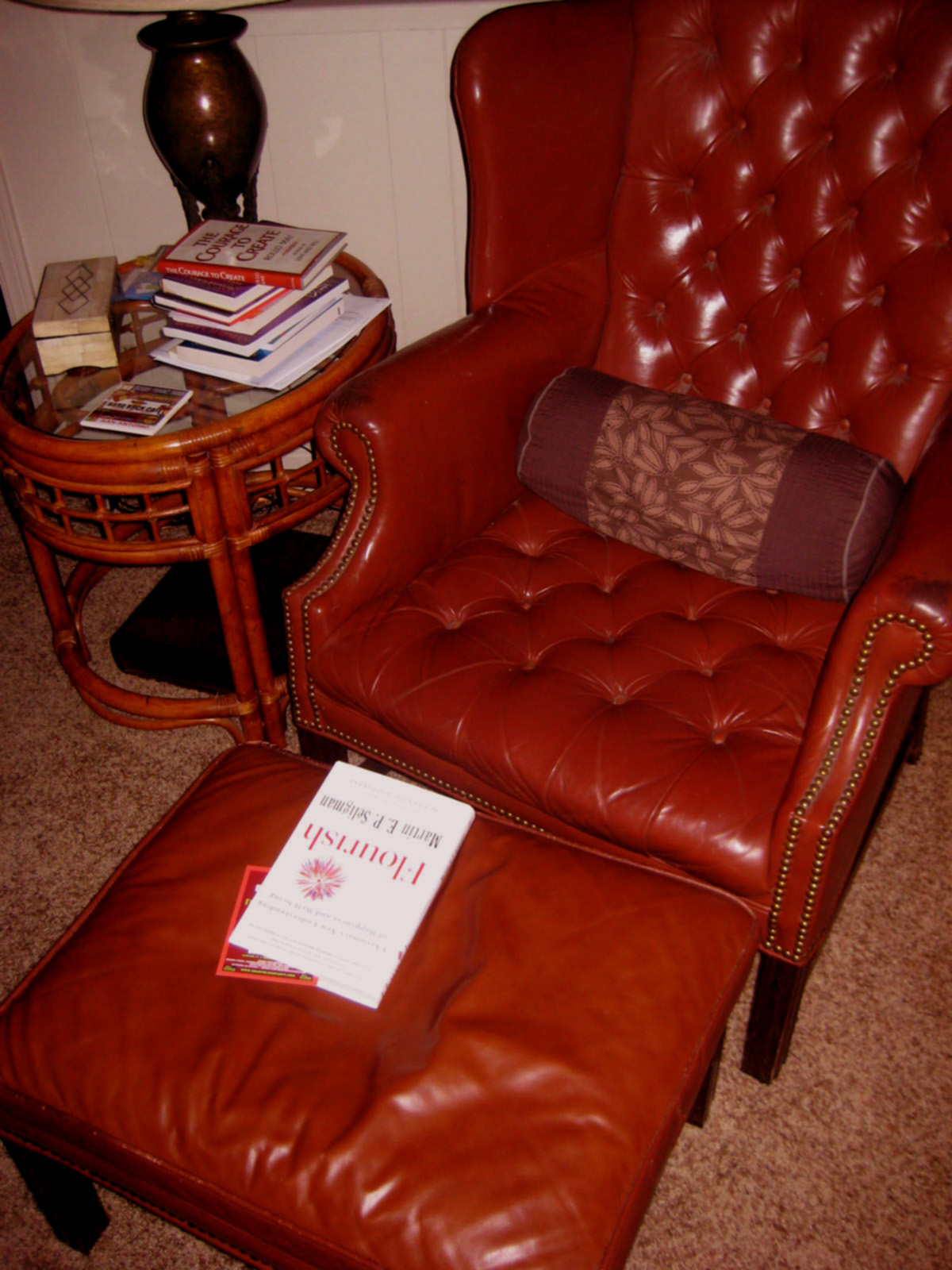
Seligman’s book “Authentic Happiness” helped me further hone my ability to live with optimism and gratitude.  And I have just begun reading his new book “Flourish”.  Thank you Dr. Seligman for all the goodness you and your work have brought to my life! 

A composer can have all the talent of Mozart and a passionate desire to succeed, but if he believes he cannot compose music, he will come to nothing. He will not try hard enough. He will give up too soon when the elusive right melody takes too long to materialize.  Martin Seligman