A Hair in a Biscuit

It’s Monday and time to head back to work. Time to put on business clothes, ready my work face and get ready for “meetin’ & greetin” people.

When meeting someone for the first time or often after not seeing a person for a while most in the western world shake hands. This used to be a gesture used largely by men, but in this age of improved gender equality shaking hands is just about as frequent for women. The ancient Greeks shook hands in similar fashion to how we do today as a gesture of friendliness, hospitality, and trust. In Europe during the Middle Ages, kings and knights would extend their hands to one another to show that they were not carrying a weapon and bore the other party no harm.

A “normal handshake” is described as: Firm; shake once or twice, but no more than three times; lasts for 5 seconds maximum. There are variations and anomalies.  Sales Psychology Expert, Dr. Gregory Stebbins has categorized what he calls the “Top 10 Handshake Types”:

1. Sweaty Palms – When a person is nervous their sympathetic nervous system often becomes overactive, sometimes resulting in sweaty palms.
2. Dead Fish – Indifferent handshakes that feel like the person has no bones in their hand often indicate a passive or reserved personality.
3. Brush Off – This handshake type is a quick grasp and then a release that feels like your hand being shoved aside.
4. Controller – You feel your hand being pulled toward the person or strongly guided in a different direction, perhaps towards a chair.
5. Politician – Your hand is firmly grasped as in a normal handshake. However, their other hand may cover yours or be placed on your forearm or shoulder.
6. Finger Vice – When someone grabs your fingers and not your entire hand it is meant to keep you at a distance.
7. Bone Crusher – The message of squeezing your hand until you cringe is clearly designed to intimidate you.
8. Lobster Claw – Like the claw of a lobster, the other person’s thumb and fingers touch the palm of your hand.
9. Hand Wrestler – Your hand is taken normally and then aggressively twisted under the other person’s.
10. Teacup – This handshake feels normal except that there is no palm-to-palm contact. The other person’s palm is cupped, like a teacup.

Then there is the more informal greeting expressed to those we often see or as a telephone salutation. I wonder how many times today I will hear “how are you” or some derivative such as “how ‘ya doing'” or “how you be”. Today I am going to attempt to keep count. As I do, I plan to hesitate a second before responding so I can notice how many actually wait for a response.

My usual response is “every day is a good day; some are just better than others”. Today I am going to try some new ones that I found on-line and see what response I get back from people. On my list to possibly use today are variations on the theme of my typical response, some just for fun and others on the wacko side.

Typical Responses
Getting better by the minute.
If I were any better there would be two of me.
Living and learning.
Excellent, but improving!
Doing great, in fact I can’t wait until tomorrow.
I am getting better every day.
Living the dream!
Feeling lucky and living large.

Fun Responses
If I was doing any better vitamins would be taking ME!
I am so excellent, if there was a law against it I would be arrested.
If I was any better I would have to run backwards to keep from flying.
My Mom tells me to quit smiling’ all the time or my face will freeze that way!
I’m still pleasantly pushing a pulse, thanks for asking.
If I were any better you’d have to tie me down ’cause I’d flying.
Happier than a cat in a room full of catnip.
I am functioning within established parameters.

‘Out there’ Responses
If I were any better, I’d need pom-poms!
Having more fun than a human should be allowed to have with their clothes on!
 If I were any better, Energizer would give me my own drum.
Hanging’ in there like a hair in a biscuit!
Much better .. according to my psychiatrist.
If I were any better, I’d have my own page on Wikipedia.
A bit gaseous…oh.. wait… never mind.
Totally Charged. Don’t get to close though, sometimes sparks shoot out my nipples.

After writing this piece I am in an incredibly good mood. Thinking about seeing people, shaking hands and trying some of these response lines to “how are you” have enhanced my day already. How cool! I am grateful.

We sometimes encounter people, even perfect strangers,
who begin to interest us at first sight,
somehow suddenly, all at once,
before a word has been spoken.”
Fydor Dostoevsky

One of the Few Havens

A good friend who knows books are prized possessions asked, “if you could only keep a few in your collection what would you pick?” This morning I spent about fifteen minutes looking from shelf to shelf in my library contemplating which of these “friends” I most prize. Here’s what’s in the stack on my desk I selected:

1 – “The Family Mark Twain”. Most all of Twain’s work in one volume. Sam Clemens had a style that speaks to me in a way no on else does. His sense of humor, adventure and speaking of the truth even when it was not popular moves my soul.

2 – “The Treasured Writings of Kahlil Gibran”. Again I am cheating just a little for a number of Gibran’s books are contained in this one big volume. He had a special way of writing that touches the fiber of my being with their emotional truth. It moves my heart.

3 – “Why Your Life Sucks..” by Alan H. Cohen. There is no modern-living handbook that lays out how to achieve some measure of contentment and happiness so practically. His advice can be life changing. It was for me! I re-read this book around every two years.

4 – “Learned Optimism” by Martin Seligman PhD. Through the knowledge in this book I came to know that Optimism or Pessimism is a learned/chosen way of being ingrained by behavior and manner of thinking. One can change/grow, it just takes time.

5 – “Man’s Search For Meaning” Viktor Frankl. From a man who survived the Nazi death camps with his sanity I learned first hand that the quality of one’s life is not so much about what happens, but how we each allow what happens to effect us.

6 – “Walden” by Henry David Thoreau. If I could keep two or three books this one would be among them. Thoreau wrote in a way that speaks authoritatively from first hand knowledge how his by-the-lake experiment showed how little a man actually needs.

7 – “The Power of Now” by Eckhart Tolle. What I needed showed up at the exact right moment. When I was truly ready to begin to learn a path to a better life, this book came to me through a friend. The past is a delusion; the future a delusion. There is only ‘now’.

8 – “Awakening the Buddha Within” by Lama Surya Das. This book and Tolle’s “Now” came into my life at almost the same time. Each compliments the other. It was here I discovered the enlightening ‘Eightfold Noble Path” I imperfectly do my best to live by.

9 – “Conversations with God” by Neale Donald Walsch. Traditional Christianity calls this book heresy, but I find it to contain a great deal practical advice about views of life and God. Fact or fiction, the contents set my mind at ease more so than ever before.

10.- “Additional Poems to the Golden Treasury”. Published in 1931, a copy of this little red book came to me over 30 years ago. More than any other factor it strengthened a still continuing love of poetry. My thanks to a one-time mother-in-law for giving it to me.

11 – “Letters of Robert Browning and Elizabeth Barrett 1845-1846”. No greater love story has ever been. My first-edition copy of this two-volume set only came into my life about six years ago. Through reading them the hapless romantic was kept alive within.

12 – “Leaving Microsoft to Change the World” by John Wood. All I have to do is look at this book to be reminded one person can make a huge difference if prepared to do what is necessary to accomplish a meaningful goal. It removes doubt about the power of one.

13 – “Growing Yourself Back Up” by John Lee. Another of the books I re-read every year or two. Small, simple and easy to read it’s been a big help in reconnecting me with my inner child. Finding out about another’s path to healing helped to heal me.

There are more and as I wrote down this list here I thought of at least a half-dozen other book with deep personal meaning. However, I have resisted the urge to lengthen the list past my initial selections. All total I paid no more than a few hundred dollars for the entire stack of thirteen, but their continuing value to me is near priceless.

To the writers I am thankful for the help each gave to me. To an even greater degree I am grateful to whatever divine force that brought book and author into my life at a time I could appreciate and learn from each one.

A book is the only place in which you can examine a fragile thought without breaking it, or explore an explosive idea without fear it will go off in your face. It is one of the few havens remaining where a man’s mind can get both provocation and privacy.
Edward P. Morgan

Things Aren’t Always What They Seem

“Beauty,” said the Beast, “if my presence is troublesome, I will end our conversation and leave you. For tell me, do not you think me very ugly?”

“It is true,” said Beauty, “for I cannot tell a lie, but I believe you are very good-natured.”
“Yes, yes,” said the Beast, “my heart is good, but still I am a monster.”

“Among mankind,” says Beauty, “there are many that deserve that name more than you, and I prefer you, just as you are, to those, who, under a human form, hide a treacherous, corrupt, and ungrateful heart.”

Later: Beast opened his eyes, and said to Beauty, “You forgot your promise, and I was so afflicted for having lost you that I resolved to starve myself, but since I have the happiness of seeing you once more, I die satisfied.”

“No, dear Beast,” said Beauty, “you must not die. Live to be my husband; from this moment I give you my hand, and swear to be none but yours. Alas! I thought I had only a friendship for you, but the grief I now feel convinces me that I cannot live without you.”

No sooner had she said this than the hide of the beast split in two and out came a most handsome young prince. The prince told her that he had been enchanted by a magician and could not recover his natural form until a maiden would, of her own free will, declare that she loved him.

Thereupon the prince… was married to Beauty, and they all lived happily ever after.

The theme of beauty and the beast is things are not always what they seem to be. One should not be deceived by appearances for beauty lies within. One must rather try to look past what the eye can see and look inside that person where his/her true personality is found.

Another old tale about things not being always as they appear:

Two traveling angels stopped to spend the night in the home of a wealthy family. The family was rude and refused to let the angels stay in the mansion’s guest room. Instead the angels were given a small space in the cold basement.

As they made their bed on the hard floor, the older angel saw a hole in the wall and repaired it. When the younger angel asked why, the older angel replied, “Things aren’t always what they seem.”

The next night the pair came to rest at the house of a very poor, but very hospitable farmer and his wife. After sharing what little food they had the couple let the angels sleep in their bed where they could have a good night’s rest.

When the sun came up the next morning the angels found the farmer and his wife in tears. Their only cow, whose milk had been their sole income, lay dead in the field. The younger angel was infuriated and asked the older angel how could you have let this happen?

The first man had everything, yet you helped him, she accused. The second family had little but was willing to share everything, and you let the cow die. “Things aren’t always what they seem,” the older angel replied.

“When we stayed in the basement of the mansion, I noticed there was gold stored in that hole in the wall. Since the owner was so obsessed with greed and unwilling to share his good fortune, I sealed the wall so he wouldn’t find it.

Then last night as we slept in the farmers bed, the angel of death came for his wife. I gave him the cow instead. “Things aren’t always what they seem”.

What initially looks true may prove false. What first appears wrong may in time prove to be correct. Truth parading as a lie makes fact no less a fact, nor does a falsehood become factual just because it looks true. Things are often not what they seem to be.

The person I have been guilty of accepting lies and deception about most in my life has been myself! Who was the biggest teller of false things? ME!  For the longest time I tried to be what I am not and kept hidden who I really was  as I tried to please others. With much effort, help and healing my view of self has become more clear and, more often than not, is seen accurately now. In forgiving and accepting myself I befriended “the beast” thereby allowing love to replace my self-contempt.  I am grateful for the life lessons learned that allows the first real happiness of my life.

The greatest achievement is selflessness.
The greatest worth is self-mastery.
The greatest quality is seeking to serve others.
The greatest precept is continual awareness.
The greatest medicine is the emptiness of everything.
The greatest action is not conforming with the worlds ways.
The greatest magic is transmuting the passions.
The greatest generosity is non-attachment.
The greatest goodness is a peaceful mind.
The greatest patience is humility.
The greatest effort is not concerned with results.
The greatest meditation is a mind that let’s go.
The greatest wisdom is seeing through appearances.
 Atisha

A Master of Love

Once upon a time, a Master was talking to a crowd of people, and his message was so wonderful that everyone felt touched by his words of love. In the crowd there was a man who had listened to every word the Master said. This man was very humble, and he had a great heart. He was so touched by the Master’s words that he felt the need to invite the master to his home.

When the Master finished speaking, the man looked into the eyes of the Master and told him, “I know you are busy and everyone wants your attention. But my heart is so open and I feel so much love for you that I have the need to invite you to my home. I want to prepare the best meal for you. I don’t expect you will accept, but I just had to let you know.”

The Master looked into the man’s eyes, and with the most beautiful smile he said, “Prepare everything. I will be there.” Then the Master walked away.

At these words, the joy in the man’s heart was strong. He could hardly wait to serve the master and to express his love for him. This would be the most important day of his life: He bought the best food and wine, and found the most beautiful clothes to offer as a gift to the master. Then he ran home to prepare everything to receive the Master, He cleaned his entire house, prepared the most wonderful meal, and made the table look beautiful. His heart was full of joy because the Master would soon be there.

The man was waiting anxiously when someone knocked at the door. Eagerly, he opened the door, but instead of the master, he found an old woman. She looked into his eyes and said, “I am starving. Can you give me a piece of bread?”

The man was a little disappointed because it was not the Master. He looked at he woman and said, “Please, come into my house.” He sat her in the place he had prepared for the Master, and gave her the food he had made for the Master. But he was anxious and could hardly wait for her to finish eating. The old woman was touched the generosity of this man. She thanked him and left.

The man had barely finished preparing the table for the master again when someone knocked at the door. This time it was another stranger who had traveled across the desert. The stranger looked into the man’s face and said, “I am thirsty. Can you give me something to drink?”

The man was a little disappointed again because it was not the Master. He invited the stranger into his home, and sat him in the place he had prepared for the master. He served the wine he had intended to give the Master. When the stranger left, the man again prepared everything for the master.

Someone knocked at the door again. When the man opened the door, there stood a child. The child looked up at the man and said, “I am freezing. Can you give me a blanket to cover my body?”

The man was a little disappointed because it was not the Master, but he looked into the eyes of the child felt love in his heart. Quickly he gathered the clothes he had intended to give the Master, and he covered the child with the clothes. The child thanked him and left.

The man prepared everything again for the master, and then he waited until it was very late. When he realized the master was not coming, he was disappointed, but right away he forgave the Master. He said to himself, “I knew I could not expect the Master to come to this humble home. Although he said he would come, something more important must have taken him elsewhere. The master did not come, but at least he told me he would, and this is enough for my heart to be happy.”

Slowly he put the food away, he put the wine away, and he went to bed. That night he dreamed the Master came to his home. The man was happy to see him, but he didn’t know that he was dreaming. “Master you came! You kept your word.”

The Master replied, “Yes, I am here, but I was here before. I was hungry, and you fulfilled my need for food. I was thirsty, and you gave me the wine. I was cold, and you covered me with clothes. Whenever you do for others, you do for me.”

The man woke up, and his heart was filled with happiness, because he understood what the master had taught him. The Master loved him so much that he had sent three people to give him the greatest lesson: The Master lives within everyone.

Perhaps you have never thought about it, but on one level or another, all of us are masters. We are masters because we have the power to create and to rule our own lives.
You have the same power as any other human in the world. The main difference between you and someone else is how you apply your power, what you create with your power. Be a master of love!

For the small measure of enlightenment I have achieved there is deep gratitude to the many people and dozens of books that have helped light my way (such as “The Mastery of Love” written by Ruiz where the story above comes from).  To those whose thoughts, words and personal assistance pick me up at the darkest hours and help me carry my burdens, I will always be humbly and profoundly grateful.

A Prayer for the day: Today is a new beginning. Help us to start our life over beginning today with the power of self-love. Help us to enjoy our life, to enjoy our relationships, to explore life, to take risks, to be alive, and to no longer live in fear of love. Let us open our heart to the love that is our birthright. Help us to become Masters of Gratitude, Generosity, and Love so that we can enjoy all of your creations forever and ever. Amen.

Above story and prayer by Don Miguel Ruiz from his book “The Mastery of Love”.
You can read the entire short book by Ruiz for free here LINK

Think Low and Think High

All my adult life I have bumped into conclusions made logically by scientists and researchers that say a person’s creativity peaks when they are young. There is no real consensus on how young this happens. Hypotheses vary from those who say eighteen months to others asserting peak creativity happens around twelve just before puberty.

The theories are that creativity is at its highest level when young while we “don’t know better” and have not been conditioned by reason and conformity. This way of thinking says in order to coexist with other people we learn to follow the rules and adhere to certain values (which are usually more about what you can’t do that what you can).  The result is creativity has to be placed into a straight-jacketed so we can follow what has already been instead of reinventing our worlds every day like a child does. Growing up we are taught to be polite and nice to people, to fit in, to adhere to what is “normal” (whatever that is!) and not scare others with our creative thoughts.

At least to a degree schools are conformity camps that, in varying degrees, attempt to drill what is conventional and customary into kids. While learning about life skills like readin’, writin’ and ‘rithmetic we also get smart-stepped into doing mostly what others do and have done. Generally we are taught there is one acceptable, true way of thinking and there is most often only one right answer for a problem (the one the teacher believes). Largely we end up being awarded for writing well, following instructions and regurgitating facts, figures and formulas and NOT for creative and lateral thinking. We are taught to rarely, if ever, question the wisdom and supreme knowledge of teachers and professors.

Research has now begun to show in adulthood we usually do lose a great deal of our creativity but it is more by choice than the cognitive fading that comes with age. The number one culprit falls under the heading of ‘use it or lose it’; we simply stop trying to be creative. We begin to do things one way, we get comfortable, don’t change and settle into easy to follow and relatively mindless ruts.

Habits are not the only things that hide away our creativity.  Falling into the ‘expert trap’ obscures it too. ‘Experts’ usually spend more time defending their “hill” than questioning it or developing other approaches. It is easy to become “all-knowing” on a subject and fall into the habit of allowing knowledge make one feel obliged to it.

Eureka! Before all my middle-aged friends begin to wring their hands in “lack of creativity anguish” I want to turn what I have written so far upside down and include material from an article in Psychology Today By Shelly Carson, PhD called “Creativity and the Aging Brain”. She wrote: In a recent study… the University of Toronto found that older participants were… more distractible than their younger counterparts. However, members of this older, distractible group were also better able to use the distracting information to solve problems presented later in the study.

Dr. Carson goes on to tell about other studies on aging and cognition that suggest an aging brain is marked by a broadening focus of attention. She says this lines up with numerous other studies that suggest that a broadly focused state of attention is a trait found in almost all highly creative people. The data suggest widened attention allows one to separate and distinguish quickly all sorts of varying information. Combining remote bits of information is the hallmark of the creative idea, Dr. Carson writes.

Still other credible research shows that the parts of the brain concerning self-consciousness and emotions are thinner in the aging brain which lines up with a diminished need to please and impress others. Dr. Carson calls this, a notable characteristic of both aging individuals and creative luminaries. She goes on to say, both older individuals and creative types are more willing to speak their minds and disregard social expectations than are their younger, more conventional counterparts.

In pondering the subject of creativity and reading about it, my conclusion is older people have a storehouse of knowledge gained from living, learning and experience. Taking bits of that knowledge and seeing them in new and original ways is what a creative brain does. The only barrier to being an older creative type is simply habits and ruts.

Highly fertile ground for deeply creative activity exists in my aging brain. To have more creativity all I need to do is throw off old ways of thinking and allow new ones to come in. That thought will send me out into the world today with a happily altered view and a grateful (and hopefully more creative) mind!

Think left and think right
and think low and think high.
Oh, the thinks you can think up
if only you try!
Dr. Seuss

A Cow in the Car

Through a good bit of intention and healing, I began to have dreams again about four years ago after barely dreaming for a long, long time. Most every morning I awake now with bits and pieces of my nighttime subconscious wandering in my thoughts.  Much like one who has eaten spaghetti can end up with a few specks of sauce on them I may not remember the whole dream, but wake with little splatters of it on my mind.

This morning as I rose and began the transition from being asleep to an awakened state I was aware of a few random pieces from the night’s dreaming forays. One found me walking down the steps for side seats at an arena for some sort of show and I was dismayed there were no hand rails. In my dream my thoughts were someone was going to fall and get hurt so I made my way down carefully.

In another dream remnant I was younger and still lived with my first wife. We had just moved to a different house and opening the front door early in the morning I was dismayed to see she had let a cow spend the night in our car (the cow apparently came with the house?!). When expressing my displeasure about the damage the cow had done inside the vehicle, her reply was something like “it had to stay somewhere and I didn’t know where else to put it”. Just as odd was the car I imagined was actually one owned a LONG time ago; a mid-70’s burgundy Pontiac Grand Prix “land-yacht”.

A hundred years ago Sigmund Freud thought dreams were a secret windows into the frustrated dreams of the unconscious and believed sex was the root cause of what occurs while dreaming. Dr. Freud opened the door to modern psychoanalysis and made many lasting contributions, but many of his thoughts about dreams, including that dreaming is all about sex, have been proven to be hogwash. Can you imagine what Freud might have said if I could have told him about my dream of the cow staying overnight in my car? Even the thought makes me laugh out loud!

Letting the thoughts about last night’s dreaming kick around in my head I got curious to know a little more and did a little surfing on the ‘net. First, I discovered most people over the age of 10 dream at least 4 to 6 times per night during REM sleep (Rapid Eye Movement). During REM periods our brains become as active as they are during waking, although not all parts of the brain are reactivated. Dreaming periods vary in length from 5 to 10 minutes for the first REM period of the night to as long as 30-35 minutes later in the night. Too bad we can’t remember them in detail as I bet they’d make great books and movie scripts sometimes!

Next I looked into what generally people dream about frequently. The following is a composite list from several sources of what is said to be the most common subjects for dreaming:

Being chased – Thought to be an indication of a threat that is felt in waking life.

Missing an important event because of being late – Looked at to be regret over a missed opportunity, inability to make a connection, or desire to pull oneself together.

Finding yourself naked in public – Perceived to have to do with feeling exposed, vulnerable and/or awkward and may or may not have any sexual meaning.

Falling – General interpretation is falling indicates feelings of insecurity, lack of support or feelings of isolation (common among professional men and women).

 Flying – Felt to represent ambitions and the important part is said to be how you are flying: successfully, trying and failing, flying high or low as possible, etc.

 Losing teeth – Thought generally to indicate insecurity about appearance. Also, since teeth are used to bite, chew, and tear, some dreaming about losing them can mean a loss of power or fear of getting old. (most common among menopausal women).

 Snakes – Many dream analysts believe dreaming of snakes signifies some hidden threat. Also, since snakes shed their skin, some believe dreaming of them may also signify renewal and transformation.

 Trapped – Perceived to mean one feels they cannot change their situation and are trapped by it; literally locked in a cage of sorts in real life.

I rarely stew about the subjects of my dreams and my memory of them evaporates quickly anyway for the most part. However, my dream about the cow spending the night in my car will be the subject of amusing thought for a good while to come. That dream image is vivid in my mind even as while writing this and makes me smile at its absurdity! Today I am grateful simply to have dreams, whatever they mean.

Dreams are answers to questions we haven’t yet figured out how to ask.
X-Files

No Apologies, No Regrets

Over time many people change. Some just get older while others find a comfy rut and live life out in it. Many just fake and and “put on” what they think people want to see. Others grow and evolve; some by choice and others out of necessity. I am one of the latter who transformed himself because there came a point life made no sense without a good deal of personal change. That’s when I got into counseling and entered recovery for depression and childhood junk. Today it is almost incomprehensible to think of living as I once did.

While many are happy for me, some are uncomfortable with the changes they notice. Others can’t or don’t want to see it at all. This is especially true of those who my connection is from long ago with little to no contemporary shared history.

Someone I knew long ago and have connected with briefly a few times over the years recently deleted me from her Facebook. The reason emailed to me was that after reading a post here about me being mostly an optimist today she simply said “I don’t believe you”. We have had little communication and had only recently established contact in limited fashion after none for over ten years.  All total we talked two or three times during relatively short phone calls and traded about that many emails. We have not seen each other in several decades.

The only real history this woman and I have dates back forty years around my high school graduation when we were both essentially kids. Yes, those were some of my dark, moody and confused days.  It was evident for anyone to see. No one would have called me anything but a pessimist then. That was then, and this is now.

My first momentary feeling about being “deleted” was to be a little hurt she could not see how far I have come and how much I have grown. Then I brought myself to the present and remembered her thoughts about me are largely stuck in a time long ago.

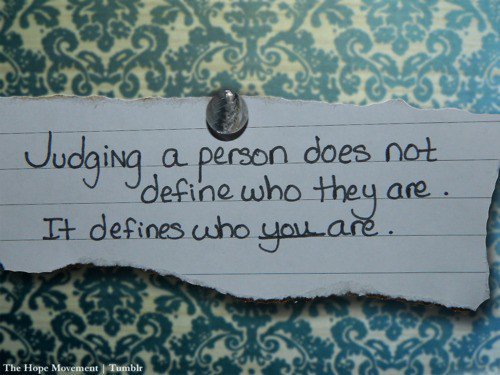
With repetition of experience, I have learned that if I present myself honestly and honorably yet someone can not see me as I am it the loss is theirs, not mine. In no way is it my fault that another person can not see truth when I present it. Nor is it healthy for me to try to convince them otherwise. Those whose presence in my life lends benefit to my existence are the only ones I have room for any more. No longer do I feel the need to attempt to get people to see me a particular way. Either they perceive me as I have become or they don’t.

Wayne Dyer stated my feelings well when he said, What you think of me is none of my business. Years and years and years it took for me to be able to practice the wisdom of those words. While being human does still cause me to care at least a little about what others think of me (still too much sometimes), for the most part I plainly just don’t care. Having spent decades trying to please others, be what they wanted me to be and doing things the way they wanted me to, life taught me the hard way such a way iof being is a fast road to continuous unhappiness and uninterrupted torment.

If someone thinks I am odd, that’s OK because I actually am. If another does not understand my unique views, that does not change them. If a person does not see truth when I express it, I lose nothing and the loss is theirs. And so on…

What you think of me is none of my business is one of the truths of living an overall contented life today. I trust the message of those ten words and do my best to live the wisdom in them. It is the ONLY way I can find some measure of peace in my life. I like who I am as a person, who I portray myself to be to others and truely accept myself.

Once again by stating it here, I let go of my concern over what others may think of me. To worry about what impression I may make on others is not healthy. It is impossible to control their thoughts anyway. Instead I focus on my own thinking and actions remaining true to myself. As long as I do this I come out of every situation, even messes made, with a good opinion of me and that is ALL that matters. To every teacher of all sorts that helped me find the path to live this insight I am humbly thankful.

Accept everything about yourself–I mean everything.
You are you and that is the beginning and the end–no apologies, no regrets.
Clark Moustakas

This Magnificent Cosmic Dance

This past weekend I read an article about our planet’s physical place in the universe that noted what I already knew: the Earth is one of the smallest planets in our solar system. What I had not been exposed to before was when the author went to note the Earth’s size makes for an estimated share of the total universe of 0.000000000000000000000000005%.  If our entire planet represents that small of a number, imagine how many zeros it would take to represent the share percentage for my physical form!  In the grand scheme of things I am indeed tiny beyond words.

Everything that exists, as we know it, originated from the same source of energy. We are connected to the entire universe.  We all came from a mother called the “Big Bang” and what followed creation. Nothing is better or worse. Everything just is. This unifying view helps me know that my smallness does not make me irrelevant.  Anything large is made up of many pieces that are small and within that structure I matter.

Although I adore traveling to see, touch and learn about foreign places my sphere of experience includes only a tiny portion of the planet.  My “world” that I live more than 90% of my life within is no more than twenty miles from where I sit typing these words on a keyboard.  It is here in “my world” that I am sizeable enough to influence in a noticeable what is around me.

The attitude that I show others, whether strangers or those I know well, sends a small ripple into my world.  A smile or a kind word has an effect on some and on others it rolls off like water on a duck’s back. At least for a few my kindness will be received openly and added to that person’s persona that in turn gets passed on to others.

Being a law-abiding citizen has an effect on those around me.  Because I choose to live responsibility, I make my community safer for all those who occupy it with me.  While a person being “good” is often overlooked and taken for granted, it is just such mundane decency of many that makes an area a pleasant place to live.

The greatest impact I have on anyone is that I have on my self.  The manner I treat “me”, the way I think of myself, the things I do to shape my being, the thoughts about the world that float in my head and the work I do or don’t do to grow and evolve all work together to shape the person that is me.  And who I am affects the world I live in and in the tiniest and smallest way imaginable, the universe is effected.

Sometimes it is my perceived imperfections that keeps me from realizing my place in the grand scheme. Yet, it was imperfection that allowed creation and life to materialize in the first place.  Since perfection can not be improved on, there would have been no need for a power greater than us bring the cosmos into existence.  It is through perfect imperfection that we came to be.

In only the last hundred years has mankind learned of the great energy stored within very tiny particles that when released for a split second changes everything nearby. Carol L. Bowman, MD wrote: Everything in our universe is made of energy. It has been said that we humans are able to perceive only approximately 1% of all the energies that exist. We are able to perceive, through our five physical senses, a limited range of smells, sounds, sights, sensations, and tastes. All of these are perceived via energetic vibrations interacting with our physical sense organs, and thus relaying messages to the brain that we can relate to and understand, based on our understanding of the world in which we live. Thus, our reality is strictly based on our ability to perceive. And we are only able to perceive 1% of what exists!

Whether I am only a small, nearly invisible, almost nonexistent, blip within the universe or a tiny particle releasing great energy that contributes greatly to all that is and ever will be does not matter.  I saw it once expressed beautifully this way:  We are part of an ever-expanding carnival of energy; we are fortunate to be able to experience and participate in this magnificent cosmic dance.

As my life ticks away one day at a time whether I accept what happens or not, it is still going to happen.  The only wise way of proceeding is for me to embrace what is happening and move forward.  As personal as I think my life is, it is only one of billions being lived at this moment like billions and billions that have come before. All things considered it is wisest for me to live in a way where I lighten up, try my best not take anything too seriously and take nothing that happens personally.  All I need to do is live as well as I can.

In her book “Dancing the Dream” Jamie Sams wrote about a vantage point toward life the Southern Seers maintain.  It begins with the question what does one get for living a good life?  The answer?  A good life!  I am grateful for mine!

When I read the Bhagavad-Gita and reflect about how
God created this universe everything else seems so superfluous.
Albert Einstein
The universe is like a safe to which there is a combination
But the combination is locked up in the safe.
Peter De Vries

At What Age Are We the Happiest?

By pure synchronicity I came in contact with two articles about levels of happiness this weekend. The first was a 2006 Harvard paper that took a look at how happy people in the USA were. Since 1972 several thousand people were asked each year “Taken all together, how would you say things are these days – would you say that you are very happy, pretty happy, or not too happy”. People were of all ages were combined and differences analyzed by comparing income levels, education, ethnicity, gender, etc.

A sobering overall conclusion was that since the 1970’s the general level of happiness has failed to grow in this country. At the same time income levels grew, discrimination by race and gender diminished markedly and the average level of education increased substantially. At first thought one would think that happiness surely would have charted better each year on those factors alone. But for the population at large, that is not what the facts say.

The second article was published a little over a year ago in the “Economist” and called “The U-Bend of Life”. Unlike the Harvard paper, global levels of happiness and well-being were looked at taking into account four main factors: gender, personality, external circumstances and age.

Generally women are slightly happier overall than men but are more susceptible to depression with about 20% of women saying they experience depression at some point in their lives compared to about 10% of men. Some suggest the percentages are probably about the same, but appear different due to men having more of a problem admitting depression and seeking help.

When personal traits were looked at, two showed themselves to be factors effecting happiness and well-being: neuroticism and extroversion. It comes as no surprise those prone to guilt, anger and anxiety tend to be unhappy. Studies over time have repeatedly shown being neurotic caused people to have negative feelings and low emotional intelligence which makes them bad at forming and managing relationships and that in turn makes them unhappy.

Being an extrovert does the opposite as being neurotic. Those who enjoy being around people, working with others and who relish social interaction tend to be happier than those who shut their office doors in the daytime or hole up at home in the evenings.

Then came the factor of age and the somewhat surprising statistic that in the great majority of countries people are at their unhappiest in their 40s and early 50s with a global average of 46. There were extremes when separated by individual country such as Ukrainians are at their most miserable at 62 and the Swiss at 35.

In 2006 in a Stanford study a group of 30 years olds and a group of 70 year olds were asked to rate their level of well-being and the 70 year olds were a lot happier. This difference is referred to as the “U-Bend” of aging where well-being consistently decreases until about fifty and then reverses to grow positively into old age. It was suggested that one explanation for this difference is that unhappy people die early. It is difficult to know for certain how much this factor needs to be taken into account. However, given that death in middle age is relatively rare it is likely to explain only a portion of the trend.

Another suggestion is differences could be an expression of external circumstances, Certain common factors affect people at particular stages of life. For example, people in their 40s, often have teenage children. Could the difficulty of the middle-aged have anything to do with sharing space with rebellious adolescents? Then older people tend to be more financially well off. Could their relative contentment be the result of their money?

The conclusion overall is people behave differently at different ages. Older people have fewer disagreements with others. They also come up with better solutions to conflict. They are better at controlling their emotions, better at accepting misfortune and less prone to anger. Maybe the experience for older people of contemporaries dying fairly frequently gives survivors determination to make the most of their remaining years.

Whatever the reason I am glad to have confirmed my growing feeling of well-being as I age is not an illusion. Further, I am grateful to know if I am blessed to live into old age, the odds are with me that my sense of well-being is likely to continue to grow!

The complete life, the perfect pattern, includes old age as well as youth and maturity. The beauty of the morning and the radiance of noon are good, but it would be a very silly person who drew the curtains and turned on the light in order to shut out the tranquility of the evening. Old age has its pleasures, which, though different, are not less than the pleasures of youth.
W. Somerset Maugham

Shut Up and Dance

My DVR is one of my most appreciated gizmos.  Every week or two I surf through listings on the movie channels I subscribe and pick out a few films showing in the future and record a few; saved for when I can get around to them.  Frequently, my searching brings me across a film I have never heard of that catches my attention due to the plot description, the subject matter, actors and actresses or some combination of these factors.

“Evening” is just such a movie.  Critics and most viewers panned the film and I can understand why.  One really has to have a very still mind and be open to the message contained within it.  This is NOT a movie intended to idly entertain those who view it.  One has to be able to relate personally in some manner to enjoy…actually ‘enjoy’ is the wrong word.. to appreciate the message of the movie.

Actress Vanessa Redgrave, at seventy years old, delivers an amazing (at least to me!) performance of a woman near death remembering bits and pieces of her romantic past and dealing with the emotional present of her daughters. As her character lays dying, she relives and is moved to convey to her daughters, the defining moments in her life 50+ years prior.

The full cast is impressive and makes the movie all the more believable.  Claire Danes, Natasha Richardson, Meryl Streep, Glenn Close, Barry Bostwick, Toni Collette and more contribute to making the story feel “real” to me. Far from being just a romantic love story, what is told on screen is a bit too gritty and realistic to be even close to a “chick flick”.  Instead it is a moving piece about life and a thinker’s movie that leaves one with a message.  What I got from it is: There are no mistakes; there is only life.  No matter whether we do good or bad or what kind of choices are made, it is still life.  And life is never a mistake.

For my way of thinking Goldie Hawn said something akin to the message of “Evening”: The lotus is the most beautiful flower, whose petals open one by one. But it will only grow in the mud. In order to grow and gain wisdom, first you must have the mud — the obstacles of life and its suffering. … The mud speaks of the common ground that humans share, no matter what our stations in life. … Whether we have it all or we have nothing, we are all faced with the same obstacles: sadness, loss, illness, dying and death.

A poem by Naomi Shihab Nye called “Kindness” also contains a similar message in these words I have selected from it to include here:

you must lose things,
feel the future dissolve in a moment
like salt in a weakened broth.
What you held in your hand,
what you counted and carefully saved,
all this must go so you know
how desolate the landscape can be
between the regions of kindness.

Before you know kindness as the deepest thing inside,
you must know sorrow as the other deepest thing.
You must wake up with sorrow.
You must speak to it till your voice
catches the thread of all sorrows
and you see the size of the cloth.

Ultimately seeing the film “Evening”, reading Goldie Hawn’s quote once again and letting Nye’s words sink in mentally all bring me back to the same place:  there are no mistakes, there is only life.  Everything that happens, good, bad or indifferent” is “my life”  and to be embraced with gratitude.

By loving the best and joyous along with most painful and difficult is how I have found a measure of peace, contentment and ease for living my days.  Far from some mystic know it all who lives in constant bliss, I am just a man doing the best he can who is grateful for his life and all that is within it!  As best I possibly can I endeavor to do what the character Buddy in “Evening” says, Shut up and dance.

The gem cannot be polished without friction,
nor man be perfected without trials.
Danish Proverb