 Every year people sharing exchanges about how quickly Christmas has arrived again is a common as leaves on the ground. And there’s plenty of talk about how fast another year has evaporated. At this point in my life, it feels kind of like a year has been shortened to last four months with a each one representing a full season. Twelve months ago in early December, 2011 I posted a piece about rapidly passing time. As I continue my “stay-cation’ and general laziness within the richness of time off, I share it again.
 If I had a dollar for every time I have exchanged a thought recently with someone about how fast times passes there’d be at least an extra hundred bucks in my pocket! The shared lamenting is often about how close Christmas already is or how fast it seems to have crept up on us. Or there is consternation about the speed 2011 has evaporated with. This morning the passage of time popped in my head as a good subject to do a free-form journey in words to aid me getting to a point just out of reach at this moment.
Clocks are a fascination of mine which led me to take apart my parents windup alarm clock with a screwdriver when I was four years old. I literally wanted to see “what made it tick”. While there was no visual explanation for me to find inside the clock about its “ticking”, I did get to marvel at all those little parts which would not go back together. Even my parents had no luck reassembling it and little ole me got into big trouble for my curiosity.
Old clocks have been an interest for years and at one point I possessed twenty-one antique seven-day mechanical wall and mantle clocks. Once upon a time on each Saturday approximately one hour was spent winding them all each week and setting the correct time. In my home there was quite a symphony of bells at the top of every hour. As the days went by each week the onslaught of chiming began about five minutes before the hour until about five past as the slow runners were late to ring and the clocks running fast rang early. It was quite a chore when the daylight savings time change came each fall and all the clocks had to be set back an hour. Mechanical clock hands can not be moved backwards so I had to move the hands forward and let the clock chime on every hour and half hour before getting back around to the correct time.
Our awareness of time is so acute today, but it was not always so. In a favorite book “The Discoverers”, Daniel J. Boorstin points out mechanical clocks did not even exist until late in the 14th century and fairly accurate ones did not come along until a hundred years later. The first people known to consistently measure time were the Egyptians who divided the day into two 12-hour time periods using a sort of sun-dial. This method of dividing each day was picked up by other civilizations and became standardized in Latin: “ante meridiem” (A.M.”before midday”) and “post meridiem” (P.M., “after midday”). The Egyptians along with the Greeks and Chinese also developed water clocks which were followed by hourglasses. Candle clocks were used in Japan, England and Iraq and something called a timestick was used in India, Tibet and parts of Europe.
For century’s most people were concerned with the passage of a day and but not about the passing of an hour and certainly not of something as small as a minute. Beginning about five hundred years ago the first widely dispersed time pieces were town or church clocks which chimed one time on the hour. Some of the earliest were in France and we get the word “clock” from the French word “cloche” which means bell. For several hundred years a single chime noted the passing of an hour because almost every one was illiterate and could not count. So our awareness of time (or is it obsession?) is a more modern affliction.
Being one of those with great curiosity who asks “why” a lot I began in childhood to drive adults crazy with inquisitiveness. Clearly in memory is asking a 5th grade teacher why our number system was based on 10 and yet we use a system of 60 to tell time (60 seconds to a minute, etc). She got frustrated I think because she did not know the answer and shooed me away, so I looked it up. What I found was the practice is carried over from the ancient Sumerians who used a number system based around the number 60. Even today some scientists and mathematicians will tell you a number system based on 60 is a more “logical” way to count and measure.
So now that I have bored you with a synopsized history lesson about time, it would be easy to ask “why”. Essentially writing this piece was a sort of meditation on the passage of time. The most important ‘ah-ha” has been conscious awareness of time actually seems to make it pass more quickly. When I can lose myself in something, as I did in writing this, time becomes largely irrelevant. At such moments I am only aware of what I doing. So that is the take-away I will gratefully head into my day with. The more engaged in life I am, the less awareness I have about the passing of time. Less awareness equals a feeling of having more time. And with that thought it is time to jump head first into my day.
Clocks slay time…
time is dead as long as it is being clicked off by little wheels;
only when the clock stops does time come to life.
William Faulkner
 Eleven days off work has turned out to be one of the best experiences I have had in ages. Once again I am reminded that too much work and not enough play dulls my senses and washes the color from my life. In the spirit of that statement I have taken the liberty of re-posting today from a Christmas past.
 The Holiday Season this year has me remembering my childhood. The older I get the more good I remember and the more not so good I seem to forget. Once upon a time I spent two Christmases with my Mother and Brother in a four-room clapboard house with cardboard walls. How far I have come yet how much I remember. The following was originally posted on August 21, 2011.



 From the holstee.com website: In the heat of the recession in May 2009, brothers Mike and Dave and their partner, Fabian started Holstee. Having just quit our jobs without a plan or idea of how we would spend our days, we were filled with a ton of raw energy, emotion, and ideas – a feeling that we never wanted to forget. So the first thing Holstee’s three founders did was sit together on the steps of Union Square and write down exactly what was on their minds and the tips of their tongues. It was a reminder of what we live for. The result became known as the “Holstee Manifesto”. A message that has since been shared over 500,000 times and viewed over 60 million times online.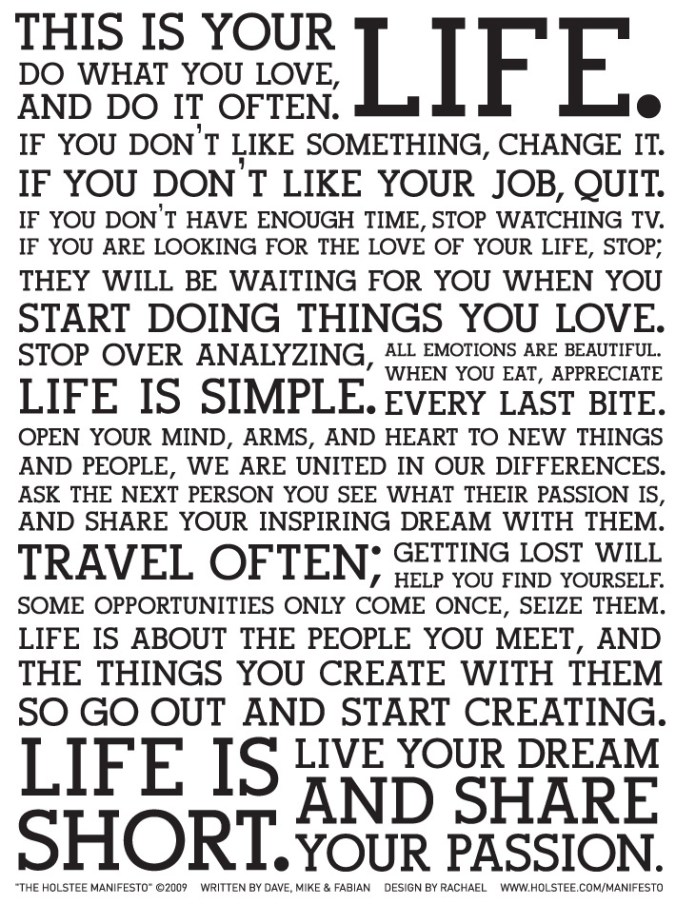
 Even just the thought of what I am about to write makes my eyes well up. Last evening watching a performance of “The “Nutcracker” there was a point I was unexpectedly moved and that feeling has grown since.
 Yesterday was my 600th day in a row to post a blog on goodmorninggratitude.com. In celebration, I have essentially taken the day off. However, I don’t want to break my string of consecutive posts and offer four quotes about gratitude that are personally meaningful to me.
 A good friend with a mostly stoic demeanor but a soft and loving heart sent a piece to me this morning where what is below was taken from. He is one of those people you have to get to know in order to realize the depth of the human being. At the most unexpected moments he has a special way of touching my heart.
 It has been my personal discovery that letting go of outcome has a tendency to make things actually turn out better than they would have otherwise. Planning and hope along with an optimistic attitude and good effort are all I have to do to allow life to unfold as it best can. To attempt to steer what unfolds beyond those things is setting myself up for disappointment. It is impossible to see all of what might happen, not matter how hard I try. Too much focus on a single spot causes a look too close to see things in a broad sense. One explanation of this principle is found in the book “The Other Way: Meditation Experiences Based on the I Ching” by Carol K. Anthony:
 Good Morning Gratitude