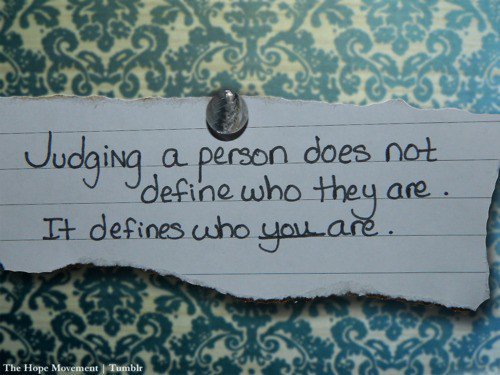
No Apologies, No Regrets

Over time many people change. Some just get older while others find a comfy rut and live life out in it. Many just fake and and “put on” what they think people want to see. Others grow and evolve; some by choice and others out of necessity. I am one of the latter who transformed himself because there came a point life made no sense without a good deal of personal change. That’s when I got into counseling and entered recovery for depression and childhood junk. Today it is almost incomprehensible to think of living as I once did.

While many are happy for me, some are uncomfortable with the changes they notice. Others can’t or don’t want to see it at all. This is especially true of those who my connection is from long ago with little to no contemporary shared history.

Someone I knew long ago and have connected with briefly a few times over the years recently deleted me from her Facebook. The reason emailed to me was that after reading a post here about me being mostly an optimist today she simply said “I don’t believe you”. We have had little communication and had only recently established contact in limited fashion after none for over ten years.  All total we talked two or three times during relatively short phone calls and traded about that many emails. We have not seen each other in several decades.

The only real history this woman and I have dates back forty years around my high school graduation when we were both essentially kids. Yes, those were some of my dark, moody and confused days.  It was evident for anyone to see. No one would have called me anything but a pessimist then. That was then, and this is now.

My first momentary feeling about being “deleted” was to be a little hurt she could not see how far I have come and how much I have grown. Then I brought myself to the present and remembered her thoughts about me are largely stuck in a time long ago.

With repetition of experience, I have learned that if I present myself honestly and honorably yet someone can not see me as I am it the loss is theirs, not mine. In no way is it my fault that another person can not see truth when I present it. Nor is it healthy for me to try to convince them otherwise. Those whose presence in my life lends benefit to my existence are the only ones I have room for any more. No longer do I feel the need to attempt to get people to see me a particular way. Either they perceive me as I have become or they don’t.

Wayne Dyer stated my feelings well when he said, What you think of me is none of my business. Years and years and years it took for me to be able to practice the wisdom of those words. While being human does still cause me to care at least a little about what others think of me (still too much sometimes), for the most part I plainly just don’t care. Having spent decades trying to please others, be what they wanted me to be and doing things the way they wanted me to, life taught me the hard way such a way iof being is a fast road to continuous unhappiness and uninterrupted torment.

If someone thinks I am odd, that’s OK because I actually am. If another does not understand my unique views, that does not change them. If a person does not see truth when I express it, I lose nothing and the loss is theirs. And so on…

What you think of me is none of my business is one of the truths of living an overall contented life today. I trust the message of those ten words and do my best to live the wisdom in them. It is the ONLY way I can find some measure of peace in my life. I like who I am as a person, who I portray myself to be to others and truely accept myself.

Once again by stating it here, I let go of my concern over what others may think of me. To worry about what impression I may make on others is not healthy. It is impossible to control their thoughts anyway. Instead I focus on my own thinking and actions remaining true to myself. As long as I do this I come out of every situation, even messes made, with a good opinion of me and that is ALL that matters. To every teacher of all sorts that helped me find the path to live this insight I am humbly thankful.

Accept everything about yourself–I mean everything.
You are you and that is the beginning and the end–no apologies, no regrets.
Clark Moustakas


This Magnificent Cosmic Dance

This past weekend I read an article about our planet’s physical place in the universe that noted what I already knew: the Earth is one of the smallest planets in our solar system. What I had not been exposed to before was when the author went to note the Earth’s size makes for an estimated share of the total universe of 0.000000000000000000000000005%.  If our entire planet represents that small of a number, imagine how many zeros it would take to represent the share percentage for my physical form!  In the grand scheme of things I am indeed tiny beyond words.

Everything that exists, as we know it, originated from the same source of energy. We are connected to the entire universe.  We all came from a mother called the “Big Bang” and what followed creation. Nothing is better or worse. Everything just is. This unifying view helps me know that my smallness does not make me irrelevant.  Anything large is made up of many pieces that are small and within that structure I matter.

Although I adore traveling to see, touch and learn about foreign places my sphere of experience includes only a tiny portion of the planet.  My “world” that I live more than 90% of my life within is no more than twenty miles from where I sit typing these words on a keyboard.  It is here in “my world” that I am sizeable enough to influence in a noticeable what is around me.

The attitude that I show others, whether strangers or those I know well, sends a small ripple into my world.  A smile or a kind word has an effect on some and on others it rolls off like water on a duck’s back. At least for a few my kindness will be received openly and added to that person’s persona that in turn gets passed on to others.

Being a law-abiding citizen has an effect on those around me.  Because I choose to live responsibility, I make my community safer for all those who occupy it with me.  While a person being “good” is often overlooked and taken for granted, it is just such mundane decency of many that makes an area a pleasant place to live.

The greatest impact I have on anyone is that I have on my self.  The manner I treat “me”, the way I think of myself, the things I do to shape my being, the thoughts about the world that float in my head and the work I do or don’t do to grow and evolve all work together to shape the person that is me.  And who I am affects the world I live in and in the tiniest and smallest way imaginable, the universe is effected.

Sometimes it is my perceived imperfections that keeps me from realizing my place in the grand scheme. Yet, it was imperfection that allowed creation and life to materialize in the first place.  Since perfection can not be improved on, there would have been no need for a power greater than us bring the cosmos into existence.  It is through perfect imperfection that we came to be.

In only the last hundred years has mankind learned of the great energy stored within very tiny particles that when released for a split second changes everything nearby. Carol L. Bowman, MD wrote: Everything in our universe is made of energy. It has been said that we humans are able to perceive only approximately 1% of all the energies that exist. We are able to perceive, through our five physical senses, a limited range of smells, sounds, sights, sensations, and tastes. All of these are perceived via energetic vibrations interacting with our physical sense organs, and thus relaying messages to the brain that we can relate to and understand, based on our understanding of the world in which we live. Thus, our reality is strictly based on our ability to perceive. And we are only able to perceive 1% of what exists!

Whether I am only a small, nearly invisible, almost nonexistent, blip within the universe or a tiny particle releasing great energy that contributes greatly to all that is and ever will be does not matter.  I saw it once expressed beautifully this way:  We are part of an ever-expanding carnival of energy; we are fortunate to be able to experience and participate in this magnificent cosmic dance.

As my life ticks away one day at a time whether I accept what happens or not, it is still going to happen.  The only wise way of proceeding is for me to embrace what is happening and move forward.  As personal as I think my life is, it is only one of billions being lived at this moment like billions and billions that have come before. All things considered it is wisest for me to live in a way where I lighten up, try my best not take anything too seriously and take nothing that happens personally.  All I need to do is live as well as I can.

In her book “Dancing the Dream” Jamie Sams wrote about a vantage point toward life the Southern Seers maintain.  It begins with the question what does one get for living a good life?  The answer?  A good life!  I am grateful for mine!

When I read the Bhagavad-Gita and reflect about how
God created this universe everything else seems so superfluous.
Albert Einstein
The universe is like a safe to which there is a combination
But the combination is locked up in the safe.
Peter De Vries

At What Age Are We the Happiest?

By pure synchronicity I came in contact with two articles about levels of happiness this weekend. The first was a 2006 Harvard paper that took a look at how happy people in the USA were. Since 1972 several thousand people were asked each year “Taken all together, how would you say things are these days – would you say that you are very happy, pretty happy, or not too happy”. People were of all ages were combined and differences analyzed by comparing income levels, education, ethnicity, gender, etc.

A sobering overall conclusion was that since the 1970’s the general level of happiness has failed to grow in this country. At the same time income levels grew, discrimination by race and gender diminished markedly and the average level of education increased substantially. At first thought one would think that happiness surely would have charted better each year on those factors alone. But for the population at large, that is not what the facts say.

The second article was published a little over a year ago in the “Economist” and called “The U-Bend of Life”. Unlike the Harvard paper, global levels of happiness and well-being were looked at taking into account four main factors: gender, personality, external circumstances and age.

Generally women are slightly happier overall than men but are more susceptible to depression with about 20% of women saying they experience depression at some point in their lives compared to about 10% of men. Some suggest the percentages are probably about the same, but appear different due to men having more of a problem admitting depression and seeking help.

When personal traits were looked at, two showed themselves to be factors effecting happiness and well-being: neuroticism and extroversion. It comes as no surprise those prone to guilt, anger and anxiety tend to be unhappy. Studies over time have repeatedly shown being neurotic caused people to have negative feelings and low emotional intelligence which makes them bad at forming and managing relationships and that in turn makes them unhappy.

Being an extrovert does the opposite as being neurotic. Those who enjoy being around people, working with others and who relish social interaction tend to be happier than those who shut their office doors in the daytime or hole up at home in the evenings.

Then came the factor of age and the somewhat surprising statistic that in the great majority of countries people are at their unhappiest in their 40s and early 50s with a global average of 46. There were extremes when separated by individual country such as Ukrainians are at their most miserable at 62 and the Swiss at 35.

In 2006 in a Stanford study a group of 30 years olds and a group of 70 year olds were asked to rate their level of well-being and the 70 year olds were a lot happier. This difference is referred to as the “U-Bend” of aging where well-being consistently decreases until about fifty and then reverses to grow positively into old age. It was suggested that one explanation for this difference is that unhappy people die early. It is difficult to know for certain how much this factor needs to be taken into account. However, given that death in middle age is relatively rare it is likely to explain only a portion of the trend.

Another suggestion is differences could be an expression of external circumstances, Certain common factors affect people at particular stages of life. For example, people in their 40s, often have teenage children. Could the difficulty of the middle-aged have anything to do with sharing space with rebellious adolescents? Then older people tend to be more financially well off. Could their relative contentment be the result of their money?

The conclusion overall is people behave differently at different ages. Older people have fewer disagreements with others. They also come up with better solutions to conflict. They are better at controlling their emotions, better at accepting misfortune and less prone to anger. Maybe the experience for older people of contemporaries dying fairly frequently gives survivors determination to make the most of their remaining years.

Whatever the reason I am glad to have confirmed my growing feeling of well-being as I age is not an illusion. Further, I am grateful to know if I am blessed to live into old age, the odds are with me that my sense of well-being is likely to continue to grow!

The complete life, the perfect pattern, includes old age as well as youth and maturity. The beauty of the morning and the radiance of noon are good, but it would be a very silly person who drew the curtains and turned on the light in order to shut out the tranquility of the evening. Old age has its pleasures, which, though different, are not less than the pleasures of youth.
W. Somerset Maugham

Shut Up and Dance

My DVR is one of my most appreciated gizmos.  Every week or two I surf through listings on the movie channels I subscribe and pick out a few films showing in the future and record a few; saved for when I can get around to them.  Frequently, my searching brings me across a film I have never heard of that catches my attention due to the plot description, the subject matter, actors and actresses or some combination of these factors.

“Evening” is just such a movie.  Critics and most viewers panned the film and I can understand why.  One really has to have a very still mind and be open to the message contained within it.  This is NOT a movie intended to idly entertain those who view it.  One has to be able to relate personally in some manner to enjoy…actually ‘enjoy’ is the wrong word.. to appreciate the message of the movie.

Actress Vanessa Redgrave, at seventy years old, delivers an amazing (at least to me!) performance of a woman near death remembering bits and pieces of her romantic past and dealing with the emotional present of her daughters. As her character lays dying, she relives and is moved to convey to her daughters, the defining moments in her life 50+ years prior.

The full cast is impressive and makes the movie all the more believable.  Claire Danes, Natasha Richardson, Meryl Streep, Glenn Close, Barry Bostwick, Toni Collette and more contribute to making the story feel “real” to me. Far from being just a romantic love story, what is told on screen is a bit too gritty and realistic to be even close to a “chick flick”.  Instead it is a moving piece about life and a thinker’s movie that leaves one with a message.  What I got from it is: There are no mistakes; there is only life.  No matter whether we do good or bad or what kind of choices are made, it is still life.  And life is never a mistake.

For my way of thinking Goldie Hawn said something akin to the message of “Evening”: The lotus is the most beautiful flower, whose petals open one by one. But it will only grow in the mud. In order to grow and gain wisdom, first you must have the mud — the obstacles of life and its suffering. … The mud speaks of the common ground that humans share, no matter what our stations in life. … Whether we have it all or we have nothing, we are all faced with the same obstacles: sadness, loss, illness, dying and death.

A poem by Naomi Shihab Nye called “Kindness” also contains a similar message in these words I have selected from it to include here:

you must lose things,
feel the future dissolve in a moment
like salt in a weakened broth.
What you held in your hand,
what you counted and carefully saved,
all this must go so you know
how desolate the landscape can be
between the regions of kindness.

Before you know kindness as the deepest thing inside,
you must know sorrow as the other deepest thing.
You must wake up with sorrow.
You must speak to it till your voice
catches the thread of all sorrows
and you see the size of the cloth.

Ultimately seeing the film “Evening”, reading Goldie Hawn’s quote once again and letting Nye’s words sink in mentally all bring me back to the same place:  there are no mistakes, there is only life.  Everything that happens, good, bad or indifferent” is “my life”  and to be embraced with gratitude.

By loving the best and joyous along with most painful and difficult is how I have found a measure of peace, contentment and ease for living my days.  Far from some mystic know it all who lives in constant bliss, I am just a man doing the best he can who is grateful for his life and all that is within it!  As best I possibly can I endeavor to do what the character Buddy in “Evening” says, Shut up and dance.

The gem cannot be polished without friction,
nor man be perfected without trials.
Danish Proverb

Most of Them Never Happened

There is a guy in this 30’s I work with who is quite a cynic but calls himself a “realist”.  A few days ago in conversation I said to him “realist is just another name for a pessimist”.  He is the sort that often finds things to be down about or else he anticipates something of the sort will come his way.  Reflecting later on what I had said, the feeling was a bit of research is in order.  I began by looking through definitions for pessimist, realist and optimist.

Pessimist:  tendency to stress the negative or unfavorable or to take the gloomiest possible view.  The doctrine or belief that this is the worst of all possible worlds and that all things ultimately tend toward evil.  A pessimist is someone who is rarely disappointed, but sadly, very rarely pleasantly surprised.

Realist:  do not see the glass as half empty or half full, but see what’s exactly in the glass.  Rarely try to make a bad situation seem better than it is, but also never sabotage any good things going on.  Realists are brutally honest in assessments of situations – and this seems to help them cope.

Optimist: expects a favorable outcome.  The tendency to expect the best, look for good in all things and have hopefulness of the ultimate triumph of good over evil while believing this is the best of all possible worlds. The state of being cheerful or hopeful about the future and about the world around you.

William Arthur Ward pointed out his view of the differences between the three when he said The pessimist complains about the wind; The optimist expects it to change; The realist adjusts the sails.  Another related thought is a pessimist is a misunderstood realist, who would like to visit the planet optimists live on, but wouldn’t like to live there.

Optimist is fairly easy to get a grasp on. In trying to get further separation between realist and pessimist I came across the statement “hyper-realism and pessimism are the same thing” and that rings true to me.  I ended up with a clear view of optimism but thinking that the boundary between realism and pessimism is a very thin one and has mostly to do with how strongly a person’s attitude leans positive or negative.

Researchers believe that a pessimistic attitude might negatively affect health. Studies conducted in the Netherlands around fifteen years ago point to a probable link between pessimism and heart disease. The studies followed over 900 Dutch citizens from ages 65 to 85 over the six-year period. Each participant was ranked on a scale of optimism and pessimism. The study found that 30.4% of the optimistic participants died during the study period, compared to 56.5% of the pessimistic participants.

And there’s more.  In a study of 99 Harvard University students, those who were optimists at age 25 were significantly healthier at ages 45 and 60 than those who were pessimists. Other studies have linked pessimistic thinking with higher rates of infectious disease, poor health, and earlier mortality.

Optimists seem to have it best.  They don’t give up as easily as pessimists. They also tend to experience less stress than pessimists or realists. Because they believe in themselves and their abilities, they expect good things to happen. Optimists see negative events as setbacks to be overcome, and view positive events as evidence of further good things to come.

Optimistic people, get sick less often, they are more successful in their careers, they make more money, they’re happier and they tend to live longer. When it comes down to it, positive, optimistic people are happier and healthier, and enjoy more success than those who think negatively. The key difference between is how they think about and interpret the events in their life.

Positive and negative thoughts can become self-fulfilling prophecies: What I expect can often come true. If I start off thinking I will mess up a task, the chances are that I will. I may not try hard enough to succeed, I won’t attract support from other people, and I may not perceive any results as good enough.

Generally speaking the American public divides itself with an approximate split of 50% optimistic, 40% realistic and 10% pessimistic.  It’s important to note that psychology has proven that about 50% of our happiness levels are set at birth by our genes.  That leaves the other 50% within our control.  Anybody can learn to be more optimistic and thus happier if they want to.

If you will call your troubles experiences, and remember that every experience develops some latent force within you, you will grow vigorous and happy, however adverse your circumstances may seem to be is a quote from John Heywood I agree with completely.  Through application of such thinking to my approach to life there has been a dramatically positive shift for me within the last ten years.

I  realize now my friend at work is probably a true realist who is fairly neutral about things most of the time. Once upon a time I identified myself as a “realist” also but was actually a pessimist who could not admit it to myself or anyone else.   Today I choose to be  optimistic and am grateful for the goodness that approach brings.  It was in deciding not to dwell on negative things ahead of time, and not “borrow trouble” as my grandmother used to call it, that brought a true change. Mark Twain summed it up in a sentence:  I’ve known a great many troubles, and most of them never happened.  I am a recovering realist, who today leans toward being an optimist.  I am thankful for how much better such a view makes life!

A man is but the product of his thoughts.
What he thinks, he becomes.
Mahatma Gandhi

Blessed Are They…

Codependency is a behavior pattern in which a person tends to form unhealthy relationships. People like me who have engaged in codependent behavior almost always appear to place the needs and desires of other people before their own. These other people often have unresolved emotional issues and sometimes addictions which the codependent person tries to repair, ignore or avoid. That is certainly true with me as I often picked people who needed “fixing”.

Ironically, the source of codependency isn’t about other people – it’s about the relationship with one’s self. Generally this manifests in things like insecurity, deficient self-confidence and even self-loathing. At the core of it all is a scarcity of self-love. Within that condition I spent many years feeling “less than” and that I didn’t measure up. I hid those feelings well and they were rarely noticed by anyone.

One of the tendencies of codependency is difficulty accepting gifts. When someone gives me something, that gift is far from unappreciated. Actually I am thankful beyond my ability to express gratitude. It’s a conflicted feeling of unworthiness in one sense, yet being hugely grateful at the same moment. Talk about bewildering!

Gifts received with difficulty are not just tangible items, but compliments and pats on the back as well. The latter two can be especially hard to accept with a tendency to deflect the good that has been expressed in my direction. At the least there is often some sort of discounting expressed. An example is someone saying to me “you did a great job on that project” with my reply being “no big deal” or “most anyone could have done it”. Receiving positive feedback is highly prized within me but even today I am uncomfortable receiving it. However I have learned to just say “thank you” even though I often blush a little when I do.

There is a tradition in most 12-Step groups to celebrate the annual anniversary of a when a person first got into recovery. Codependents Anonymous is no exception. A brass coin is given which is first “charged” with a few encouraging comments said by each group member one at a time while holding the coin.

The date marking the end of my fourth year was last October, but when it came up in the group to award my coin I always found some excuse to put off the award. I’d say I wanted to make sure “so and so” was at the meeting or something of the sort. Of course I always picked someone who rarely came to the meetings any more as my way of putting it off.

Why I kept dragging my feet on the simple little celebration of my anniversary was simple: Listening to good things said about me on other “recovery birthdays” embarrassed me. I LOVED HEARING THEM but reception of those “gifts of love in words” from the group members conflicted with the conditioning of codependence of not being “worthy”.

Last night almost six months after I should have been open to receiving my 4th year coin I opened up and allowed the group to present it to me. It helped that a relative newcomer to the group also received a coin earlier in the meeting. Somehow my not being the only one deflected enough of my dysfunction to allow me to open up and accept the “gifts” others spoke to me.

Such kindness and love expressed toward me last night brought fidgeting, teared up eyes and even a red face of positive embarrassment more than one. The latter coming from the simple fact that it is still hard to imagine that people like and respect me as much as they said. Yet, I know all spoke honest words from their heart. A day latter the joy still dances in me for the sincere people who said such loving things to me. The little boy who rarely if ever got such praise as a child is happily frolicking within today. I am grateful beyond words to my Wednesday Codependence Anonymous group!

Blessed are they who see beautiful things
in humble places where other people see nothing.
Camille Pissarro

I’ve Learned…

Good morning! I do my best to keep original the majority of what I put here each morning. Today is an exception. Saved on my computer I came across “I’ve Learned…” which I tucked away about five years ago during some of the darkest days of my life so far. Those were times filled with doubt, depression, self loathing and grieving the ending of a marriage. The words originally by Kathy Kane Hansen then added to and adapted by Omer B. Washington speak to me strongly still. I hope they serve you well to as a reminder of many things as they really and truly are.

I’ve learned that you cannot make someone love you.
All you can do is be someone who can be loved.
The rest is up to them.
I’ve learned that no matter how much I care,
some people just don’t care back.
And it’s not the end of the world.
I’ve learned that it takes years to build up trust,
and only seconds to destroy it.

I’ve learned that it’s not what you have in your life,
but who you have in your life that counts.
I’ve learned that you can get by on charm for about fifteen minutes.
After that, you’d better know something.
I’ve learned that you shouldn’t compare yourself
to the best others can do,
but to the best you can do.

I’ve learned that it’s not what happens to people,
It’s what they do about it.
I’ve learned that no matter how thin you slice it,
there are always two sides.
I’ve learned that you should always leave loved ones with loving words.
It may be the last time you see them.
I’ve learned that you can keep going
long after you think you can’t.

I’ve learned that heroes are the people who do what has to be done
When it needs to be done
regardless of the consequences.
I’ve learned that there are people who love you dearly,
but just don’t know how to show it.
I’ve learned that sometimes when I’m angry I have the right to be angry,
but that doesn’t give me the right to be cruel.
I’ve learned that true friendship continues to grow even over the longest distance.
Same goes for true love.

I’ve learned that just because someone doesn’t love you the way you want them to
doesn’t mean they don’t love you with all they have.
I’ve learned that no matter how good a friend is,
they’re going to hurt you every once in a while
and you must forgive them for that.
I’ve learned that it isn’t always enough to be forgiven by others.
Sometimes you have to learn to forgive yourself.
I’ve learned that no matter how bad your heart is broken,
the world doesn’t stop for your grief.

I’ve learned that our background and circumstances may have influenced who we are,
but we are responsible for who we become.
I’ve learned that just because two people argue, it doesn’t mean that they don’t love each other.
And just because they don’t argue, it doesn’t mean they do.
I’ve learned that sometimes you have to put the individual
ahead of their actions.
I’ve learned that two people can look at the exact same thing
and see something totally different.

I’ve learned that no matter the consequences,
those who are honest with themselves get farther in life.
I’ve learned that your life can be changed in a matter of hours
by people who don’t even know you.
I’ve learned that even when you think you have no more to give,
when a friend cries out to you,
you will find the strength to help.

I’ve learned that writing,
as well as talking,
can ease emotional pains.
I’ve learned that the people you care most about in life
are taken from you too soon.
I’ve learned that it’s hard to determine where to draw the line between being nice
and not hurting people’s feelings and standing up for what you believe.
I’ve learned to love
and be loved.
I’ve learned…

I am grateful for the deeply emotional feeling I get when I read the words above. The thoughts have a way of penetrating to my core and reminding me the way things actualy are. The better I become at living life as it is insteadinstead of the way I fantazie it might be, the better being alive is. I am very thankful for this insight.

I don’t believe that life is supposed to make you feel good,
or make you feel miserable either.
Life is just supposed to make you feel.
Gloria Naylor

We Are All Meant to Shine

For the first time since my twenties not long ago I went through a period as a renter instead of a home owner.  This was a part of the chaos created by a very difficult divorce which took a long time to work through mentally, emotionally and financially.  After over 4 years things settled to where I was able to purchase a house and I happily moved in where I live now just about this time last year.

The period of change, heartache and growth turned out to be the greatest bringer of gratitude so far in my life. If one is paying attention, lack has a tendency to bring appreciation when times of plenty arrive again. And so it is with my new home. There is much determination within not to ever lose this ‘attitude of gratitude’ within me now!

There is a saying by an unknown author that states enjoy the little things in life, for one day you may look back and realize they were the big things.  Being blessed to own my home in the past for over 25 years I had begun to take the ability to be the owner of one for granted.  In the lack, the not being able to have one, I learned a whole new way of appreciating.  A few weeks short of a year ago, soon after I moved into my new place, I began this blog:  goodmorninggratitude.com.  In 21 days I will have written here EVERY day for one full year.

What I have discovered is gratitude can be cultivated.  With a bit of focus and a little practice results can be brought about that are mind-blowing.  Studies have shown growing a sense of gratitude helps one maintain a more positive mood in daily life and contribute to greater emotional well-being. Over and over research has shown cultivating gratitude is one of the simpler routes to a greater sense of emotional well-being, higher overall life satisfaction, and a greater sense of happiness in life. I know for an absolute fact this is true.

Spiritual activist Marianne Williamson said Our deepest fear is not that we are inadequate. Our deepest fear is that we are powerful beyond measure. It is our light, not our darkness, that most frightens us. We ask ourselves, who am I to be brilliant, gorgeous, talented and fabulous? Actually, who are you not to be? You are a child of God. Your playing small does not serve the world. There’s nothing enlightened about shrinking so that other people won’t feel insecure around you. We are all meant to shine, as children do. We were born to make manifest the glory of God that is within us. It’s not just in some of us; it’s in everyone. And as we let our own light shine, we unconsciously give other people permission to do the same. As we’re liberated from our own fear, our presence automatically liberates others.  

That quote by Ms. Williamson causes me to read it two or three times on every occasion I come across it.  Her words are so deeply meaningful on a personal level.  At one point I printed them out and hung the page on my fridge where it stayed for two years.  There were many “down” days as I worked through the painful divorce, emotional recovery and becoming financially stable again.  For a long while so much was moving away from me it took a long time to reverse the direction so what I needed was moving in my direction.  My discovery most of all is my state of mind had all to do with what I was attracting and in what quantity.

Henry Ward Beecher described the way of being I had to arrive at before my life began to move forward.  He wrote the unthankful heart… discovers no mercies; but let the thankful heart sweep through the day and, as the magnet finds the iron, so it will find, in every hour, some heavenly blessings!

So here I am five years later after being served divorce papers in the airport as I arrived then finding I had been locked out (OK, thrown out) of the home I owned and lived in.  Read about that day here link.  I hope never to feel the panic, loss of direction and pain I experienced that day and those that followed.  In spite of it all, I will be always grateful for what the agony and strife taught me.

The photo at the top is of a huge wisteria vine that is on a large arbor over my back patio.  I learned from a neighbor the plant is almost 40 years old.  The main two trunks from the ground are almost five inches around!  For many years emotionally and mentally I was inside like the wisteria vine in winter:  alive with little to show for it.  Today I am more like the photo at the top taken a week ago of the wisteria vine in the full glory of spring-flowering.  To look at it is to get a sense of what is blooming inside me.  To have come from where I was to be where I am is nothing short of a miracle.  I am deeply thankful.

The world has enough beautiful mountains and meadows,
spectacular skies and serene lakes.
It has enough lush forests, flowered fields and sandy beaches.
It has plenty of stars
and the promise of a new sunrise and sunset every day.
What the world needs more of is people to appreciate and enjoy it.
Michael Josephson

Scarred But Whole Again

For most of my life I have been nursing a broken heart. There were times the breaker was me and at others it was someone I trusted and loved. A mother and a father are on that list as are lovers I gave all of me I knew how to. And there is the name of a few “friends” close and dear who found reason to violate the bond that was shared and wound my heart.

I am not unique. Everyone has had their heart broken a number of times. Some recover quickly, but I have always be one of those slow to heal. It takes years and even then a little of the wound always seems to survive within me. Maybe it is like that for everyone.

WHERE DO BROKEN HEARTS GO?”
Written by Linda McLellan

and posted here with many thanks to the author

Where do broken hearts go?
When the tears don’t seem to stop
When a part of you feels missing
And hands move slowly on the clock
Your thoughts are filled with memories
Swirling through your mind
You pray to stop the aching
But you know it will take time
Sometimes you look for answers
And they do not seem to come
Why did this all happen?
How could it become undone?
Often there are no answers
To the mysteries of life
Though you search for understanding
For the pain, the tears and strife
You gave your heart to someone
Your trusted them with its care
They willingly accepted it
It was the best that you could share
You took your heart from your chest
And wrapped it in dreams of two
You gently placed it in their hands
You gave away the gift of you
The journey of hopes and wishes began
But somewhere along the way
Your gift was taken for granted
And your heart was cast away
It crashed to the ground and shattered
The pain stung your eyes with tears
How I will recover from this, you thought
The deep pain, the hurt and the fears
The heart is such a fragile thing
Fragile but yet so strong
Even filled with cracks and breaks
It continues to beat on
Where do broken hearts go?
When the ache you cannot bear
The pieces of heart go to Heaven
For the Angels to repair
How do I know all this you ask?
The despair, hurt, and the pain
Because my heart has gone to Heaven
It came back scarred, but whole again.

The pain of heart-break is not something within itself I can say I am grateful for. However, I am clearly grateful for what this cumulative hurting taught me. The discomfort and discord of pain kneaded my heart like a bread maker does dough. A baker’s kneading warms and stretches a mixture into a springy and elastic dough. If not kneaded enough, it will collapse, leaving a heavy and dense loaf that can be hard almost like a rock.

And so it has been with me as the breaking of my heart has molded, strengthened and shaped my ability to love. My gratitude for those teachings is true and genuine. I only hope the major portion of that education are behind me.

A final comfort that is small, but not cold: The heart is the only broken instrument that works.
T.E. Kalem

What Day Is It? (April Fool’s Day!)

I thought about writing that this would be my final blog because I was part of a pool of people who won Friday’s 650 million Mega Lottery and planned to collect my cash slip quietly into rich obscurity.  Then I thought about revealing that I had made arrangements to go into space on one of Richard Branson’s Virgin Galactic spaceships.  Or maybe revealing the year I dated Cindy Crawford secretly and the child we had together that almost no one knew about.  Of course, those were my feeble attempts at a April Fools joke.  There are some really good ones in the past that really did fool people.  Here is thirteen of them:

New Starbucks drink sizes – Starbucks announced the introduction of two new beverage sizes in stores in the U. S. and Canada this Fall. The announcement follows a year of research and direct customer feedback through MyStarbucksIdea.com requesting even more choice in beverage size.  “Whether customers are looking for a large or small size, the Plenta and the Micra satisfy all U.S. and Canada customers’ needs for more and less coffee,” said Hugh Mungis, Starbucks VP of Volume. “Our size selection is now plentiful.” (see photo above)

Auspicious Alignments – April 1976, BBC Radio 2 astronomer Patrick Moore announced the approach of a once-in-a-lifetime astronomical event and said the planet Pluto would pass directly behind Jupiter. At that moment their gravitational alignment would counteract and thus lessen the pull of Earth’s gravity. Moore told his listeners that if they jumped in the air at the exact moment of this planetary alignment, they would experience a strange floating sensation. At 9:48, callers flooded the lines of BBC 2 with stories of their brief buoyant experiences.

Flying Penguins – On April 1, 2008, the BBC played footage of a colony of flying penguins that it claimed had just been discovered on King George Island near Antarctica. In the “mockumentary,” former Monty Python star Terry Jones played the David Attenborough-esque guide.

Telepathic Tweeting – The April 1999 edition of Red Herring Magazine, then a successful tech/business publication, included an article about a revolutionary new technology that allowed users to compose and send email messages of up to 240 characters… telepathically. The article attributed the new development to computer genius Yuri Maldini, who had supposedly created it as a spinoff of the encrypted communications systems he developed for the U.S. Army during the Gulf War.

Discovering the Bigon – In April 1996, Discover Magazine reported that physicists had discovered a new fundamental particle of matter: the bigon. Like other recent particle finds, the bigon flutters in and out of existence in mere millionths of a second, they explained. But unlike the others, this one is the size of a bowling ball.

New Google Email Feature – Last year, Google announced “Gmail Motion”,  a feature in Gmail that would allow your webcam to recognize simple actions like pretending to open an envelope in order to open your inbox. Because gesture recognition is indeed a hot trend, this video is almost real enough to believe.

The Swiss Spaghetti Harvest – On April 1, 1957, a news show news announced that thanks to a very mild winter and the virtual elimination of the dreaded spaghetti weevil, Swiss farmers were enjoying a bumper spaghetti crop. It accompanied this announcement with footage of Swiss peasants pulling strands of spaghetti down from trees. Huge numbers of viewers were taken in. Many called wanting to know how they could grow their own spaghetti tree

Sidd Finch – The April 1985 issue of Sports Illustrated contained a story about a new rookie pitcher who planned to play for the Mets. His name was Sidd Finch, and he could reportedly throw a baseball at 168 mph with pinpoint accuracy. This was 65 mph faster than the previous record. Surprisingly, Sidd Finch had never even played the game before. Instead, he had mastered the “art of the pitch” in a Tibetan monastery under the guidance of the “great poet-saint Lama Milaraspa.”

Instant Color TV – In 1962 there was only one TV channel in Sweden, and it broadcast in black and white. But on April 1, 1962, the station’s technical expert, Kjell Stensson, appeared on the news to announce that, thanks to a new technology, viewers could convert their existing sets to display color reception. All they had to do was pull a nylon stocking over their TV screen.

The Taco Liberty Bell – The Taco Bell Corporation took out a full-page ad that appeared in six major newspapers on April 1, 1996, announcing it had bought the Liberty Bell and was renaming it the Taco Liberty Bell. Hundreds of outraged citizens called the National Historic Park in Philadelphia where the bell was housed to express their anger

San Serriffe – On 1 April 1977, a European newspaper published a special seven-page supplement devoted to San Serriffe, a small republic said to consist of several semi-colon-shaped islands located in the Indian Ocean. A series of articles affectionately described the geography and culture of this obscure nation. Its two main islands were named Upper Caisse and Lower Caisse. Its capital was Bodoni, and its leader was General Pica.

 The Left-Handed Whopper – Burger King published a full-page advertisement in the April 1st edition of USA Today announcing the introduction of a new item to their menu: a “Left-Handed Whopper” specially designed for the 32 million left-handed Americans. According to the advertisement, the new whopper included the same ingredients as the original Whopper (lettuce, tomato, hamburger patty, etc.), but all the condiments were rotated 180 degrees for the benefit of their left-handed customers.

Whistling Carrots – The British supermarket chain Tesco published an advertisement in 2002 in The Sun announcing the successful development of a genetically modified ‘whistling carrot.’ The ad explained that the carrots had been specially engineered to grow with tapered air holes in their side. When fully cooked, these air holes caused the vegetable to whistle.

Drunk Driving on the Internet – An article by John Dvorak in PC Computing magazine described a bill going through Congress that would make it illegal to use the internet while drunk, or to discuss sexual matters over a public network. The bill was supposedly numbered 040194 (i.e. 04/01/94), and the contact person was listed as Lirpa Sloof (April Fools backwards).

I am grateful for my sense of wonder, humor and amazement at what people will believe and for the good feeling inside I got from reading about the pranks above.  It confirms what I already know as true:  you can fool all of the people some of the time!

If every fool wore a crown, we should all be kings.
Welsh Proverb