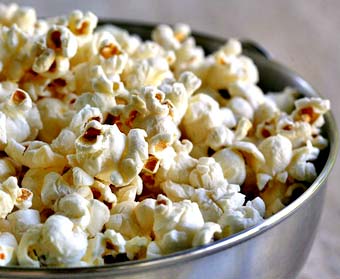
 I love the smell of popcorn. I love the taste. I love the texture of popcorn and I love chewing it. I feel even better about my love of the fluffy stuff after seeing an article from 2009 called “Popcorn is Good for You, Say Scientists” by John von Radowitz.
The traditional cinema snack contains “surprisingly large” amounts of healthy antioxidant plant chemicals called polyphenols known to protect the heart and reduce the risk of cancer. Popcorn is one of the richest sources.
US chemist Dr Joe Vinson, who made the discovery, said: “We really were surprised by the levels of polyphenols we found in popcorn. I guess its because it’s not processed. You get all the wonderful ingredients of the corn undiluted and protected by the skin. In my opinion it’s a good health food.”
Here comes an admission that surely shows I am descended from a long line of Alabama rednecks and hill rats: I love pork rinds! Knowing some people find it disgusting to even think about cooked pig skin, I don’t often admit I enjoy it (ironic since a lot of those same people enjoying eating other parts of the same animal). I feel somewhat vindicated by an article by Jeff Volek, Ph.D., R.D. titled “Junk Food that’s Good for You”.
A 1-ounce serving (of pork rinds) contains zero carbohydrates, 17 grams (g) of protein, and 9 g fat. That’s nine times the protein and less fat than you’ll find in a serving of carb-packed potato chips. Even better, 43 percent of a pork rind’s fat is unsaturated, and most of that is oleic acid—the same healthy fat found in olive oil.
Another 13 percent of its fat content is stearic acid, a type of saturated fat that’s considered harmless, because it doesn’t raise cholesterol levels.
Over time I have found lots of people don’t care for coconut and many say it is not a healthful food. As far as I’m concerned that just leaves more coconut for me! In the same article, Dr. Volke sheds some light on the subject.
Even though coconut is packed with saturated fat, it appears to have a beneficial effect on heart-disease. One reason: More than 50 percent of its saturated-fat content is lauric acid. A recent analysis of 60 studies published in the American Journal of Clinical Nutrition reports that even though lauric acid raises LDL (bad) cholesterol, it boosts HDL (good) cholesterol even more.
The rest of the saturated fat is almost entirely composed of “medium-chain” fatty acids, which have little or no effect on cholesterol levels.
And one more: Eggs! Liza Barnes, a health educator adds some clarity about “chicken fruit” in her article “Healthy or Not? We Crack the Case!”.
Eggs are an excellent source of low-cost, high-quality protein. One large egg provides more than 6 grams of protein, yet contains only 75 calories. And the protein is “complete,” providing all nine of the body’s essential amino acids.
Eggs are one of the best sources of choline. Primarily in the egg yolk, one large egg provides 30% of the recommended daily allowance (RDA) of this essential nutrient, which plays an important role in brain health and the reduction of inflammation.
Eggs protect eyesight. Egg yolks contain a highly absorbable form of vision-protective carotenoids like lutein and zeaxanthin, which help to prevent age-related macular degeneration and cataracts.
So there! Four things I enjoy eating which now can be defended as not being “bad” for me. Of course, each should be consumed in moderation. But that’s only common sense with most everything in life. So here I go into my day feeling grateful to know I can “come out” so to speak about enjoying four foods most people put down. Hooray for popcorn, pork rinds, coconut and eggs!
Only actions give life strength;
only moderation gives it charm
Jean Paul Richter
 Good Morning Gratitude
Now that is quite the snack! 😉