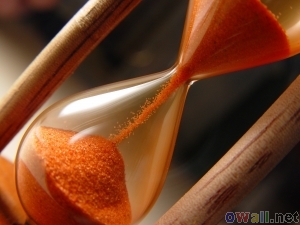
 Short of the point of being an off-putting obsession, I have a “thing” about time. I love clocks. There’s at least one in every room in my home including the bathrooms. Except when I am at home on my wrist is a watch. I am usually conscious naturally of what day it is. If not the specific date and day, I always have a prominent date I can count from. For the most part this awareness is a healthy practice for me as I cherish each and every day of my life. As I have less and less time remaining the more treasured is the remainder I have.
To remind myself of the value of time, one of my occasional exercises is taking stock of the hours and days of my life. Ten days ago I celebrated my 58th birthday. Using that date as a hash mark along with seventy-six years as an average American male life expectancy I can do some sobering calculations.
As of my latest birthday I have lived 21,170 days or 508,080 hours which represents 76% of the life span of an average male in the USA. Conversely, I have 6,570 days remaining which accounts for 157,680 hours or about 24% of my life remaining. Of course, when my life ends is beyond me to calculate or guess at. However, this little exercise drives home how valuable the time I have is.
Once I started calculating last eveningI went off on a few other tangents and will share two. Sleeping on average around 7 ½ hours each night I spend the equivalent of 114 days (31%) of each year sleeping. Being blessed with a very short fifteen minute commute to and from work I spend 2 ½ hours weekly in the car for that purpose (on a yearly basis it totals five full 24-hour days commuting). Once upon a time I lived in large cities and spent hours each day commuting. Much thankfulness is within not to be doing that today.
I know there are specific areas of the brain I use in my perception of time. I have my own internal timekeeper called a circadian rhythm. It’s an instinctive attribute that makes me aware of time passing and plays a part in waking and sleeping patterns. However, the actual passing of time as I perceive it is deemed by science as subjective. Consequently, my perception of time duration is variable and not necessarily measurable in any exact scientific units. In other words, my time awareness is “all in my head”.
While it is not my intention to get “too deep”, to make my case I want to bring up a concept of a human being’s perception of time. The “Kappa Effect” generally speaking means a faster journey over more distance will still appear more time-consuming than a slower journey over less distance. That does help me to understand why at first glance the 58 years lived so far feels more time-consuming than the remaining distance that could be lived somewhat slower.
Being the sort of person who has always had a rebellious soul, I don’t plan to just let the time left click off the clock. It is my belief time can be made to feel longer by how rich I cause my life to be with experiences and activity if I am mindful and living in the “now”. Psychology Today defines mindfulness as a state of active, open attention on the present. When you’re mindful, you observe your thoughts and feelings from a distance, without judging them good or bad. Instead of letting your life pass you by, mindfulness means living in the moment and awakening to experience.
Mindfulness means I need to do my best to think less and be aware more, to live in the here and now of my experience instead of the ‘there and then’ of my thoughts. To do so stretches time in exactly the same way new experience does: because I give more attention to my experience, I take in more information from it. So at least to some extent I can control time. It doesn’t have to continue to speed up as I get older. My perception of time is like so many things; “it’s all in my head”.
But what minutes! Count them by sensation, and not by calendars, and each moment is a day. Benjamin Disraeli
 Good Morning Gratitude
Why be saddled with this thing called life expectancy? Of what relevance to an individual is such a statistic? Am I to concern myself with an allotment of days I never had and was never promised? Must I check off each day of my life as if I am subtracting from this imaginary hoard? No, on the contrary, I will add each day of my life to my treasure of days lived. And with each day, my treasure will grow, not diminish.
~Robert Brault
Thank you for your thoughts this morning. Smiling.
If we were all mindful of our actions and our thoughts, the world would be a better,safer place, 🙂