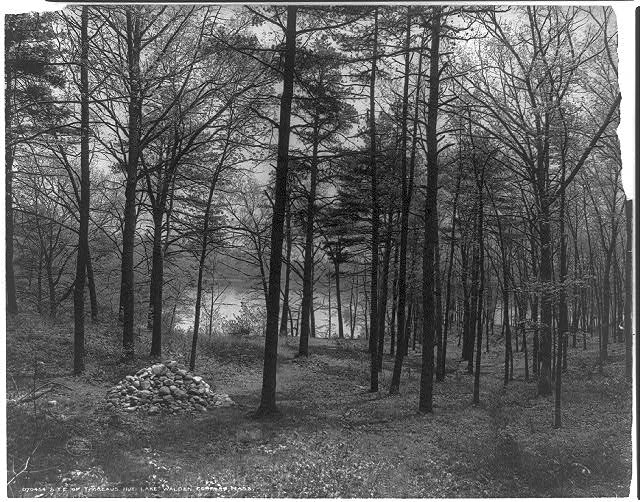
I was in the 11th grade when I first came in contact with “Walden or Life in the Woods” by Henry David Thoreau. I recall little about the book from then except reading it was an assignment and I had to do a report on it. At that age my mind was a swirling mass of girls, cars, grades, dreams and hopes seasoned with a screwy home life. Absorbing what Thoreau was saying and the depth of his message were wasted on the teenage version of me. I re-discovered “Walden” about a decade ago and it is now one of my top ten books and one I have read cover to cover three times. I often pick up a well worn copy I have and randomly open it to read a page. Wisdom usually finds me each time I do.
“Walden” is today considered to contain some of the first American writing about transcendental thinking. One of Thoreau thought’s about his two years living in the woods in a self built cabin was to find out just how much a man needed to work to supply the basic essentials of life. I recall that his conclusion was an estimate of about six to eight weeks of labor each year.
Thoreau said his intention was to “live deliberately, to front only the essential facts of life, and see if I could not learn what it had to teach, and not, when I came to die, discover that I had not lived.” There in the 1850’s on Ralph Waldo Emerson’s property at Walden Pond, he lived in a one room cabin furnished with castoffs. Thoreau found his food in the woods around him, in the lake beside him and in the field near him where his garden was. He scavanged for lumber and nails and worked barter fashion with farmers for supplies, seed, food, and other things he needed.
Thoreau told time by the train whistle from the nearby tracks which he thought often disrupted his contented existence. He preferred the sounds of whip-poor-wills, owls, loons, frogs, chattering squirrels and distant crowing roosters. Thoreau spent much of his time observing everything from the seasonal changes of trees and plants to the activity of the animals around him. He spent hours with self-assignments such as with a rock and string ascertaining the depth of Walden Pond to a degree that he could map the entire bottom of the lake.
Some of my favorite passages I have underlined in my most worn copy of “Walden” are:
“I would rather sit on a pumpkin and have it all to myself, than be crowded on a velvet cushion.”
“I learned this, at least, by my experiment; that if one advances confidently in the direction of his dreams, and endeavors to live the life which he has imagined, he will meet with a success unexpected in common hours.”
“However mean your life is, meet it and live it; do not shun it and call it hard names.”
“A simple and independent mind does not toil at the bidding of any prince”.
“As for the pyramids, there is nothing to wonder at in them so much as the fact that so many men could be found degraded enough to spend their lives constructing a tomb for some ambitious booby, whom it would have been wiser and manlier to have drowned in the Nile, and then given his body to the dogs”.
“Why should we live with such hurry and waste of life… When we are unhurried and wise, we perceive that only great and worthy things have any permanent and absolute existence, that petty fears and petty pleasures are but the shadow of the reality”.
“Every man is the builder of a temple called his body…We are all sculptors and painters, and our material is our own flesh and blood and bones”.
“You must live in the present, launch yourself on every wave, find your eternity in each moment”.
“Time is but the stream I go a-fishing in. I drink at it; but while I drink I see the sandy bottom and detect how shallow it is”.
“Why should we be in such desperate haste to succeed, and in such desperate enterprises? If a man does not keep pace with his companions, perhaps it is because he hears a different drummer. Let him step to the music which he hears, how ever measured or far away”.
Today I eagerly express my thanks for the work that Henry David Thoreau left behind for me to discover. It served a large role in my “awakening” starting around ten years back. It was then that I began to uncover the real meaning and purpose of my life. While a difficult journey, I am deeply grateful for the discoveries I have made since that initial inspiration. Further, there is much thankfulness within for the 14 years of life I have already had beyond that of Thoreau’s time on Earth.
My writing is far below the caliber of his work. My thoughts are not as original and deep. However, I do hope in a small way I am showing my deep gratefulness to Mr. Thoreau for his impact on my life by playing forward his original thoughts of 160 years ago.
A good book has no ending. R.D. Cumming
 Good Morning Gratitude